Home Blog Page 35

Hereditary Chief Watahayetsxw vows to defend Gitanyow territory with blockades to stop PRGT pipeline and Ksi Lisims LNG terminal

Video still: Gitanyow Hereditary Chief Watahayetsxw responds to Canadian Prime Minister Mark Carney’s announcement today. Video from Laxyipyouth on Instagram.

Members from the Gitanyow, Gitxsan and Wet’suwet’en nations, as well as the Kispiox Valley Community Association, travelled to Terrace, British Columbia today to respond to Canadian Prime Minister Mark Carney’s announcement about the fast-tracking of two major projects despite Indigenous opposition.

Those who travelled to Terrace included Gitanyow Hereditary Chief Watahayetsxw, Wet’suwet’en Hereditary Chief Na’Moks, Lax’yip Firekeeper Drew Harris, and Kispiox spokesperson Graeme Pole.

Victoria News reports: “Outside of the Skeena Substation [where Carney announced a new list of megaprojects to be fast-tracked], a group of representatives from the Gitxsan, Gitanyow, and Wet’suwet’en Nations, and the Kispiox Valley Community Association, responded to the prime minister’s announcement.”

Speaking to reporters, Watahayetsxw stated: “We weren’t consulted about what health impacts would be to my wilp [house group].”

She then highlighted: “This is our territory, we did not cede the territory to government. …Our goal is to protect the territory. …My wilp is impacted by this. …We are the Ganada clan. And that’s our territory they’re going to transect [with the PRGT pipeline]. But [the prime minister] never mentioned that.”

Watahayetsxw then stated: “I’ll keep fighting, I’m not going to stop because to me it’s clean air and the health of my great-grandchildren. …I’m going back on the ground. Whether I’m in two feet of snow, ten feet of snow, it doesn’t matter. I’m going back on the ground. …I’m blockading because there is not one level of government whether it be British Columbia or Canada that has come to talk to me. I did not give permission, I did not give consent for them to be here.”

Her full comments can be heard here.

Additional context

The Toronto Star reports: “In Terrace, B.C., Carney announced a new list of projects that his government is referring to the Major Projects Office, including the Ksi Lisims LNG plant near Prince Rupert, B.C. and the North Coast Transmission line, a power line project that will help power the plant…”

That article further notes: “The Ksi Lisims LNG project received federal approval in September, when the government accepted British Columbia’s review. It is proposed as a floating facility that would export 12 million tonnes of LNG and is a partnership between the Nisga’a Nation and Western LNG, an American-owned LNG firm.”

And it reports: “The North Coast Transmission line would run from Terrace to Prince Rupert and carry hydroelectric power to the LNG plant… Carney announced [on November 13] the Canada Infrastructure Bank would lend $140 million to BC Hydro to build the power line. The B.C. government has passed legislation to fast-track the line through its own regulatory process.”

The Ksi Lisims fossil fuel project would be fed by the Prince Rupert Gas Transmission (PRGT) pipeline that would cross Gitanyow and Gitxsan territory adjacent to Wet’suwet’en territory in northern British Columbia.

Victoria News also notes that the North Coast Transmission line is expected to power the LNG Canada terminal in Kitimat and that the first round of major projects announced by Carney in September included the LNG Canada Phase 2 expansion.

Today’s announcement from the Prime Minister’s Office can be read at Prime Minister Carney announces second tranche of nation-building projects referred to the Major Projects Office (November 13, 2025).

Five days ago, The Juice Media, an Australian company, posted this 4-minute satire video Honest Government Ad | Watch out, Canada about the Ksi Lisims terminal.

The Vancouver Sun reports that construction of the Ksi Lisims terminal “is expected to be completed by 2028.”

We continue to follow this.

Canada calls on Honduras to strengthen its Protection Mechanism for human rights defenders at UPR intervention at the UN in Geneva

Video still of Canada presenting during the UPR of Honduras, November 7, 2025.

On November 7, Canada commented on the protection needs of human rights defenders in Honduras during the Universal Periodic Review (UPR) of Honduras at the United Nations Human Rights Council in Geneva.

The UN has explained: “The Universal Periodic Review (UPR) is a unique mechanism of the Human Rights Council that calls for each UN Member State to undergo a peer review of its human rights records every 4.5 years.”

Speaking on behalf of Permanent Mission of Canada to the United Nations and the World Trade Organization, Joseph Flores Ayala stated:

“Canada recommends that Honduras fully implement the National Protection Mechanism by establishing robust accountability measures for state authorities who fail to provide adequate protection to human rights defenders, including Indigenous rights defenders, environmental rights defenders, and journalists.”

The video of that intervention starts at the 01:47:23 mark here.

The text of the full intervention by Canada can be read below.

PBI-Honduras has also noted: “A total of 27 countries from the Americas, Asia, Europe, and Oceania recommended that Honduras improve protection and/or access to justice for human rights defenders.”

We further note that this list includes countries where PBI teams are present: Mexico, Nepal, the Netherlands, Norway, Spain, Switzerland, the United Kingdom, Belgium, Cameroon, Colombia, France, Germany and Italy.

We also highlight that Berta Oliva from the Committee of Relatives of the Detained and Disappeared in Honduras (COFADEH) presented to the UN Human Rights Council during the UPR.

Video still (starting at the 50:51 mark) of Berta Oliva from COFADEH.

At this time, PBI-Canada draws attention to two situations that relate to Canada’s intervention at the United Nations Human Rights Council:

1. The Municipal Committee in Tocoa

On November 3, just a few days before the intervention by Canada at the United Nations Human Rights Council, Criterio.hn published an open letter signed by several organizations including Bufete Justicia para los Pueblos and the Comité Municipal de Defensa de los Bienes Comunes y Públicos de Tocoa that states:

“Two years after the Inter-American Commission on Human Rights (IACHR) granted Precautionary Measure No. 137-23 in favor of members of the Municipal Committee for the Defense of Common and Public Goods of Tocoa and the Justice for the Peoples Law Firm in Honduras, the State of Honduras has not complied with the effective implementation, comprehensive and collective measures. … The murder of Juan López, a renowned human rights and environmental defender and beneficiary of this measure at the time of his death in September 2024, shows the tragic consequences of the lack of a comprehensive state response.”

Photo: PBI-Honduras and PBI-Canada visited Tocoa and Guapinol on October 30, 2024.

2. Mabel Robledo in Nueva Armenia

On the same day as Canada’s intervention at the UN, Criterio.hn reported: “On November 7, the deadline granted by the Inter-American Court of Human Rights (Corte IDH) to the State of Honduras for reporting on the provisional measures adopted to protect the life, integrity, and personal safety of Mabel Robledo, a Garifuna leader, expires.”

For more context on this, please see our article: PBI-Canada notes international court’s ruling that Honduras provide protection measures for Mabel Robledo, report by November 7 (October 29, 2025).

Photo: PBI-Honduras and PBI-Canada with Mabel Robledo in Nueva Armenia on Garifuna territory in Honduras, October 31, 2024.

We continue to follow this.


Intervention by Canada at the UPR for Honduras

Thank you, Mister President.

Canada thanks Honduras for its participation in the Universal Periodic Review. We welcome the positive steps taken by Honduras toward eliminating violence against women and girls, supporting survivors of intimate partner violence, promoting safe and dignified human mobility, and the reintegration of returnees.

Canada recommends that Honduras:

  1. Fully implement the National Protection Mechanism by establishing robust accountability measures for state authorities who fail to provide adequate protection to human rights defenders, including Indigenous rights defenders, environmental rights defenders, and journalists.
  2. Strengthen enforcement of Article 118-A of the Penal Code, which defines and penalizes femicide, by improving prevention, investigation, and prosecution of gender-based violence.
  3. Enhance the independence and integrity of the justice system by establishing a transparent judicial appointment process in line with the UN Basic Principles on the Independence of the Judiciary.


Advance questions

  1. What concrete measures is Honduras implementing to demilitarize its prison system and broader public security structures, in accordance with international human rights standards and recommendations from treaty bodies, including the UN Subcommittee on Prevention of Torture?
  2. Could Honduras elaborate on efforts to strengthen the National Protection Mechanism for Human Rights Defenders, particularly regarding its independence, effectiveness, and accessibility for those working in high-risk areas such as land, environmental, and Indigenous rights?

PRELIMINARY FINDINGS from Order Paper Question on the CANSEC arms show and human rights considerations

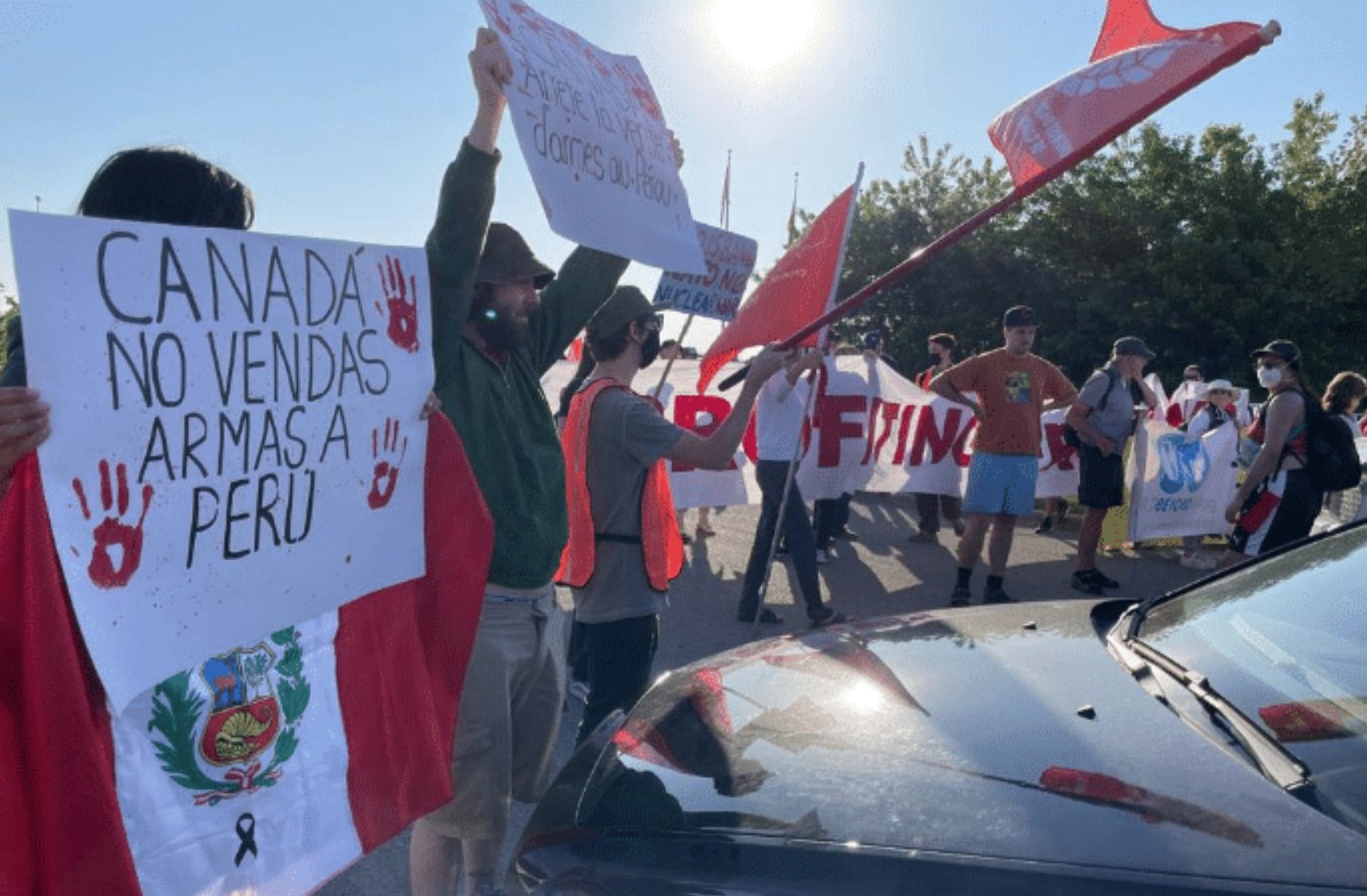
Photo: Protest against CANSEC, May 28, 2025.

Order Paper Question Q-323 was submitted by Member of Parliament Heather McPherson on September 16, 2025.

The response was tabled on November 3, 2025.

Notable excerpts from that response include:

INVITATIONS

From the Canadian Commercial Corporation

From National Defence

From the Canadian Commercial Corporation

HUMAN RIGHTS ASSESSMENTS

From Global Affairs Canada

From National Defence

From the Canadian Commercial Corporation

VISA PROCESSES

From Immigration, Refugees and Citizenship Canada

UN GUIDING PRINCIPLES

From Global Affairs Canada

ROLE PLAYED

From Global Affairs Canada

From the Canadian Commercial Corporation

FUNDING

From Global Affairs Canada

From the Canadian Commercial Corporation

Overview and comments

1- From the responses provided, four government departments appear to be involved in the invitation of foreign delegations to CANSEC: Canadian Commercial Corporation, Global Affairs Canada, Department of National Defence, Public Services and Procurement Canada – Government Contracts for Military (PSPC-GCMII).

2- There appears to be no formal human rights assessment done with respect to those invitations.

3- Global Affairs Canada and Public Services and Procurement Canada do not answer question (b) what delegations, from which countries, have been invited by the government to attend CANSEC? This despite the Order Paper Question suggesting that Global Affairs Canada was required to answer this question.

4- National Defence responds to question (b) by noting: “National Defence does not centrally track foreign delegations invited by the Department. These details would require a manual search that cannot be completed in the time allotted.”

5- The Canadian Commercial Corporation responds to question (b) only for the most recent CANSEC, indicating: Armenia, Argentina, Austria, Dominican Republic and Portugal.

6- Amnesty International reports from 2024 express concern that journalists and environmental defenders were being “threatened and harassed” in Armenia, that “repressive responses to public demonstrations increased” in Argentina, that “peaceful acts of civil disobedience were met with prison terms without due process” in Austria, the “unabated” harassment of human rights defenders in the Dominican Republic, and that “there were credible reports of torture and ill-treatment in prisons” in Portugal.

7- The response from Immigration, Refugees and Citizenship Canada does not suggest a rigorous scrutiny of the business temporary resident visa applications of international attendees to CANSEC.

8- Any application of international conventions including the UN Guiding Principles on Business and Human Rights appears to be weak.

9- Global Affairs Canada and the Canadian Commercial Corporation appear to play an active role in supporting foreign delegations at CANSEC.

10- Global Affairs Canada provided $125,000. in 2025-26 to the Canadian Association of Defence Industries (CADSI) for the purposes of CANSEC, while the Canadian Commercial Corporation provided $13,940. to CADSI and $236,228.41 to CANSEC. The expenditures from these two departments total $375,168.41. in 2025-26.

The approaching final investment decision on the PRGT pipeline brings concerns about the risk of aggressions against land defenders

Photo: In June 2025, PBI-Canada and PBI-Colombia visited the site of the Gitanyow blockade against the PRGT pipeline.

A spokesperson for Texas-based Western LNG recently stated they are aiming to make a final investment decision (FID) on the Prince Rupert Gas Transmission (PRGT) pipeline by the end of this year that they would be starting construction on it in northern British Columbia soon thereafter.

Last year, The Narwhal reported: “After closing the Nass Forest Service Road to all pipeline vehicles on Thursday [August 22, 2025], two chiefs of the Ganeda (Raven/Frog) Clan, Gamlakyeltxw Wil Marsden and Watakhayetsxw Deborah Good, set up a checkpoint where the road meets Highway 37, about 170 kilometres north of Terrace, B.C. The road is the shortest route to transport heavy equipment and supplies for a sprawling work camp being built to support pipeline construction.”

Around that time, Marsden told journalist Brandi Morin via telephone from that blockade: “This project doesn’t make any sense.”

The imminent final investment decision and the probability of Gitanyow blockades leads to concerns for the safety and security of Indigenous land and environmental defenders who oppose this pipeline on their territories.

These concerns include PRGT project manager Bechtel’s previous use of former SAS soldiers, the role that C-5 major project “fast-track” and “national interest” legislation and C-2 security and surveillance legislation could be used to criminalize Indigenous land defenders upholding their rights, and the likely deployment of militarized Royal Canadian Mounted Police CRU-BC officers against future blockades.

Bechtel

In August 2024, Western LNG announced: “Bechtel, a leading engineering, procurement, and construction company, has been selected to oversee and manage the execution of the PRGT natural gas pipeline.”

Dogwood has highlighted: “The Times reports Bechtel hired ex-special forces soldiers to protect its construction managers in Iraq. This is now common practice in pipeline construction. When the Coastal GasLink project was forced through Wet’suwet’en territory, the security team included ex-soldiers and reservists who had fought in Afghanistan and Northern Ireland.”

C-2 and the repression of land defenders

Furthermore, Greenpeace has raised concerns about the powers outlined in new federal legislation, C-5 and C-2, commenting: “History tells us that these powers will be misused to surveil and repress land defenders.”

They also note: “One of the issues of concern is how the lines between peaceful, democratic protest and violent extremism are deliberately blurred to ‘conflate social movements with extremism and criminality’.”

The RCMP CRU-BC

Additionally, there is the concern about the deployment of Royal Canadian Mounted Police (RCMP) Community Response Unit-British Columbia (CRU-BC) officers on Gitanyow territory. This RCMP unit, was rebranded in January 2024 after the Civilian Review and Complaints Commission (CRCC) launched a systemic investigation of the Community-Industry Response Group (C-IRG) in March 2023.

Tara Marsden, sustainability director for the Gitanyow hereditary chiefs, has told CBC News: “From the Coastal GasLink pipeline we learned that companies will do whatever it takes, they will bring in militarized police and they will remove Indigenous people from their lands.”

Marsden also told PBI-Canada: “Our learning is that consent only works when we say yes, if we say no, even if we say no with science behind us, and our knowledge and our laws behind us, then we will be met with force from the C-IRG, from militarized invasion and occupation and intimidation and harassment.”

In February 2025, ruling on an abuse of process petition that included comments made by RCMP C-IRG officers who arrested land defenders and journalists on Wet’suwet’en territory n November 2021, BC Supreme Court Justice Michael Tammen noted: “I found those comments to be grossly offensive, racist and dehumanizing.”

We continue to follow this with concern.

For more, please see the Flying Frogs Awakened website, a land-based initiative guided by Wilp Simogyet Watahayetsxw.

Video (with language warning): The Juice Media has produced a 4-minute satire video that notes “expanding police powers to treat land defenders as terrorists”.

Norwegian activists call on Canadian company to stop the Nussir mine on the traditional lands of the Indigenous Sámi people

lagnorge (Latin American groups in Norway): “The fights against extractivism are connected, that’s why LAG’s Solidarity Brigade members have participated in the protest fight against Nussirgruva this week [August 28, 2025]. We have had important conversations about how we can strengthen solidarity between movements that fight against different forms of oppression and environmental destruction.” Photo: Isak Gregers Eriksen and Eri Melhus.

The Toronto Star reports on the Nussir copper mine in the Repparfjord near Hammerfest, Norway. The mine was acquired in November 2024 by Toronto-based Blue Moon Metals Inc. A first blast and initial underground construction on the mine began in June 2025.

The article highlights opposition to the mine given “plans to dump the Nussir mine’s waste in the sea, and potentially huge disruptions to reindeer herds and the livelihoods of traditional herders…”

It also notes: “In September, Blue Moon Metals announced it had negotiated financing of up to $140 million (U.S.) from Oaktree Capital Management and Hartree. The two global investment firms are subsidiaries of Brookfield Asset Management, the company chaired by [Prime Minister Mark] Carney until last January, when he launched his campaign for the Liberal party’s leadership.”

This past August, France 24 also explained: “Environmentalists and Sami reindeer herders are protesting the development of the Nussir copper mine in the Repparfjord, in the country’s far north, well above the Arctic Circle. The Sami people, who live in Norway, Sweden, Finland, and Russia, are the only recognised Indigenous people in Europe.”

Environmental destruction

The Toronto Star article further notes: “A 2012 report into the mining project by the Norwegian Institute of Marine Research concluded that the mine’s operation would result in two million tonnes of waste rock, including high contents of heavy metals, being dumped into the fjord. The other issue with the Nussir mine is the threat it poses to reindeer, for whom the mine site serves as an annual calving ground, and to the livelihoods of Sami reindeer herders.”

Resistance to the mine

France 24 has reported: “A new wave of opposition emerged after Blue Moon Metals – the Canadian company that acquired the mine in 2024 – began initial construction on June 12, 2025. In response, Nature and Youth established a protest camp near the site, calling on the public to join them. Protesters chained themselves to the construction site again, leading Nussir to call for police intervention. Footage posted on social media shows officers removing the individuals from the site.”

The Toronto Star notes: “This summer, the Norwegian environmental group Nature and Youth set up a permanent camp about two kilometres from the mine site to protest the project.”

And this past September, NRK reported: “Right now, there are about eight people in the protest camp at Repparfjorden, according to [Helene Sofie] Smit [a central board member of Nature and Youth], who expects more.”

For more on this on Instagram, go to reddrepparfjord (Save Repparfjord – updates from the protests against the Nussir mine in Norway), naturogungdom (Nature and Youth – “Working to preserve nature and stop climate change! Norway’s largest environmental organization for youth”) and  lagnorge (“Latin American groups in Norway”).

We continue to follow this.

Photo: October 5, 2025.

Video still: September 20, 2025.

Photo: September 17, 2025.

Photo: August 28, 2025.

Photo: July 30, 2025.

Can COP30 stop climate change, aggressions against land and environmental defenders who resist megaprojects?

Video still: The Mesoamerican Caravan for Climate and Life action outside COP30 on November 6, 2025. They mention the name of Indigenous Lenca defender Berta Caceres who was murdered in March 2016, weeks after COP21. More than 1,729 land and environmental defenders have been killed since then.

The United Nations COP30 “conference of parties” climate summit starts tomorrow, Monday November 10, in Belém, Brazil.

An estimated 50,000 people, including the leaders of 100 countries and more than 5,350 fossil fuel lobbyists, will gather in this “city that lies at the mouth of the Amazon River and at the edge of the rainforest considered the lungs of the planet.”

The first COP took place 30 years ago in Berlin. At that time, global carbon emissions from fossil fuels were approximately 22 billion tonnes of carbon dioxide per year. That figure now stands at about 37.8 billion tonnes.

Canada’s reduction targets

Canada will be represented at COP30 by Julie Debrusin, the Minister of Environment and Climate Change.

Several days ago, the Canadian Press reported: “Canada is not backing down ‘in any way’ on its 2030 and 2035 greenhouse gas (GHG) reduction targets, Ottawa insists… [but] …officials noted that Canada faces ‘challenges’ in meeting its GHG reduction targets, such as the 2030 target, which calls for a reduction of at least 40 per cent from 2005 levels, and the 2035 target, which calls for a reduction of at least 45 per cent.”

That article further notes: “A report released last year by the federal commissioner of the Environment and Sustainable Development indicated that Canada was not on track to meet its 2030 target. Jerry DeMarco estimated that Canadian emissions had fallen by only seven per cent from 2005 levels.”

In September 2025, the Canadian Climate Institute documented: “Canada’s emissions progress flatlined in 2024, according to the latest Early Estimate of National Emissions (EENE) from 440 Megatonnes, a project of the Canadian Climate Institute. With emissions essentially unchanged from 2023, at 694 megatonnes of carbon dioxide-equivalent (Mt), the new data shows that previous years’ improvements have stalled.”

Land defenders can stop GHG pollution

In August 2021, the Indigenous Environmental Network and Oil Change International produced a report that highlighted Indigenous water protectors and land defenders have “stopped or delayed greenhouse gas pollution equivalent to at least one-quarter of annual U.S. and Canadian emissions.”

That report attributed 125 Million Metric Tons Annual CO2e Pollution to the Coastal GasLink pipeline, 130 megatons to the Trans Mountain Extension Oil Pipeline, and 175 megatons to the Line 3 Oil Pipeline Expansion.

The completion of these three pipelines since this report involved violence against Indigenous land and water protectors.

Two new pipelines in Canada?

Now, news reports suggest construction on the Prince Rupert Gas Transmission (PRGT) pipeline on Gitanyow territory in northern British Columbia could “start as early as the New Year”, while just two days ago the Canadian Press reported on the probability of a new oil pipeline from Alberta to British Columbia with an article headlined Carney tells business crowd a new pipeline project is ‘going to happen’.

What would be the impact in megatonnes of the PRGT pipeline and associated Ksi Lisims LNG export facility? How would this impact the Canadian government’s 2030 and 2035 greenhouse gas reduction targets? What risks do Indigenous land and environmental defenders prepared to blockade the construction of this pipeline face? Does COP30 (or any future COP) offer any hope for both the actual reduction of greenhouse gas emissions and the safety of land and environmental defenders?

In short, what can COP30 achieve?

COP30

On November 11, Global Witness notes “coalitions of defenders, allied NGOs, and government representatives” will officially launch the Leaders Network for Environmental Activists and Defenders (LEAD) at COP30.

Indigenous Climate Action (ICA), an Indigenous-led climate justice organization from Turtle Island (Canada), will also be sending a delegation to COP30 and will be “following and acting on key moments that could threaten the rights and self-determination of Indigenous peoples globally”. Among the events the ICA will be participating in include Women for Climate Justice Leading Solutions on the Frontlines of the Climate Crisis, that will in part discuss “support for women land defenders”.

COP30 is scheduled to conclude on November 21. Texas-based Western LNG, one of the companies behind the PRGT pipeline, says the consortium is aiming to make a final investment decision on the pipeline by the end of this year.

We continue to follow this.

Additional reading: How climate activists and environmental defenders can stay safe at COP30 (Open Briefing, November 3, 2025).

PBI-Canada observes march in Ottawa that calls for an end to Canadian-made rifles and armoured vehicles in Sudan

On November 7, PBI-Canada observed a protest march in Ottawa that called for “peace, freedom, justice” in Sudan, expressed concerns about external powers seeking control of Sudan given it is Africa’s third largest producer of gold, and noted news reports about Canadian-made weapons used in the context of war crimes.

Specific concern was expressed about the city of el-Fasher in Darfur, where, as the BBC reports, more than 150,000 people are estimated to have been killed over the past two years in the war between the Sudanese Armed Forces (SAF) and the Rapid Support Forces (RSF), a Darfur-based paramilitary that emerged from the Janjaweed militia.

Human rights defenders

Both the SAF and RSF have been implicated in human rights violations that could include the targeting of human rights defenders.

Earlier this year, a report on the Situation of human rights in the Sudan by the United Nations High Commissioner for Human Rights detailed “widespread disappearances and a generalised crackdown on civic space, including killings of journalists and attacks on human rights defenders.”

That UN report specifically called “upon the parties to the conflict … to refrain from restricting civic space and the work of civil society representatives, human rights defenders, inclusive of women human rights defenders, and journalists, including on the basis of states of emergency and emergency orders.”

Front Line Defenders has also noted: “The ongoing violence by government forces, pro-government militia groups and anti-government armed group forms the backdrop to continued harassment, arbitrary arrests, incommunicado detentions and alleged torture of human rights defenders (HRDs) by Sudanese military and security forces.”

UNSC and Canada sanction Sudan

The Government of Canada says: “On July 30, 2004, acting under Chapter VII of the Charter of the United Nations, the United Nations Security Council adopted Resolution 1556 imposing sanctions against Sudan in response to the humanitarian crisis and widespread human rights violations resulting from the conflict in Darfur region.”

UNSC Resolution 1556 states: “All states shall take the necessary measures to prevent the sale or supply, to all non-governmental entities and individuals, including the Janjaweed, operating in the states of North Darfur, South Darfur and West Darfur, by their nationals or from their territories or using their flag vessels or aircraft, of arms and related materiel of all types, including weapons and ammunition, military vehicles and equipment, paramilitary equipment, and spare parts for the aforementioned, whether or not originating in their territories…”

Weapons exports to the UAE

Amnesty International has documented: “Despite the mandatory UNSC embargo which has been in place for two decades, recently manufactured weapons and military equipment from countries such as Russia, China, Türkiye, and the United Arab Emirates (UAE) are being imported in large quantities into Sudan, and then diverted into Darfur.”

Over the past five years, Canada has exported more than $62 million of military goods to the United Arab Emirates: $7,071,997.75 in 2024, $13,371,252.28 in 2023, $25,624,998.56 in 2022, $3,070,851.22 in 2021, and $24,818,351.43 in 2020.

Rifles and armoured vehicles in Sudan

Now, CBC News reports:

“Weapons bearing the logo of a Canadian arms manufacturer have been identified in the hands of a paramilitary group in Sudan responsible for massacres of civilians, analysis by CBC’s visual investigations unit has found.

The city of El Fasher — considered the last stronghold of the Sudanese Armed Forces (SAF) in Darfur — has become the epicentre of Sudan’s spiralling war. For more than 500 days, the city had been under siege, encircled entirely by the Rapid Support Forces (RSF), which experts have accused of ethnic cleansing. On Oct. 26, the city finally fell to the RSF. Reports of civilian massacres followed.

Multiple photos posted online and verified by CBC show rifles with the logo of Sterling Cross Defense Systems, an Abbotsford, B.C.-based company that produces firearms and ammunition, in the hands of RSF fighters.

When reached for comment, Sterling Cross would not answer specific questions about CBC’s findings in Sudan, its current international arms sale business — which would fall under the purview of Global Affairs Canada — and whether it has sold weapons to countries that are alleged to supply factions in Sudan, including the United Arab Emirates.

Global Affairs Canada did not respond to CBC’s request for comment in time for publication.

It’s unclear how the Sterling Cross-branded weapons made their way into Sudan. But experts told CBC countries such as the United Arab Emirates have rerouted Canadian equipment in the past.

Armoured vehicles produced by Canadian firm Streit Group and outfitted with machine guns have been pictured carrying RSF fighters in Sudan for more than a decade. In 2016, a UN report accused Streit Group and the U.A.E. of brokering sales.

However, Streit opened a factory in the U.A.E. in 2012, and there were no rules regulating the flow of weapons if they were not produced in Canada. In 2019, Canada joined the international Arms Trade Treaty and implemented legislation that requires Canadian citizens to obtain a permit to export arms from one country to another and take action against international brokers.”

The full CBC News article can be read at Sudanese fighters accused of massacres use Canadian-made rifles (CBC News, November 7, 2025).

We continue to follow this situation.

PBI-Honduras celebrates the 17th anniversary of the Rainbow Dolls Trans Women Collective

On October 29, PBI-Honduras posted on social media:

“Yesterday we celebrated the valuable work of the Muñecas de Arcoiris Trans Women’s Collective, which has been defending the rights of trans people in Honduras for 17 years. During the anniversary, the trans defenders affirmed that they are more than a collective, they are a family. At PBI, we can only emphasise that for many of the brigade members who have had the honour of accompanying Muñecas de Arcoíris over the last 10 years, the @arcoirishn office has also felt like our home.”


PBI-Canada warmly echoes the solidarity and affection expressed by PBI-Honduras.

We visited with Arcoíris and the Trans Women’s collective in November 2024 for their 16th anniversary. Our report on that visit noted:

FRIDAY NOVEMBER 1

Arcoíris LGTB Association of Honduras

In the afternoon we met with Arcoíris and the Trans Women’s collective Rainbow Dolls. It was an accompaniment of their 16th anniversary gathering.

Criterio.hn has noted: “The Trans Women’s collective Rainbow Dolls [Mujeres Trans Muñecas de Arcoíris] was founded in 2008, with the aim of claiming and strengthening the human rights of the trans woman population in Honduras.”

In January 2020, PBI-Honduras noted that they are “extremely concerned over the high number of attacks against trans women and individuals who defend trans rights, as well as the impunity that has continued in these cases.”

They added: “We are particularly concerned by the security situation of the members of the Muñecas Trans Women’s Collective of Arcoiris LGBT Association, which has experienced an increase in attacks and assaults over the last six months.”

Human Rights Watch has previously documented: “LGBT people in Honduras continue to suffer high levels of violence and discrimination in all areas of life, pushing some to flee the country. In May 2022, President Castro committed to implement a 2021 Inter-American Court of Human Rights ruling finding Honduras responsible for the killing of Vicky Hernández, a transgender woman, during the 2009 military coup. Among other measures, the ruling ordered the creation of a simple and accessible procedure through which trans people can change their name and gender on official documents to reflect their gender identity. As of October 2022, it had not been established.”

Photo: We appreciate the time given to us by Jlo Córdoba and Donny Reyes for a conversation, and the hospitality of the Arcoiris community. Afterwards, it was nice to watch together a couple episodes of The Secret of the River (a TV series now on Netflix).

PBI-Honduras began accompanying Arcoíris in July 2015.

PBI-Colombia accompanies Nomadesc and Intercultural University of the Peoples on territorial tour to Bahía Málaga

On November 1, PBI-Colombia posted on social media:

“We accompanied @nomadescdh [the Association for Research and Social Action] and the UIP [Intercultural University of the Peoples] on their third territorial tour, ‘an open-air learning experience’.

We observed this sky from the Bahía Málaga Community Council, made up of four communities: La Sierpe, Mangaña, Miramar and La Plata.

The Council is resisting threats to dispossess them of their territory and the entry of armed actors, promoting responsible productive projects such as community tourism.

On this occasion, we also paid tribute to Alán Valencia, a young man from the community who was killed in September as a result of the violence. We did so through words, song and dance, reaffirming his memory and the collective strength of the community.

The relevant authorities must respond to the situation of the Community Council and Buenaventura.”

Nomadesc has also posted on social media:

“From October 24th to 27th, we made our second territorial tour of the Intercultural University of Pueblos. On this occasion we head to the Community Council of Bahía Málaga, specifically to the island La Plata, where we were received with a great load of good energies and the warm feeling of the community for our presence…”

In the news

La Plata

This past March, Soy de Buenaventura reported: “The Community Council of La Plata – Bahía Málaga, in Buenaventura, is one step away from making the La Sierpe Waterfalls Tourist Trail a reality, a project that has been working together for more than six years between the community, the District Administration and various national and international entities. Santiago Valencia González, community leader and tourism manager in the area, stressed that this initiative not only benefits Bahía Málaga, but all of Buenaventura, improving the tourist offer and economic opportunities in the region.”

Then in April, Q’hubo Cali reported: “The growing wave of violence that is hitting Buenaventura, in Valle del Cauca, has set off alarms in the local tourism sector. A few days before the start of Holy Week, one of the most anticipated seasons for economic reactivation, hotels, tour operators and coastal communities report a significant decrease in reservations, attributed to the fear generated by the presence and actions of illegal armed groups in the area. Emblematic destinations such as Playa Chucheros, Bahía Málaga, La Barra and Juanchaco have experienced a notable reduction in the influx of tourists.”

Alán Valencia

This past September, El Pais reported: “Communities of Buenaventura denounced the murder of Alan Josué Valencia, a 17-year-old social and youth leader from the port of Valle del Cauca, last Thursday, September 11. Alan Josué … exercised his leadership in areas such as Bahía Málaga, seeking to help young people like him to get away from the world of violence.”

El Tiempo also noted: “Following the young man’s murder, the Community Council of Black Communities of Bahía Málaga issued a statement in honour of Valencia Cuero. It reads: ‘Our reborn people deserve to live in peace. Alan’s departure leaves a huge void in the territory. His legacy, his struggle and his love for life and the land will continue to guide our steps. We will continue to resist, for memory, for life and for the territory!’”

PBI-Canada visit to La Plata, Bahía Málaga

In the early morning hours of July 3, 2022, we departed Cali for Buenaventura. After a boat ride to the island of La Plata, we joined Nomadesc and a Canadian labour delegation to hear the Afro-Colombian community of Bahia Malaga on the threat of “conservation” to ancestral and collective rights. On the way to the island, we saw dolphins and a whale in the area where there is the threat of the channel being dredged for a deep water port and an expanded Colombian military base.

Accompaniment

Peace Brigades International has accompanied the Association for Research and Social Action (NOMADESC) since 2011 and its president Berenice Celeita since 1999.

Additional reading

PBI-Colombia accompanied NOMADESC calls for protection measures after attack on Bahía Málaga in the rural area of Buenaventura (PBI-Canada article, January 24, 2024)

PBI-Colombia joins with Nomadesc in mourning the murder of 17-year-old social leader Alan Josué Valencia Cuero (PBI-Canada article, September 16, 2025)

Photo-journal of 10-day PBI-Canada visit to frontline communities in Colombia (PBI-Canada article, July 8, 2022).

PBI-Guatemala accompanies criminalized members of the Maya Ch’orti’ Indigenous Council of Olopa Chiquimula at court hearing

On October 31, PBI-Guatemala posted on social media:

“Yesterday PBI accompanied members of the Maya Ch’orti’ Indigenous Council of Olopa Chiquimula at the seventh hearing of the criminalization case for their fight against mining in Olopa.

It was the turn of two witnesses to the accusation, a member of the PDH [the Human Rights Ombudsman of Guatemala] and the other from the PNC [the National Civil Police], both were present on the day of the incident they are accused of. Both said they did not see weapons at the scene and they did not notice that the aggressors were tied up, but they saw them calm.

Next November 13 at 9h the defense will present its evidence.”

In the news

At the time of the fourth hearing in September 2025, Prensa Comunitaria provided this background and context:

“This Friday, September 26, the oral and public trial against 10 Mayan Ch’orti’ indigenous authorities of Olopa, in the Criminal Sentencing Court of Chiquimula, accused of illegal detentions by owners of the Cantera Los Manantiales mining company in which three witnesses: Guillermina Guzmán Landaverry, owner of the mining company; his son Rony Leonardo Guzmán Guzmán and Orlando Ramírez gave their statements.

Guzmán Landaverry stated that the Cantera Los Manantiales mining company that exploited antimony, an element used in the chemical and plastic industry, has had an exploitation license granted by the Ministry of Energy and Mines (MEM) since 2017 with a validity of 25 years in the community of Carrizal in the municipality of Olopa, Chiquimula.”

According to the owner of the mining company, it exploited natural resources between 2017 and 2018 normally, but community resistance interrupted exploitation in January 2019.”

Otto Pérez Molina and Canada in 2012

PBI-Guatemala has previously explained: “In 2012, the government of Otto Pérez Molina, through the Ministry of Energy and Mines (MEM), granted the company American Minerals S.A. an exploitation license for the extraction of antimony valid for 25 years in the Los Manantiales Quarry.”

The independent Canadian magazine The Walrus has further reported:

“According to geographers Catherine Nolin [a professor at the University of Northern British Columbia] and Jacqui Stephens … Canada’s ‘pro-business, pro-mining stance, through its embassy’s activities,’ have shaped Guatemala’s development model and, in turn, have helped plunder the resources of Indigenous and local communities.

Documents received through Access to Information requests show that the embassy was active in creating a favourable environment for the operation of Canadian companies. This included forming ties with Otto Pérez Molina, Guatemala’s president from January 2012 to September 2015 who was imprisoned in 2015 for his alleged involvement in a multi-million dollar customs corruption scandal.

Pérez Molina is an ex-military and intelligence officer, trained at the US Army School of the Americas. …According to the National Security Archive, Pérez Molina was allegedly involved in ‘scorched earth campaigns,’ which annihilated entire Indigenous villages during the country’s civil war.”

Ownership of American Minerals S.A.

As noted above, PBI-Guatemala links the extraction licence for the Los Manantiales mine to the American Minerals S.A.

This report by the Costa Rica-based La Ruta del Clima (the Climate Route Association) published in December 2023 with the technical and financial support of the Heinrich Böll Foundation notes on page 36:

“Los Manantiales corresponds to the transnational company Texas American Minerals, and to the Guatemalan company American Minerals, S.A. Also listed are the names Industria de Canteras and Industria de Canteras y Minas S.A. (INCAMIN S.A.) according to Arreaga (2018); and BC Enterprises, Guillermina and Odilio Guzmán according to Albritton (2023). According to one of the people interviewed, the strategy of multinationals is to work through subsidiaries, so that the companies appear to be local, but are linked to foreign capital, in this case Canadian.”

Source

Source

Accompaniment

Peace Brigades International began accompanying the Maya Ch’orti’ Indigenous Council of Olopa in June 2021, following their request based on the serious increase in security incidents, defamation and criminalization processes.