


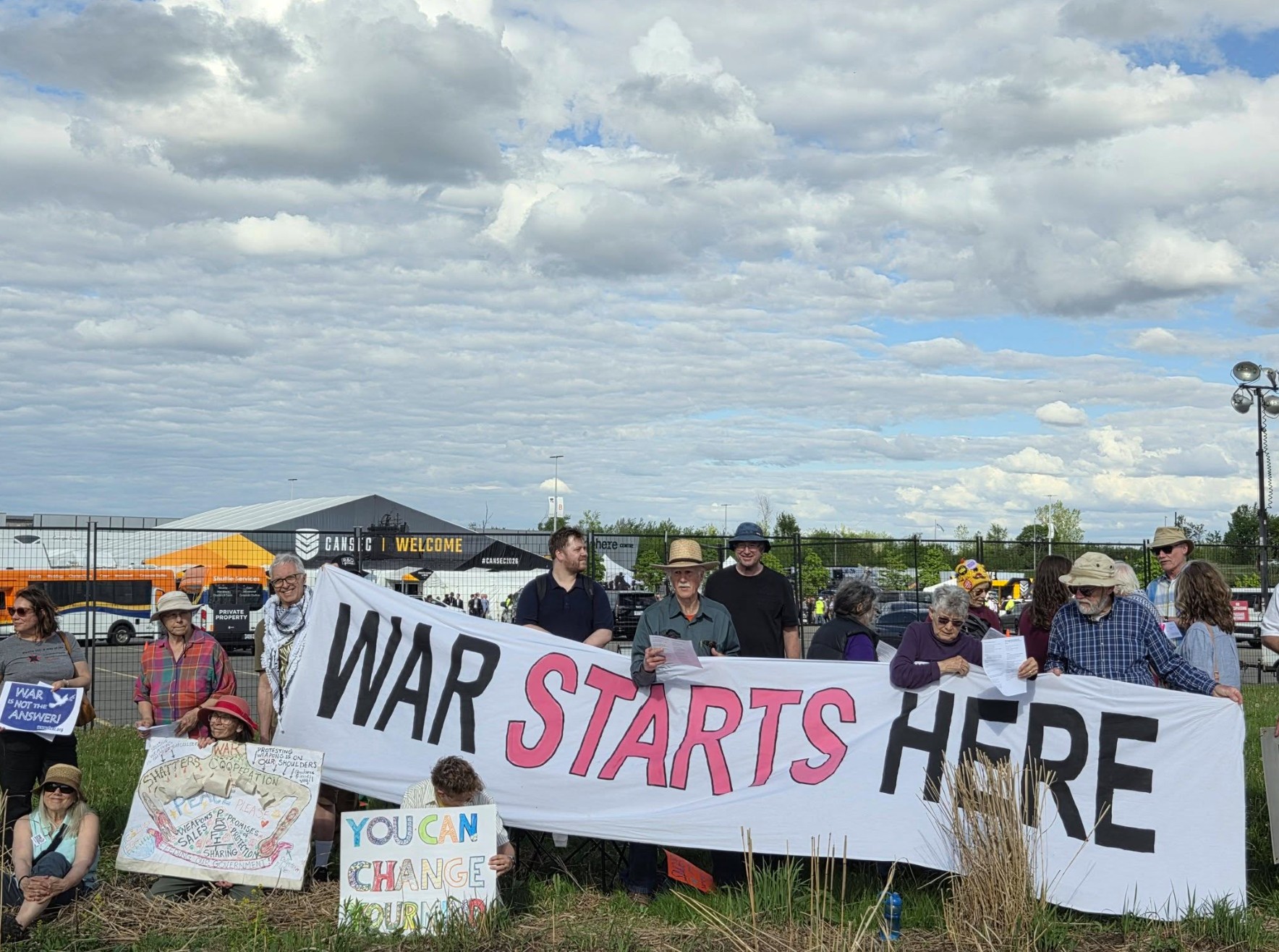
Photo: The Peaceful Faithful Gathering outside the CANSEC arms show at the Cohere Centre in Ottawa, May 27, 2026.
The United Nations observes Disarmament Week as a way “to promote awareness and better understanding of disarmament issues and their cross-cutting importance.” This year, Disarmament Week is October 24-30.
On October 26, twenty-nine Christian denominations and organizations, including the Canadian Friends Service Committee, Canadian Yearly Meeting of the Religious Society of Friends, Canadian Jesuits International, Kairos Canada, and Project Ploughshares, wrote Prime Minister Mark Carney “to express our deep concern over the government’s approach to securing Canada’s economic and national security”.
Conflict prevention
Their open letter highlights: “We ask that you ensure that part of Canada’s defence spending be explicitly allocated for non-violent conflict prevention efforts, climate monitoring systems and support for democratization…”
Peace Brigades International-Canada coordinator Brent Patterson contributed to the writing of the “Defence chapter” in the recently-published Alternative federal budget 2026-27: Bridge to independence report.
Among the actions recommended in the Defence chapter:
“The AFB will allocate funding for multilateral engagement, diplomacy, peace and stability, including for a Civil Peace Service (CPS) to promote human rights and peace on a long-term basis in crisis zones and conflict regions and to strengthen the Protection Mechanism for Human Rights Defenders and Journalists in Mexico to address the threats they face from military and security forces.”
Since the formation of the Ziviler Friedensdienst (Civilian Peace Service) in Germany in 1999, more than 1,200 experts have supported peacebuilding efforts in 60 countries around the world. It is also a significant funder of the human rights work done by Peace Brigades International.
Weapons exports
The letter from the twenty-nine Christian denominations and organizations further notes: “We also ask you to ensure that our economy is not dependent on weapons production and exports that will harm others in conflicts far from us, especially without adequate accountability regulations.”
The Alternative federal budget (AFB) would also “rescind Defence Industrial Strategy funding for military exports and trade shows” estimated at approximately $30 million over the 2027-28 to 2029-30 period.
The AFB states: “The government has now committed to increase the export of Canadian-made military goods by 50 per cent by hiring a ‘new dedicated team for export promotion’ and appointing ‘new trade commissioners in the United Kingdom and key European Union markets to support Canadian business abroad and ramp up Canada’s presence at major global defence and aerospace trade shows’.”
The AFB further notes: “When Canadian military equipment is exported to governments implicated in human rights violations or in situations marked by serious violations of international law and human rights norms, it undermines Canada’s international reputation, as well as peace and security.”
PBI-Canada continues to document how the export of “military goods” and technology from Canada affect the safety and security of human rights defenders, journalists, organizations and communities. Our case studies include research on arms exports and attacks against human rights defenders in The Philippines, Guatemala, Mexico, Honduras, Indonesia, Ecuador, Turkiye, Saudi Arabia.
The full letter can be read at 29 Christian denominations and organizations ask for a shift from military spending towards peacebuilding.

