


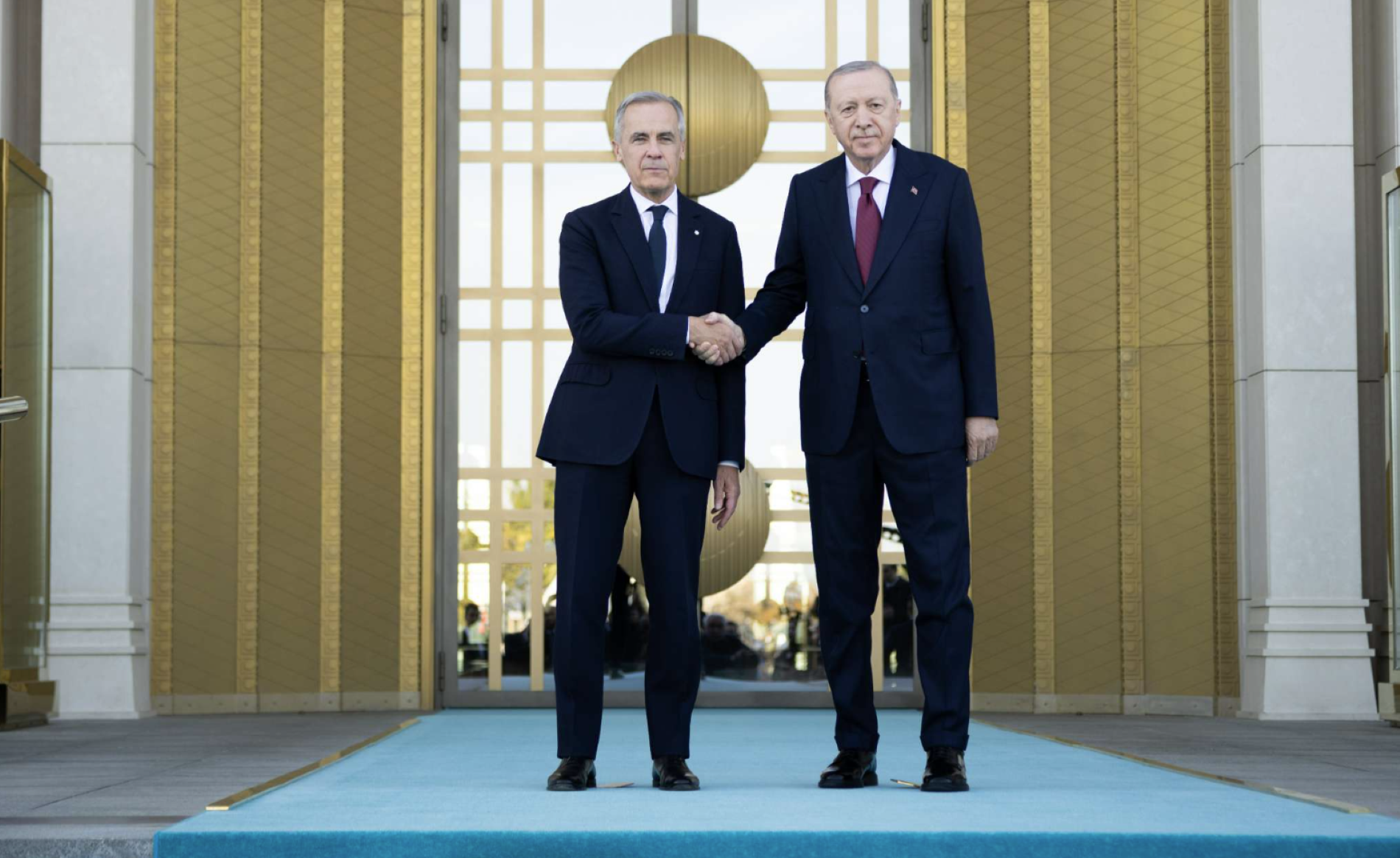
Photo and joint statement: “Canada and Türkiye are bound together by shared values: human rights, individual liberties, democracy and the rule of law.”
At the beginning of this year, Canadian Prime Minister Mark Carney stated in his address to the World Economic Forum annual meeting in Davos, Switzerland: “Our new approach rests on what Alexander Stubb, the President of Finland, has termed ‘value-based realism’ – or, to put it another way, we aim to be both principled and pragmatic.”
As the year has unfolded what does that mean for human rights defenders, journalists and the LGBT community in countries such as Türkiye and Saudi Arabia.
Human rights defenders
Amnesty International has noted that in Türkiye in 2025: “Baseless investigations, prosecutions and convictions of human rights defenders, journalists, opposition politicians and others intensified.”
In Saudi Arabia, Amnesty reported: “Authorities continued to severely restrict freedom of expression and association, with critics and human rights defenders facing long prison terms, grossly unfair trials, and arbitrary travel bans.”
Journalists
In May 2025, the Committee to Protect Journalists and sixteen other human rights organizations stated: “Saudi Arabia is one of the most dangerous countries for journalists, with at least 10 behind bars on December 1, 2024, making it the 10th worst jailer of journalists globally.”
And earlier this week, the Executive Committee of the International Federation of Journalists (IFJ) unanimously passed a motion “expressing solidarity with journalists, trade unions, and professional organizations in Türkiye in their fight against censorship, intimidation and the criminalization of journalism.”
LGBT rights
Just over a month ago, on September 18, 2026, Human Rights Watch posted: “The Turkish government’s major crackdown on groups and activists defending the rights of lesbian, gay, bisexual, and transgender (LGBT) people threatens the rule of law and fundamental rights in Türkiye, Human Rights Watch said today.”
And in Saudi Arabia, Human Rights Watch has previously documented: “The authorities continue to repress the rights of lesbian, gay, bisexual, and transgender (LGBT) people and have eliminated discussion of gender and sexuality from the public sphere online and offline.”
Overall, the Freedom House annual Freedom in the World report gives Türkiye a score of 32/100 and Saudi Arabia a score of 9/10.
Both countries are considered “not free”.
‘Engaging with the world as it is’
In January 2026, Prime Minister Carney stated during his visit to China: “We fundamentally stand up for human rights. We stand up for democracy, territorial integrity, rights to self-determination. We take the world as it is not as we wish it to be.”
He further commented: “That means we do engage with countries. We calibrate that engagement depending on our values and our interests so that engagement is more narrow when there are those issues. We also have a sort of value-based realism to the approach. We will engage on those issues with coalitions because that has more influence. …With other countries our engagement is more narrow. It’s more specific. And we keep within those guardrails and for those relationships. We’re very clear about where we will cooperate, where we differ.”
Carney added: “Our cooperation is more focused, more limited. But to have the effective relationship, we have the direct conversations. We don’t grab a megaphone and have the conversations that way.”
By July 2026, while in Saudi Arabia and questioned about human rights, Prime Minister Carney commented: “I do see that lecturing countries from afar is an ineffective strategy. It’s satisfying, but it’s ineffective.”
And this week ahead of meetings in Türkiye, the Minister of Energy for Canada Tim Hodgson commented: “The prime minister has been very clear. We need to engage with the world as it is, not the way we wish it to be. Where we have differences of opinion, we discuss those in private.”
The joint Statement by Prime Minister Carney and President Recep Tayyip Erdoğan states: “As NATO Allies, Canada and Türkiye are bound together by shared values: human rights, individual liberties, democracy and the rule of law.”
This hour CBC News reports: “Carney was asked by journalists on Friday [October 23] whether he personally raised concerns with Erdogan during their separate meeting. The prime minister refused to be pinned down. ‘My approach on these issues is I have direct conversations with leaders’, Carney said. ‘I find those conversations are more effective when they’re direct and open and not then reported out in detail, but we have raised these issues.’”
‘Defence industry co-operation’
This past summer, CBC News reported: “Carney announced during his visit to Jeddah, Saudi Arabia, that Canada would be sending a permanent defence attaché to its embassy in Riyadh to ‘increase exports from Canada’s defence sector,’ and opening a Canada exhibit at the World Defence Show there 18 months from now.”
And this week, Radio-Canada reported: “[Carney] and Turkish President Recep Erdogan announced a strategic partnership aimed at expanding trade and defence co-operation. …The partnership includes a new agreement on defence industry co-operation that will better connect Canadian and Turkish companies.”
‘No substantial risk’
In the context of the approximately $14-billion contract with Saudi Arabia for Canadian-made light armoured vehicles signed in February 2014, and the murder Saudi journalist Jamal Khashoggi in October 2018, Global Affairs Canada produced a departmental briefing note for the Minister of Foreign Affairs.
By November 2019, CBC News reported: “While the document [the briefing for the Minister] acknowledges that Saudi Arabia’s overall human rights record remains problematic, it says ‘officials found no credible evidence linking Canadian exports of military equipment or other controlled items to any human rights or humanitarian law violations committed by the Saudi government.’ …The document says the department believes there is ‘no substantial risk’ that current Canadian exports of military equipment will result in any human rights violations within Saudi Arabia.”
The implication is an acknowledgement of human rights violations, but a burden of proof in relation to specific military goods.
Amnesty International and Project Ploughshares responded by saying: “Canada is continuing to breach its international legal obligations on arms exports”.
Arms exports
In 2025 alone, Canada exported $403,946,393.05 in of “military goods and technology” to Saudi Arabia, and $129,939,659.74 to Türkiye.
The agenda is now to increase those exports. This was signaled in February 2026 in the Canadian government’s Defence Industrial Strategy that announced the intention to increase “our defence exports by 50%”.
We are also seeing this in relation to the announcements made in Saudi Arabia in July 2026 and Turkiye in October 2026.
CANSEC 2027
Türkiye and Saudi Arabia will likely be among the 100+ international delegations at the CANSEC arms show on June 2-3, 2027, at Cohere Centre in Ottawa. CANSEC is described by its organizers as “Canada’s largest defence, security & emerging tech tradeshow where $1B+ in business deals happen every year.”
As noted above, Canada will also be at the World Defence Show in Saudi Arabia from January 16 to January 20, 2028. It is also likely that Canada will be at the next International Defence Industry Fair (IDEF) that will be held from May 3 to May 9, 2027, at the Istanbul Expo Center in Istanbul, Turkey.
We continue to follow this.

