


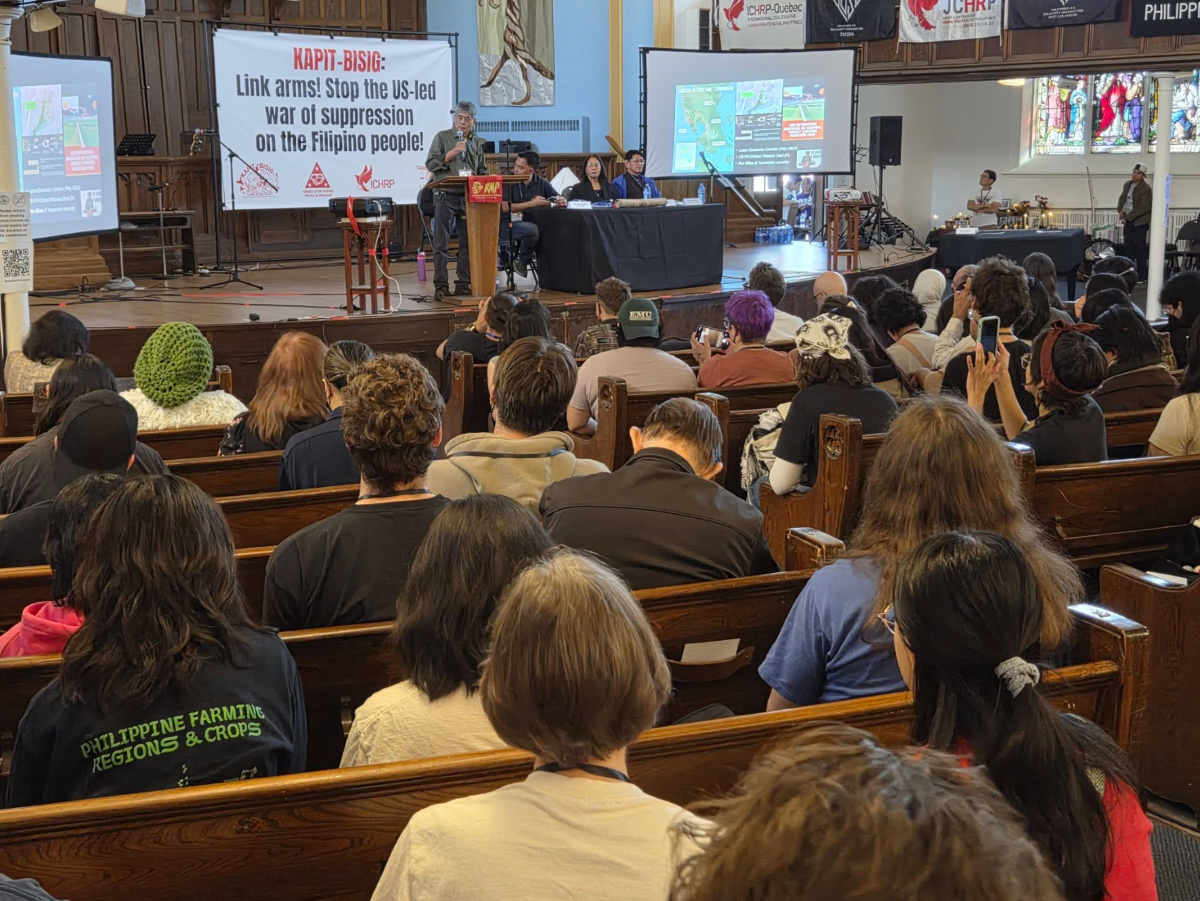
Danilo “Ka Daning” Ramos, the National Chairperson of the Peasant Movement of the Philippines (KMP), spoke about Pax Silica at the recent Kapit Bisig: Linking Arms Across the World Against the US War of Suppression on the Filipino People conference that was held on September 25-26, 2026, in Toronto.
Ramos leads the KMP, the largest national democratic mass organization of peasants in the Philippines with a membership of more than 2 million peasants, farm workers, and rural people collectively defending their life and lands.

What is Pax Silica?
The United States launched Pax Silica as a “flagship effort” to secure their supply chain for the critical minerals and rare earths required for semiconductors, artificial intelligence (AI), high-level technologies, and advanced military equipment.
The Pax Silica website prominently features a quote from Jacob Helberg, the Under Secretary for Economic Affairs, who says: “If the 20th century ran on oil and steel, the 21st century runs on compute and the minerals that feed it.”
What could this mean for farming communities?
The president of the Philippines, Ferdinand “Bongbong” Marcos Jr., has committed more than 4,000 acres of land to establish an AI industrial hub under the Pax Silica initiative. This would displace farmers, fisherfolk, workers, and the Indigenous Aeta communities who live and work in the “Luzon Economic Corridor”.
The International Coalition for Human Rights in the Philippines (ICHRP) comments: “Marcos is paving the way for foreign capital while ancestral lands and farming communities are pushed aside in the name of ‘development’.”
They further explain: “The proposed Pax Silica hub in Tarlac [in the Luzon Economic Corridor] could affect around 1,620 hectares of agricultural and ancestral lands. Local groups report that around 20,000 farmers and Indigenous residents face serious risks of land conversion and displacement. For communities, it is losing more than land – it means losing livelihoods, food security, and ancestral territories.”
Land and environmental defenders at risk
ICHRP has also cautioned: “Communities have reported experiences of military red-tagging when raising concerns about the project.”
Red-tagging is a practice where individuals or groups (often progressive political activists or land and environmental defenders) are labelled as communists, terrorists or subversives. This can lead to serious consequences, including further harassment, threats, violence and even extrajudicial killings.
Global Witness has documented the killing of 318 defenders in the Philippines since 2012, including 12 defenders killed in 2025.
Global Witness adds: “Indigenous Peoples account for a staggering one-third of land and environmental defender killings in the Philippines in 2012-23. Neary half of these cases were linked to mining. The military was responsible for 64 out of 117 killings of Indigenous defenders between 2012-23.”
Canada deepening its relationship with the Philippines
Canada is an observer, not a member of Pax Silica, but in July 2026 invested $2 million for a future project aligned with the Luzon Economic Corridor. The Manila Standard reports: “[President Marcos] welcomed Canada’s participation in the Luzon Economic Corridor, noting that Ottawa committed an initial C$2 million to support infrastructure, supply chain, and clean energy projects.”
The Manila Standard also reports: “Mr. Marcos said meetings [in Vancouver in July 2026] with Canadian business leaders yielded $2.5 billion in investment commitments covering mining, critical minerals, energy, information technology-business process management (IT-BPM), and the digital economy. Among the companies he met were B2Gold Corp., OceanaGold Corp., TELUS Corp., and NQX.”
The US$2.5 billion in investment commitments made by Canadian companies this past summer represents a significant increase of the $844 million of Canadian investment in the Philippines as of 2024.
Canada and the Philippines are currently negotiating a free trade agreement that could be concluded as early as November 2026; announced a Canada-Philippines Strategic Partnership along with a Joint Declaration of Intent concerning Energy and Natural Resources Cooperation and a Technical Assistance Partnership in July 2026; signed a Mutual Logistics Support Arrangement and a Statement of Intent on Strengthening Defence Cooperation in June 2026; and signed a Status of Visiting Forces Agreement in November 2025. A delegation from the Philippines is also expected again at the annual CANSEC arms show in Ottawa on June 2-3, 2027.
Ramos at protest in Toronto on September 25, 2026: “We want land, not Pax Silica. Canadian troops joined the visiting forces in the Philippines from April 20 to May 8 this year. We urge the Canadian government, not only US troops out in the Philippines, but also Canadian troops out in the Philippines.”

In April 2026, Peace Brigades International (PBI) launched a Southeast Asia Project to accompany human rights defenders in the Philippines, Cambodia, Malaysia, Myanmar, and Thailand. This project is focused on the acute exposure to extractive industries, land conflicts, and climate-related violence defenders face.
Peace Brigades International-Canada is following the opposition to Pax Silica with the awareness that the Philippines is an extremely dangerous country for land and environmental defenders.
Additional reading
–Filipino youth hold protest in Ottawa to denounce the visit of the president of the Philippines to Canada (PBI-Canada, July 2, 2026)
–PBI-Canada observes vígil for the Toboso 19 outside the Embassy of the Philippines, May Day call to shut down CANSEC in Ottawa (PBI-Canada, May 2, 2026)
–PBI-Canada meets with Filipino human rights defender Danilo “Ka Daning” Ramos in Ottawa (PBI-Canada, April 29, 2026).


