

The Peace Brigades International-Honduras Project has posted on social media:
“’In contexts marked by historical processes of dispossession and injustice, states are obligated to drive agrarian reforms that ensure equitable access to land,’ asserts the peasant, Indigenous, and grassroots alliance of Honduras, which continues to seek justice in line with rulings by the Inter-American Commission on Human Rights.
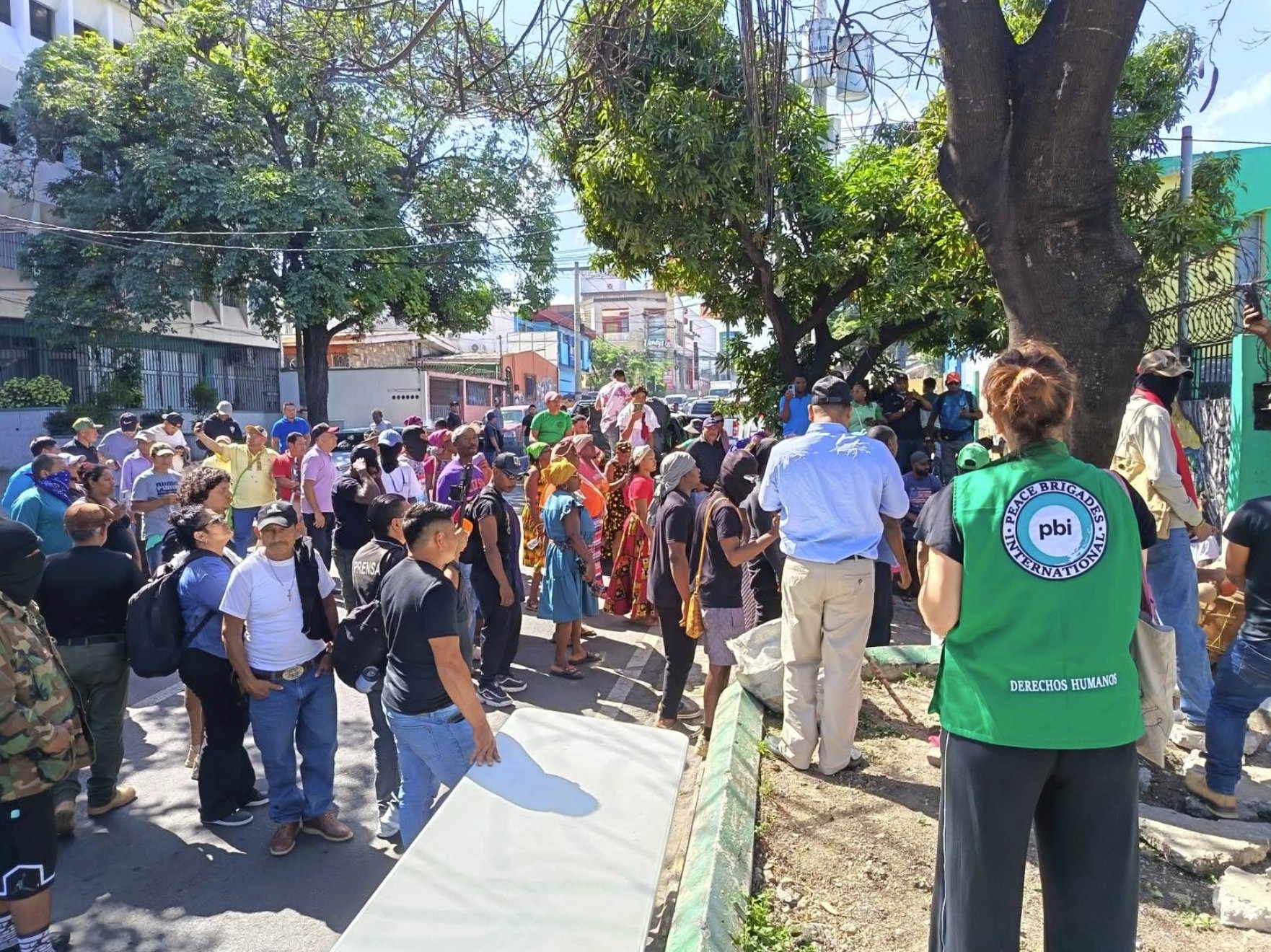
During a press conference in front of the INA [National Agrarian Institute] headquarters in Tegucigalpa, the Agrarian Platform and OFRANEH [the Black Fraternal Organization of Honduras] pointed out that the Agro-industrial Law and related decrees ‘could become new tools for the persecution of human rights defenders, Indigenous peoples, and peasant communities in a country marked by decades of the criminalization of struggles for land rights.’
PBI expresses its concern regarding the difficulties organizations have faced in exercising their right to freedom of expression—difficulties we witnessed firsthand during the peaceful protest.”

The Agro-Industrial Law
The Center for the Study of Democracy (CESPAD) has noted: “On February 10, 2026, a draft law aimed at granting preferential legal and administrative protection to the agro-industrial sector was presented in the National Congress.”
Then on June 10, Criterio.hn reported: “In a clear violation of parliamentary regulations, the National Congress of Honduras expanded the scope of the Law … to include the energy and tourism areas.”
And on June 15, Criterio.hn further reported: “Not satisfied with the legislative shield granted to sectors such as agribusiness, energy and tourism, the liberal deputy for Puerto Cortés, Alex Berrios Lamothe, promoted the initiative called the Safe House Law. Presented as a response to crime, the initiative deepens the protection of private property by expanding the cases of legitimate defense, even in situations where the protected legal asset is not life but property.”
Canada and the Agro-Industrial Law
It does not appear that the Government of Canada has commented publicly on the human rights implications of the Agro-Industrial Law.
Canada congratulates Asfura
On December 24, 2025, the Government of Canada posted on social media: “Canada congratulates President-elect Asfura and commends the Honduran people for participating in the democratic process. We look forward to advancing shared priorities, including justice, democracy, and tackling corruption.”
Canada abstains on the rights of peasants
PBI-Honduras has previously noted that the United Nations Declaration on the Rights of Peasants and other people working in rural areas recognizes key elements such as “the right to land, to natural resources and to food sovereignty, based on the principle of equality between men and women.”
Canada abstained in the vote on that was adopted by the UN General Assembly in December 2018.
Canada-Honduras relations
The Government of Canada has stated: “Canada works with Honduras on gender equality, economic opportunities, governance, including strengthening of justice and democracy, irregular migration, and the fight against impunity and corruption. In doing so, Canada contributes to the protection and promotion of the rights of the most vulnerable, including women and girls, Indigenous people, Afro-descendants and rural communities. Honduras is also an important bilateral trading partner in Central America. Looking to the future, Canada remains committed to support Honduras’ efforts towards building a more inclusive, democratic and secure society.”
Trade and economic relations
The Government of Canada has also noted: “The Canada-Honduras Free Trade Agreement entered into force in October 2014. The annual bilateral merchandise trade between Canada and Honduras in 2025 was $735.5 million, compared with $423 million in 2020. …In 2019-2020, Canada contributed CAD$ 33.5 million in international assistance from all aid channels to Honduras.”
Canada imports Honduran coffee
The Observatory of Economic Complexity notes that in 2024 Honduras exported $339 million of goods to Canada. The top export product was coffee at $67.2 million. With respect to growth, in June 2026 the rise in Canada’s imports from Honduras was mainly attributed to imports of Coffee (C$15.8M or 53.5%), Insulated Wire (C$822k or 12%), and Non-Retail Synthetic Filament Yarn (C$822k or 292%).
Trading Economics further documents: “Canada Imports from Honduras was US$465.82 Million during 2025, according to the United Nations COMTRADE database on international trade.” In 2025, this included: Coffee, tea, mate and spices ($127.49 million); Edible fruits, nuts, peel of citrus fruit, melons ($49.97 million); and Edible vegetables and certain roots and tubers ($27.82 million).
Canadian tourism to Honduras
Roatan Online indicates: “In 2025, Honduras achieved a historic milestone in tourism, welcoming 3.1 million visitors nationwide, the highest figure ever recorded. This represents an 11.6% increase compared to 2024, confirming the country’s consolidation as one of the most dynamic tourism destinations in Central America. At the heart of this growth stands Roatan, the undisputed leader of Honduras’ tourism performance and the main gateway for international visitors.”
Roatan Vacation Rentals adds: “Canadians travel to Roatan for many different reasons, but most seem to stay on the island for a love of the lifestyle…. No more snow tires! Canadians are not hard to find on Roatan and neither are Canadian owned businesses! The most widely known Canadian owned business on Roatan is Sundowners in West End. Here you will find many other Canadians along with travellers from all other parts of the world. Other Canadian owned businesses include the Hangover Hut and JavaVine in West Bay as well as Gran Bleu Diving in Sandy Bay.”
As many as 65,000 Canadians may be visiting Honduras each year.
Roatan is situated on Garifuna territory.
Canadian mining and energy projects in Honduras
In April 2016, CBC News reported that the Canadian mining company Aura Minerals was affecting the health of the Honduran village of Azacualpa by exposing them to cyanide leaching and from its open-pit gold mine.
In 2009, The Guardian reported concerns about Toronto-based Goldcorp killing livestock and making people sick by polluting land and rivers in the Siria valley because the San Martin opencast mine discharged highly acidic and metal-rich water in 2008. Goldcorp shut the decade-old San Martin mine after extracting nearly 12,000 tonnes of ore from its forested slopes.
And Manitoba Hydro International (MHI) has previously noted: “MHI has kicked off a 7-year supervisory project in Honduras, which will run until 2024. Working with the Honduran utility, the National Company of Electric Energy (ENEE), MHI will act as the project supervisor to oversee the operations of Empresa Energía Honduras (EEH). MHI will provide oversight and reporting on the main activities of the operator on the distribution system and customer service of the ENEE.”
Canada and ZEDEs
The “Zones for Employment and Economic Development” (ZEDEs) have been controversial in Honduras.
Canadian investors have been linked to the displacement of the Garifuna as noted in these PBI-Canada articles: “OFRANEH denounces Canadian Randy Jorgensen for trafficking archaeological items, usurpation of Garifuna lands” (November 28, 2024) and “PBI-Honduras accompanies meetings that reject ZEDEs, while Canadian investor pursues the Mariposa ZEDE” (September 4, 2021).
Military training, goods and assistance
On July 30, 2009, about a month after the coup, The Globe and Mail reported: “Canada is still providing training to members of the Honduran army.”
By February 17, 2015, Sandra Cuffe reported in Ricochet: “Militarization, impunity, and human rights abuses have dominated Honduras since the coup. …Canadian aid to security forces and investigative units has picked up, but some of it has produced more concerns than results.”
Canada does not appear to export a large amount of “military goods” to Honduras. Canada exports approximately $1 billion to $2 billion in “military goods” to the United States each year. The United States has provided well over $114 million in security assistance to Honduras between 2008 and 2014. In 2017, Global Witness documented that at least $18 million in U.S. aid was sent to Honduran police and military “in spite of their abuse against activists.”
We continue to follow this.
Further reading: CEHPRODEC’s decade-long struggle against the General Mining Law in Honduras (PBI-Canada, April 11, 2022).

