

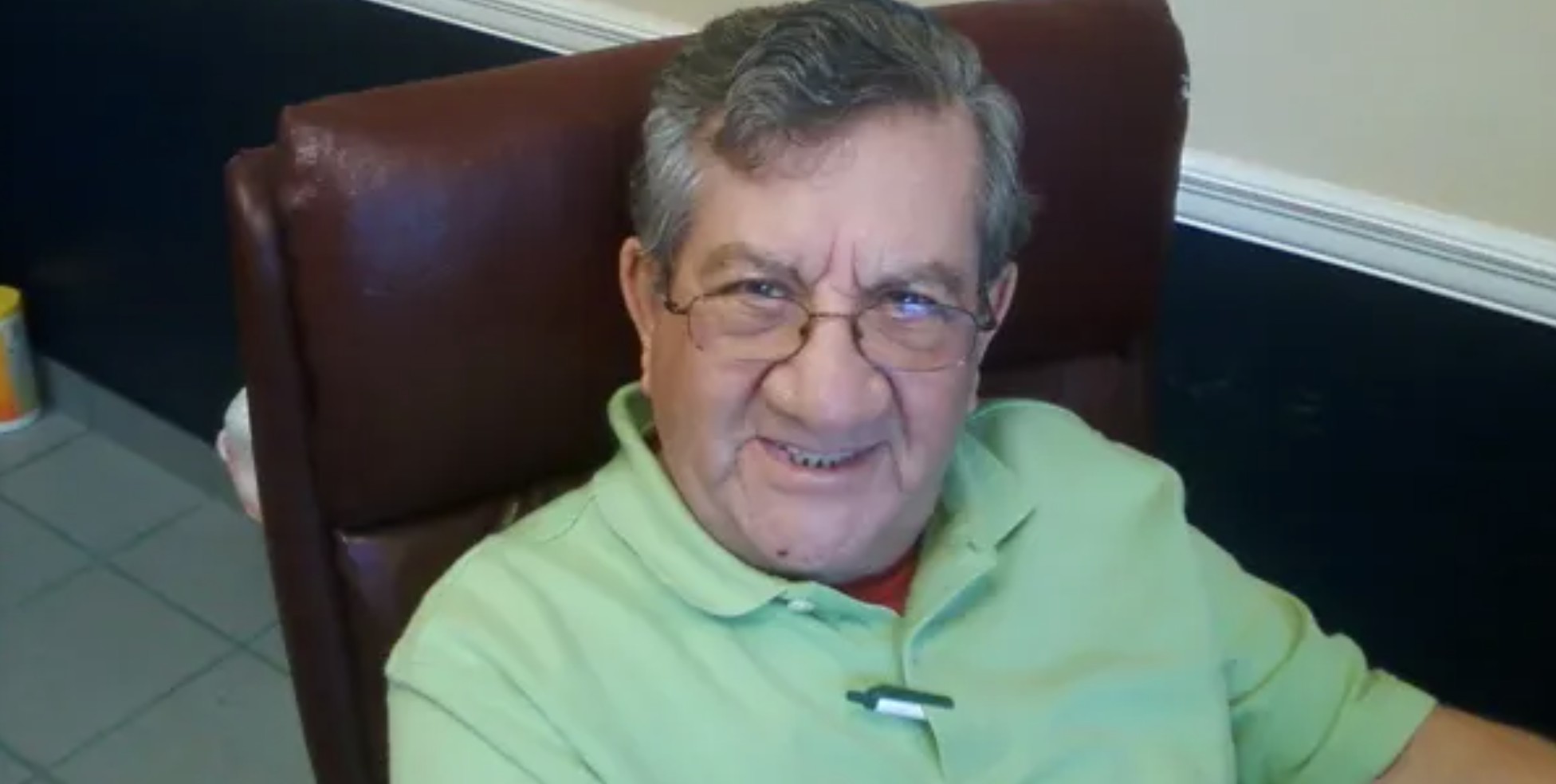
Photo: Father Jaime de Jesus Diaz.
Daniel N. Clark has written that one of the eleven original co-founders of Peace Brigades International 45 years ago was “Jaime de J. Diaz, a Catholic priest with the Corporation for Cultural and Social Development in Colombia”.
Clark noted that at the founding meeting an “international council” was formed, along with an administrative team, and a directorate that include Diaz, Narayan Desai, Murray Thomson and Charles Walker as an ex-officio member.
Clark also writes that in January 1982 a three-person team was formed “which would travel through Nicaragua and Honduras in May exploring possible peace brigade activities”. That team consisted of Clark, Diaz and Julio Quan, the director of the Latin American Center of Friends World College in Costa Rica. Clark adds: “In preparation, Jaime visited Costa Rica and Nicaragua for a few days in March.”
Clark has also noted: “In June [1982], at Charlie [Walker’s] suggestion, I had been appointed Project Director of PBI’s Central America Peace Teams Project, and at the Bergen meetings was named as convener of PBI’s Central America committee, which included Jaime Diaz, Paul Hare, and Julio Quan.”
Clark continues the story of this formative time in his book: Peace Brigades International: Roots and Early Years.
Writings on peace just prior to the formation of PBI
In October 1979, Diaz wrote: “As we have seen from recent events [perhaps referring to the Sandinista Revolution in July 1979], whether one considers it possible to bring about progressive change through democratic and/or legal means or whether one believes this can be done only by resort to arms, there is a growing agreement that radical worldwide change is needed.”
In September 1980, Diaz wrote in the Unesco Courier: “The Third World has for the most part been absent from discussions on disarmament, because it is wrongly believed that this problem solely concerns the superpowers, or the club of countries possessing nuclear weapons.” He continued: “In Latin America the most-costly weapons are imported…The multinational firms make profits either by exporting directly or authorizing manufacture under licence. Arms sales take place without restriction either through the official market or clandestinely. Governments use arms mostly to suppress ‘subversion’. However, the term ‘subversion’ is used arbitrarily to describe any attempt to change the prevailing political and economic order.”
Diaz added in that article: “We have in fact reached the paradoxical situation where the most sophisticated and costly arms race is justified precisely on the grounds of maintaining peace, yet this peace is nothing but a cold war based on official lying, fear, mistrust, the lust for power and profit, and the maintenance of a violent political and economic system whose leaders are firmly resolved to survive even at the expense of the greater part of mankind.”
And years after the formation of PBI, Diaz commented: “Parents who put war toys in their children’s hands are training them, not to defend themselves, but to attack. …This feeds the personal and national armaments and the ideology of violence and unconsciously supports the big arms business, the second largest in the world, along with drug trafficking. Two industries of death that are sisters and support each other.”
His passing
In July 2019, the Archdiocese of Bogotá, Colombia announced: “Father Díaz, priest emeritus of the archdiocese of Bogotá, was on pastoral leave in the diocese of St. Petersburg, Florida, United States. We join in prayer to thank God for the life of Father Jaime de Jesus, to ask the Lord to receive him into his Kingdom, and to beg for comfort and peace for the Díaz Castañeda family.”

