


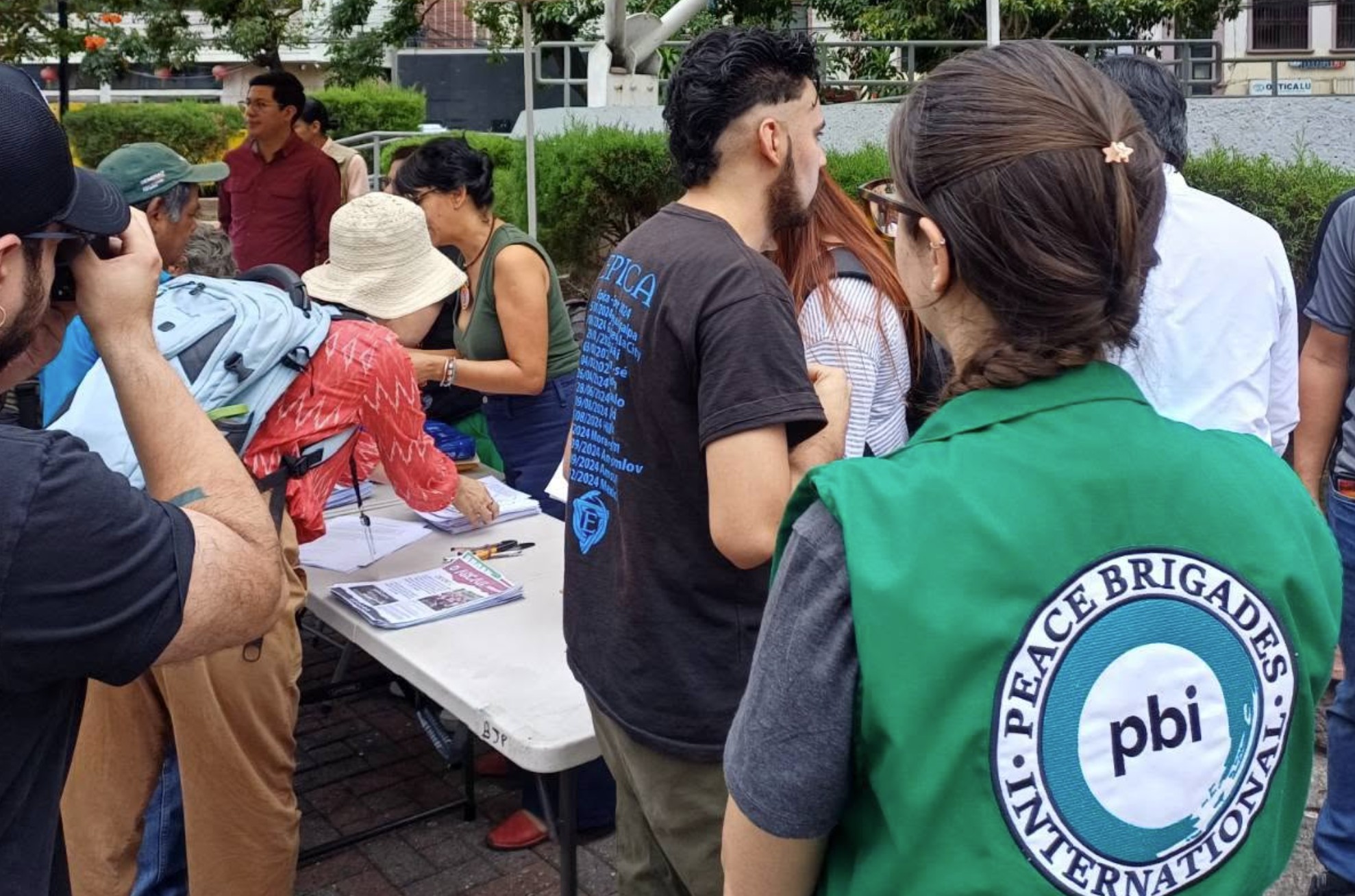
On June 3, the Peace Brigades International-Honduras Project posted on social media:
“Social organizations reject the Law for the Strengthening and Protection of the Agro-industrial Sector.
In a press conference, accompanied by PBI, @arcahhonduras [the Alternative for Community and Environmental Reclamation of Honduras] and other organizations have identified this Law as a direct threat to human rights that: ignores historical rights on land, weakens environmental controls, fails the right to free and informed #prior consultation, privilege to large agro-industrialists and criminalizes the social protest.
From PBI we express our concern and urge the international community to guarantee the right to protest and remain vigilant about the security situation of signing organizations.”

Reportar Sin Miedo further reports: “The coordinator of [ARCAH] Cristhopher Castillo, said that the legislation responds to the interests of large economic groups and not to the real needs of the population. Castillo explained that there is a substantial difference between community food production and agribusiness aimed at the accumulation of capital to crush the peoples.”
Law passed on June 3, 2026
Reportar Sin Miedo then reported: “A few hours after social, peasant, indigenous and Afro-descendant organizations from different regions of the country expressed their rejection of the bill for the Strengthening and Protection of the Agro-industrial Sector of Honduras, the National Congress proceeded to approve it amid questions from opposition sectors.”
After that, Infobae commented: “The approval of the Law for the Strengthening and Protection of the Agroindustrial Sector by the National Congress has opened a broad debate among productive sectors, peasant organizations, human rights defenders and international organizations on the scope and possible consequences of the new regulations. …The implementation of the regulations and their effects in the coming months will be decisive in assessing their impact on one of the most sensitive issues in the Honduran reality: agrarian conflict and the coexistence between economic development, productive investment and the rights of rural communities.”
Immediate interventions by National Police
After the passage of the “Law for the Strengthening and Protection of the Agroindustrial Sector of Honduras”, El Heraldo noted: “The forces of public order will be obliged to intervene immediately in cases of strikes, demonstrations or protests on public roads. In such crisis scenarios, the National Police and road authorities must enable safe logistics corridors and clear accesses, ports and routes without delay.”
Law then expanded to include energy and tourism
Then on June 10, Criterio.hn reported: “In a clear violation of parliamentary regulations, the National Congress of Honduras expanded the scope of the Law for the Strengthening and Protection of the Agroindustrial Sector to include the energy and tourism areas.”
Safe House Law
And on June 15, Criterio.hn further reported: “Not satisfied with the legislative shield granted to sectors such as agribusiness, energy and tourism, the liberal deputy for Puerto Cortés, Alex Berrios Lamothe, promoted the initiative called the Safe House Law. Presented as a response to crime, the initiative deepens the protection of private property by expanding the cases of legitimate defense, even in situations where the protected legal asset is not life but property.”
In another article, Criterio.hn additionally notes: “Pedro Mejía, a lawyer for the Agrarian Platform, [says] the reform is aimed at peasant and indigenous movements that maintain processes of territorial recovery and vindication of ancestral rights.”
That article adds: “He warned that owners or companies could invoke legitimate defense to act against these populations in the face of alleged threats to their property or heritage, even when there is no risk to life, which he considers unconstitutional and contrary to international human rights standards.”
The Asfura presidency
This is happening in the context of the aftermath of the November 30, 2025, presidential election in Honduras.
The Associated Press reported: “On Wednesday [November 26, 2025, Nasry ‘Tito’ Asfura] received the endorsement of U.S. President Donald Trump.”
On December 5, 2025, PBI-Honduras accompanied several peasant and Indigenous organizations in a press conference, march and stand in front of the United States Embassy in Tegucigalpa where they alleged interference of the United States government in the electoral process of Honduras.
On December 8, 2025, PBI-Honduras observed several Honduran land and territory organizations, including ARCAH and the Agrarian Platform, file a “motion to annul the election results with the National Electoral Council and a complaint for electoral crimes with the Public Prosecutor’s Office.”
Asfura was declared the winner of the election on December 24, 2025, and was sworn into office on January 27, 2026.
On March 4, 2026, PBI-Honduras observed a press conference organized by popular movements who warned of the “serious repercussions” of the Law for the Strengthening and Protection of the Agro-industrial Sector.
As noted above, that Law was passed on June 3, 2026.
We continue to follow this.

