

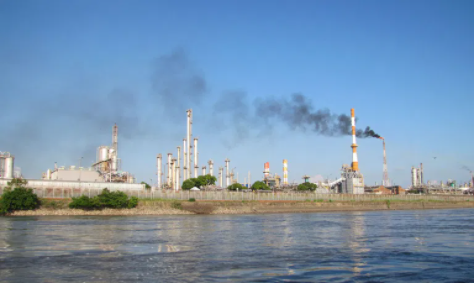
The Ecopetrol refinery in Barrancabermeja. Photo by PBI-Colombia.
Click here to hear Colombian environmental defenders discuss the issue of fracking and public health this Thursday at 2:30 pm COT/3:30 pm EST.
David R. Boyd, the United Nations Special Rapporteur on human rights and the environment, has argued that clean air is a human right. Significantly, it is a human right that is put at risk by the airborne pollution associated with fracking.
The Guardian has reported: “Research has found that fracking and other types of extraction are dangerous for the people who live near drilling sites – causing higher rates of asthma and cancer, as well as preterm births.”
A recent Binghamton University study also found that 20 people lost their lives in Pennsylvania between 2010 and 2017 because of particulate matter pollution emitted by shale gas (fracking) wells. The researchers found that airborne pollution was detectable up to 10 kilometres (about 6 miles) and possibly further downwind from an active fracking well.
Speaking about the situation in California, with low-income of communities of colour nearest fracking sites, Martha Dina Agruello of the Physicians for Social Responsibility says: “Communities need immediate relief to the heath assaults of oil and gas extraction.”
The Alliance for a Colombia Free of Fracking has also highlighted that fracking threatens the health of local communities and ecosystems.
To date, the National Hydrocarbons Agency (ANH) has approved two fracking pilot projects near the community of Puerto Wilches in the Magdalena Medio region of Colombia. One of the blocks where the fracking would take place (the VMM-37 block operated by the American transnational ExxonMobil) is partly owned by Toronto-based Sintana Energy.
Last May, Mongabay reported that ExxonMobil owns the Manatí Blanco-1 well (in the VMM-37 block) that it intends to use for fracking. That well is situated less than 500 metres (1,640 feet) from the community of Terraplén.
The city of Barrancabermeja, which is situated in the Magdalena Medio region, is already the site of Colombia’s largest oil refinery (owned by Ecopetrol) which processes about 250,000 barrels per day. If fracking were to be fully approved, Ecopetrol has stated production at the refinery could increase to 300,000 barrels per day.
Webinar this Thursday
This Thursday April 29 at 2:30 pm COT/3:30 pm EDT, four Colombian environmental will speak about their concerns about fracking and extractivism in the Magdalena Medio region.
Click here to join them in a bilingual English-Spanish webinar.
Webinar panel: Colombian environmental defenders Ivan Madero, Yuli Velasquez, Oscar Sampayo, Yuvelis Natalia Morales, plus Karen Hamilton (Above Ground), Luis van Isschot (Peace Brigades International-Canada).

