

Click here to join a webinar this Thursday that will discuss the impact of fracking and extractivism on the peace process in Colombia.
Oil Change International has stated that oil producing countries are 50 per cent more likely to have civil wars and has made this link to the armed conflict in Colombia.
Almost 20 years ago, the Christian Science Monitor reported: “Colombia’s two largest guerrilla armies, the Revolutionary Armed Forces of Colombia (FARC) and the National Liberation Army (ELN), oppose foreign involvement in the nation’s oil industry and, according to the Colombian military, the rebels hope that [their 170 bomb attacks on the Caño Limón pipeline will] weaken the government by depriving it of foreign earnings.”
Now, with two fracking pilot projects authorized to proceed in the Magdalena Medio region there are concerns about more violence.
Alexander Rustler, a researcher at the New York City-based Columbia Center on Sustainable Investment, has commented that fracking would put at risk the already precarious peace process in Colombia.
He writes: “The first fracking projects are intended to be carried out in Magdalena Medio, a region in the North of the country that was among the hardest hit by conflict.”
Rustler further cautions: “Fracking’s expansion risks aggravating tensions, potentially causing demonstrations against oil and gas drilling to metamorphose into violent clashes between communities and companies.”
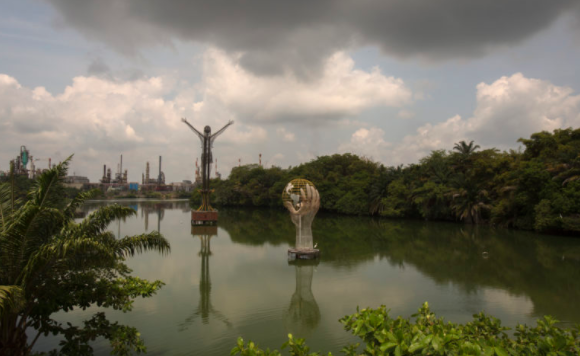
There are already aggravated tensions, including around the San Silvestre wetland that would be put at risk by fracking.
Last month, The World reported: “Every couple of weeks, Yuli Velasquez patrols Saint Silvester Lake near Barrancabermeja, Colombia, looking for signs of pollution.”
That article adds: “[Her organization FEDEPESAN says] that armed groups like the National Liberation Army and the [right-wing paramilitary] Gulf Clan are using the forests around the lake to stash drugs and weapons.”
FEDEPESAN says: “If we patrol the area, they are immediately suspicious, they think we are snitches. So, that turns us into their enemies and puts our lives at risk.”
Furthermore, Infobae has reported that eighteen social leaders in Magdalena Medio were threatened with death last November by the Black Eagles (a paramilitary that is reportedly linked with the Gulf Clan). Six of those threatened are members of the Alliance for a Colombia Free of Fracking.
Amnesty International has also highlighted the context in which Barrancabermeja-based CREDHOS, an organization that defends the right to a healthy environment in the Magdalena Medio region, recently received a death threat from a man self-identified as a member of the Magdalena Medio Block of the armed group FARC-EP.
Meanwhile, Rutas del Conflicto and La Liga Contra el Silencio have reported that more than 70 companies have more than 200 “cooperation agreements” with public institutions such as the Ministry of Defence to provide them with protection.
One of the companies noted in that article is Ecopetrol which was recently awarded a contract to conduct a fracking pilot project near the community of Puerto Wilches, Santander in the Magdalena Medio region.
Webinar this Thursday with environmental defenders
This Thursday April 29 at 2:30 pm COT/3:30 pm EDT, four Colombian environmental defenders will speak about their efforts to protect the San Silvestre wetland, uphold the right to a healthy environment, and stop fracking and environmentally harmful extractivism in this context of legal and illegal armed actors.
To register to hear them, click here.
Webinar panel: Colombian environmental defenders Ivan Madero, Yuli Velasquez, Oscar Sampayo, Yuvelis Natalia Morales, plus Karen Hamilton (Above Ground), Luis van Isschot (Peace Brigades International-Canada).

