


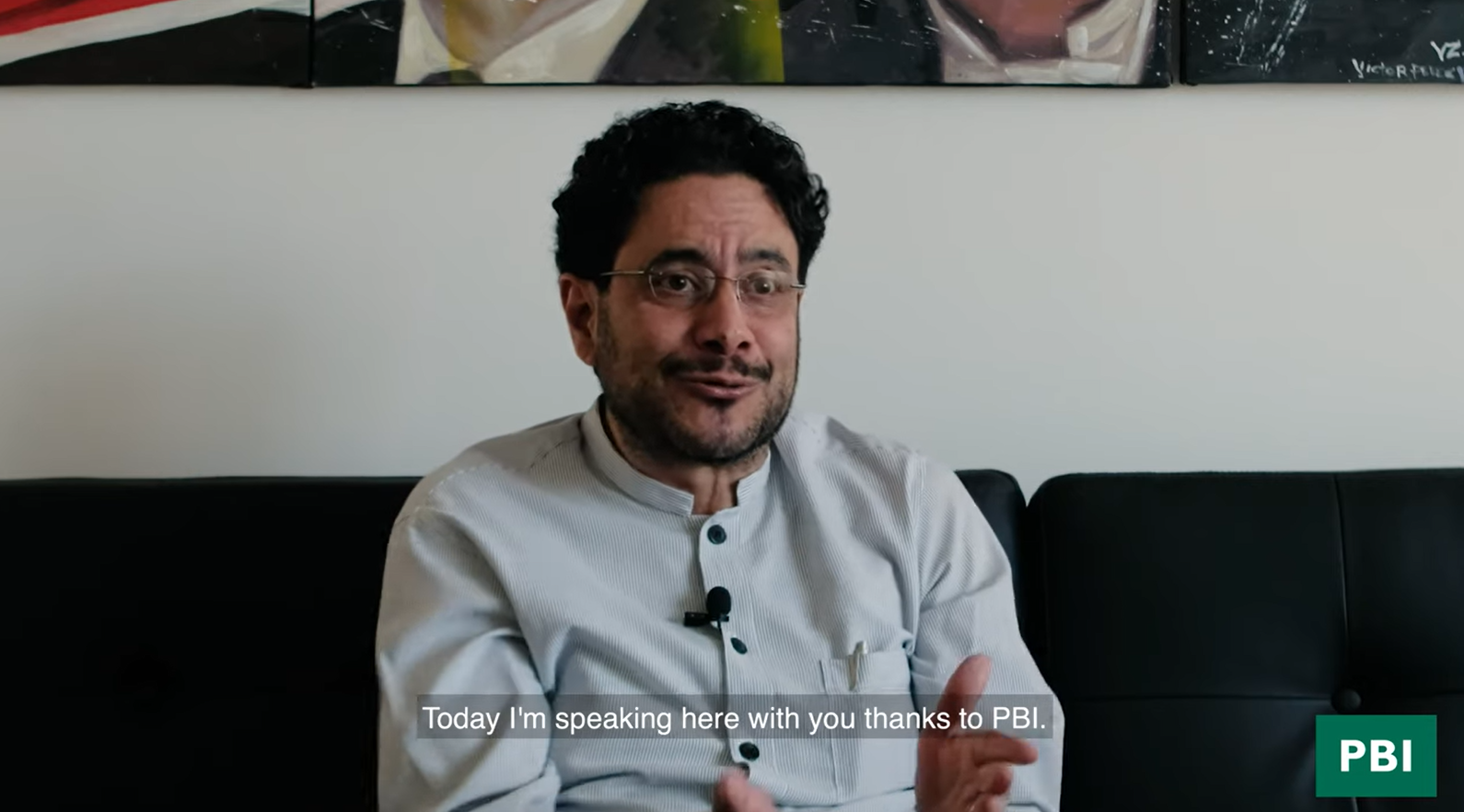
Video still: Iván Cepeda, who now leads in the polls, was accompanied by PBI from April 2004 to November 2009.
The presidential election in Colombia will take place on May 31, 2026, just a little over two months from now. In this election period there is a heightened risk of smears and attacks against human rights defenders and communities.
Election monitoring
ABC Colombia has noted the European Union is deploying an Election Observation Mission to Colombia to monitor Presidential elections with more than a hundred observers distributed across different regions of the country.
The Brussels Times has further reported: “Esteban González Pons, a Vice-president of the European Parliament, has been appointed as the mission’s Chief Observer by the EU’s High Representative for Foreign Affairs and Security Policy, Kaja Kallas, the European External Action Service (EEAS).”
And the San Francisco-based Global Exchange says it “is activating electoral monitoring tools to help document the process, support transparency, protect human rights, and amplify the voices that are building the nation from the ground up.”
Disinformation
Now, La Silla Vacía reports that a video clip is circulating on social media that implies presidential candidate Iván Cepeda demanding respect for the Revolutionary Armed Forces of Colombia (FARC).
La Silla Vacía notes Cepeda was instead defending the Peasant Association of the Cimitarra River Valley (ACVC).
Peace Brigades International has accompanied the ACVC since 2007.
Cepeda says: “These peasants live in very difficult situations, I ask you to please respect them.” Democratic Center Party Senator Maria Fernanda Cabal responds: “Don’t ask me to respect those who recruit children, such as the members of the ACVC.”
This was a debate in June 2017.
In that debate, Cabal also says the Peasant Association of Catatumbo (Ascamcat) has “a lot of relationship with illegal groups”.
In November 2025, PBI-Colombia physically accompanied Ascamcat on a verification mission in Catatumbo.
Cepeda has now posted on social media: “As part of the various campaigns of lying communication being carried out by various far-right media outlets, a new dirty campaign against me is now unfolding on social media. It involves slanderous messages in which a fragment is taken from the debate I held years ago with Senator Cabal, in which she accused peasant associations and civil organizations of being guerrillas and child kidnappers. They decontextualize the video fragment and put it into circulation on social networks.”
Stigmatization, attacks against the ACVC
La Silla Vacía notes: “Since its inception, ACVC members have been stigmatized, according to Peace Brigades International. Between 1990 and 2010, the Truth Commission documented systematic persecution against the peasant movement with the aim of dismantling and displacing its social fabric. The last recorded murder of a member occurred in August 2023, along with the kidnapping of three other leaders. In the last year alone, at least 187 leaders were murdered in the country.”
The election, May 31 and June 21
On March 20, The Rio Times reported: “Cepeda leads Colombia’s presidential race at 35%, followed by nationalist lawyer Abelardo de la Espriella at 21% and center-right Paloma Valencia at 16%, according to the first major poll since March 8 primaries.”
Politichance notes: “Colombia’s presidential elections are scheduled for May 31, 2026, and a second round (if required) on June 21, 2026, in case no candidate secures more than 50% of the valid votes in the first round.”
PBI accompaniment of Cepeda
In this video clip produced by PBI-Colombia in 2019, Cepeda says: “Today I’m speaking here with you thanks to PBI. The paramilitary took me off a vehicle and there was a moment where if two PBI women hadn’t been with me, an Italian and a Norwegian, they would have probably made me disappear.”
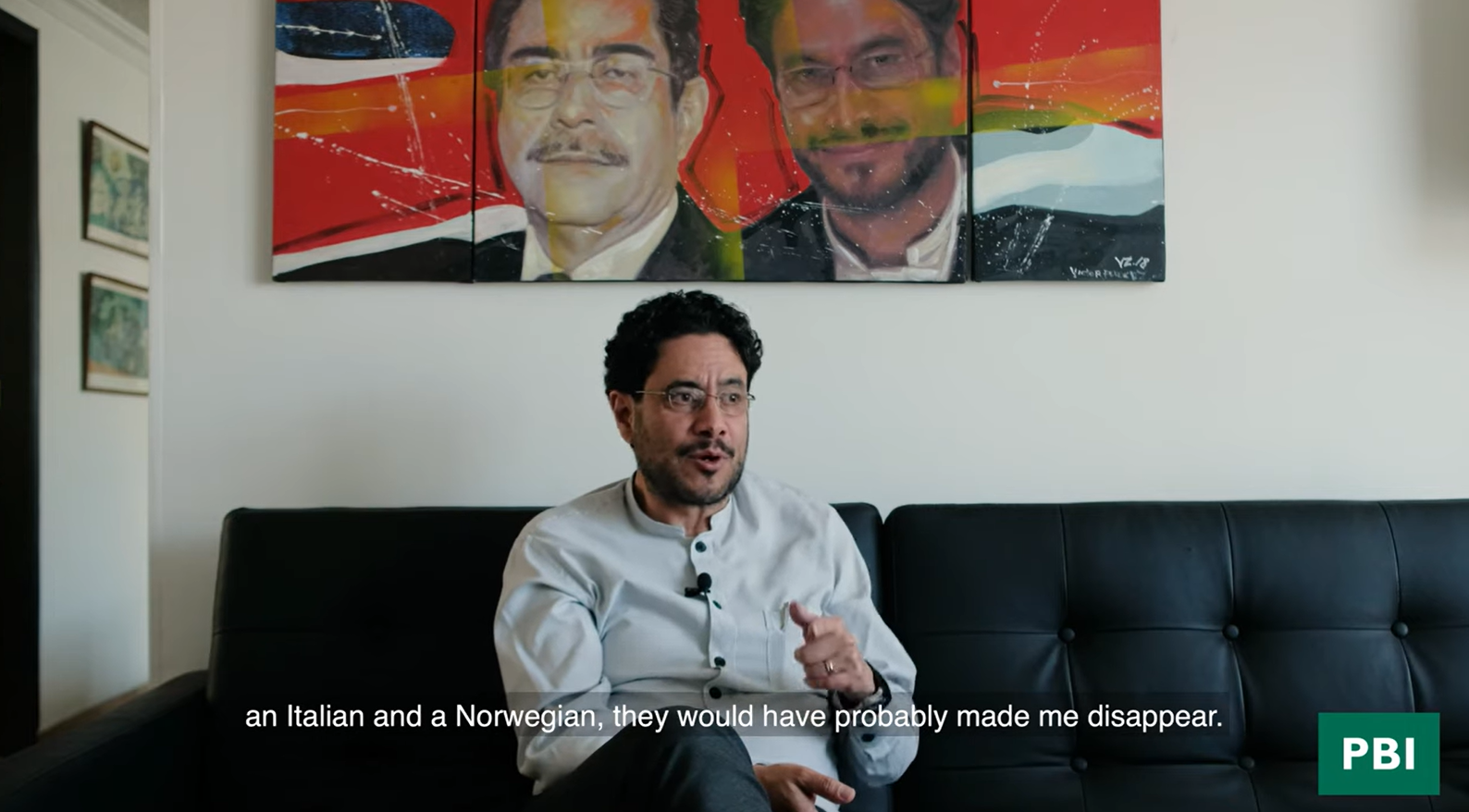
PBI-Colombia has previously noted: “PBI has accompanied the Manuel Cepeda Vargas Foundation’s Executive Committee since April 2004, when Iván Cepeda and Claudia Girón returned to Colombia after four years of exile in France (resulting from the death threats they received in 2000).”
The Foundation was named after Cepeda’s father.
The Jacobin notes: “His father, Manuel Cepeda, a congressman for the Patriotic Union — a party that emerged from a peace process with the FARC — was assassinated in 1994 by paramilitaries in a campaign of extermination of the party’s leaders, for which the Inter-American Court of Human Rights condemned the Colombian state. After his father’s murder, Cepeda promoted the National Movement for Victims, with the aim of achieving justice for the people murdered by state agents and paramilitaries.”
PBI-Colombia also explains: “In November 2009, PBI suspended its accompaniment of Iván Cepeda when he announced he would run for congress in March 2010. Due to PBI’s mandate of non-partisanship, it does not accompany candidates for office or elected officials.”
Cepeda comments on Canadian companies
In a webinar in November 2020 alongside Canadian Member of Parliament Leah Gazan, Cepeda stated: “There is evidence of companies, I’m not saying just Canadians, but there is evidence of companies that have hired paramilitary groups. [There are also contracts between companies and the Colombian armed forces] in a sense the army becomes a privately hired company for security purposes for the multinational.”
It has been reported that 70 companies, mainly in the mining-energy sector, have 200 cooperation agreements with public institutions in Colombia, including the Ministry of Defence and even the Attorney General’s Office.
This includes agreements between the Canadian company Frontera Energy and the Colombian military that led to the criminalization and arrest of eight social leaders in San Luis de Palenque, Casanare who are accompanied by the PBI accompanied organizations the Committee for Solidarity with Political Prisoners (CSPP) and the Social Corporation for Community Advice and Training (COSPACC).
Will Trump interfere in the Colombian election?
Cepeda has been asked: “Do you fear a direct intervention by the United States in the upcoming elections?” His response: “Yes. When a foreign power issues opinions against a government during an electoral period, when it says that government has favorable attitudes toward criminal organizations, that it can have a harmful effect on the region — that has a purpose. Figures from President Trump’s circle, both congresspeople and administration officials, have spoken in this way.”
Cepeda has also been asked: “Beyond the statements, do you believe there could be a more direct intervention by the US government during the campaign and the presidential and legislative elections this year in Colombia?”
Cepeda has replied: “We will see. There is a real danger. There are precedents.”
We continue to follow this.

