

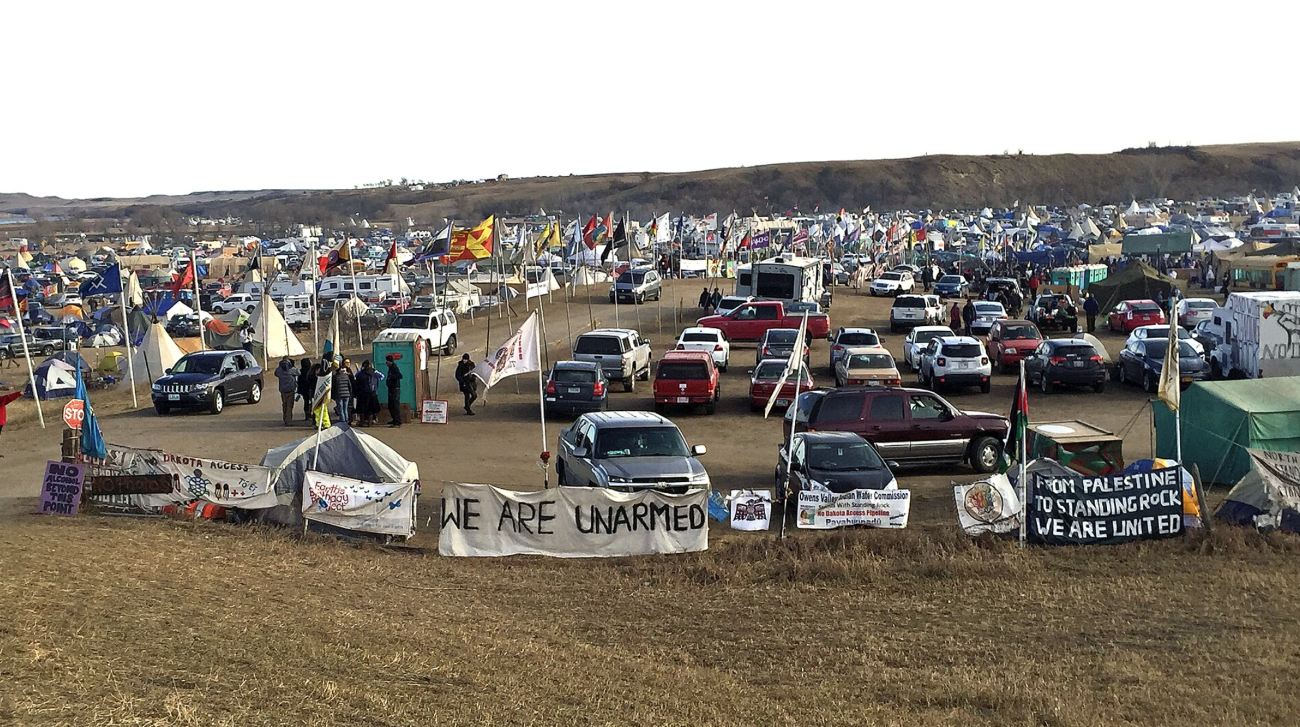
Photo: Signs in front of Oceti Sakowin Camp at Standing Rock, Dakota Access Pipeline protests, November 2016. Source: camp Palestine; Becker1999.
Bloomberg reports: “South Bow Corp. is considering an expansion of its pipeline system that may revive a version of the canceled Keystone XL project.”
The article further notes that Bridger Pipeline LLC is in the early stages of considering a 550,000 barrel per day pipeline that would move oil from Canada through Montana to Wyoming. The original Keystone XL pipeline would have taken oil from Hardisty, Alberta to Steele City, Nebraska.
Bloomberg also explains: “South Bow was spun off in 2024 from TC Energy Corp., which originally proposed Keystone XL.”
CBC News adds: “Canadian Prime Minister Mark Carney was aware of oil company South Bow’s plans to revive parts of the canceled Keystone XL pipeline to the United States when he floated the idea to U.S. President Donald Trump in October, a source familiar with the matter told Reuters on Tuesday [February 24].”
That article also notes: “A spokesperson for Calgary-based South Bow confirmed in an email to Reuters that the company is evaluating a proposal that would leverage its existing infrastructure and already-permitted corridors in Canada to potentially connect to crude oil pipelines in the U.S.”
The CBC News article further reports: “U.S. company Bridger Pipeline recently filed a proposal with Montana regulators that describes the construction of a potential 1,038-kilometre pipeline beginning near the U.S.-Canada border in Phillips County, Mont., and transiting to Guernsey, Wyo.”
Resistance to KXL
In October 2025, the BBC reported: “Environmentalists and indigenous groups have also long opposed the project.”
In January 2017, The Guardian reported: “Opposition to the Keystone project was driven by grassroots environmental activism. Campaigners from 350.org and other environmental groups made it a test case of Obama’s promise to act on climate change – elevating a little-noticed infrastructure project into a national issue.”
In March 2017, CBC News explained: “Keystone XL has faced multiple delays since it was first pitched in 2008. When it was blocked by President Barack Obama in 2015, many environmentalists declared a victory. Now [with the election of Donald Trump as US president], south of the U.S. border, many Indigenous groups are vowing to fight once again. ‘The fight to kill the Keystone XL pipeline begins anew — and Donald Trump should expect far greater resistance than ever before,’ wrote Dallas Goldtooth, lead organizer for the Indigenous Environmental Network.”
Indigenous Climate Action has also previously posted: “[The Keystone XL pipeline] was fiercely opposed by groups in both the United States and Canada, including Dene, Cree, Metis, Oceti Sakowin, and Ponca tribes and communities. Indigenous leaders helped lead a coalition that also included Nebraska landowners and environmentalists in more than a decade-long struggle. In 2021, President Joe Biden revoked the presidential permit for KXL and 6 months later, in June 2021, TC Energy (formerly TransCanada) announced the project was officially dead.”
Resistance to DAPL
This week, Nicholas Gottlieb wrote in Ricochet: “Late last year, Enbridge and Energy Transfer, the company that built and operates the controversial Dakota Access Pipeline (DAPL), told shareholders that they are working on a plan to begin transporting as much as 250,000 barrels per day of Alberta tar sands crude oil through the pipeline to refineries in the United States. …The companies’ new plan, referred to by Enbridge as its Mainline Optimization Phase 2 project, would mark a more direct incorporation of the pipeline into the Canadian oil industry. It is part of a broader set of brownfield projects that Enbridge says could add as much as 600,000 bpd of southbound export capacity, roughly the same amount added by the Trans Mountain Expansion Project.”
Formation of the RCMP CRU
With the news reports about the possibility of a South Bow-Bridger crude oil pipeline from Alberta through Montana to Wyoming, along with the news from Gottlieb about the emerging plan from Enbridge and Energy Transfer, we recall the resistance in 2016-2017 against the Dakota Access Pipeline (DAPL), most notably at the Standing Rock Sioux Reservation in North and South Dakota.
Gottlieb explains: “The conflict over DAPL had profound implications for Canada’s oil and gas industry through its role as an impetus for the formation of the CRU (formerly C-IRG) police unit and as a model for the kind of counterterrorism police tactics that would later be deployed to defend Trans Mountain and Coastal GasLink.”
He then comments: “To move DAPL forward, Energy Transfer hired a private security contractor founded during the US occupation of Iraq to surveil and suppress the protests. The contractor, TigerSwan, worked with local, state, and federal police agencies, deploying a variety of ‘counterterrorism tactics’, including embedding double agents within protest camps.”
Gottlieb further notes: “These tactics would come to Canada almost immediately: DAPL was explicitly cited by RCMP as justification for the formation of the C-IRG police unit (now CRU). CRU was originally formed to suppress any Indigenous resistance that might crop up, but it has since been used to surveil and police Palestine solidarity marches and a wide array of other forms of political speech and action. We also know that CRU has closely collaborated with industry and private security firms, as state and federal police did during the #NoDAPL conflict. As I’ve argued before, CRU is our ICE, its scope keeps growing, and its primary mission seems to be to defend the profit margins of US-led capital in this country.”
We continue to follow this.


