


Photo: Rubén Amílcar Farfán was kidnapped on May 15, 1984.
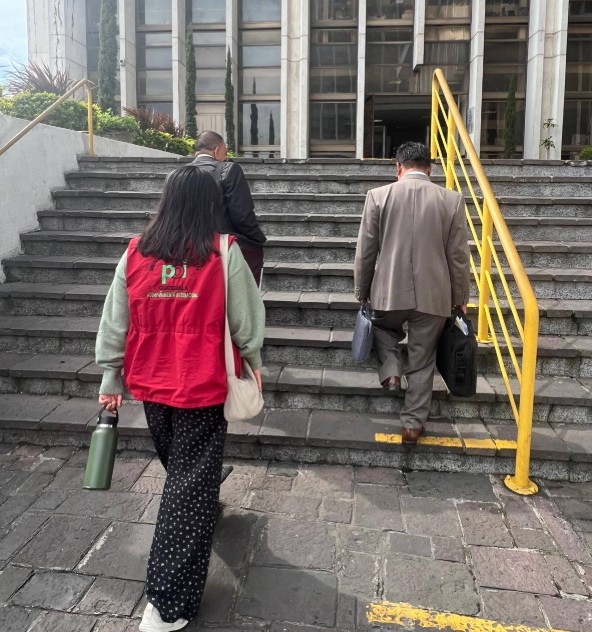
PBI-Guatemala has been accompanying the #CasoDiarioMilitar (Military Diary Case) court hearing process that began in May 2021.
Most recently, PBI-Guatemala posted on October 14 that it had accompanied the intermediate stage hearing of the case in High Risk Court C. They further highlighted that the Public Prosecutor’s Office proposed closing the case.
The Military Diary includes trade unionists
The Military Diary gives an account of more than 183 people who were subjected to state security violence between 1983 and 1985.
Ruda has explained that the Military Journal itself is “a record of the names, photographs, and addresses of men and women who were arrested, detained, disappeared and murdered. The list includes students, university professors, trade unionists, and members of social organizations that the Army identified as allies of the guerrillas.”
More pointedly, the National Security Archive also notes: “The military diary is a chilling artifact of the political terror techniques used by Mejía Víctores during that period. It details the kidnapping of 183 people and uses coded language to record the execution of 93 of them. In order to identify and eliminate insurgent leaders and their alleged collaborators, the military and national police used surveillance, wiretapping, kidnappings, interrogations, and torture to extract information from prisoners about their comrades, friends, and family members. The diary was created precisely to report and classify this information so that security forces could operate against other potential targets.”
Reflecting on this time, Miguel Angel Albizures, a trade unionist in the 1980s, tells Agencia Ocote: “The workers’ movement, the trade union movement, was seriously affected with the kidnapping and disappearance of many leaders.”
Rubén Amílcar Farfán
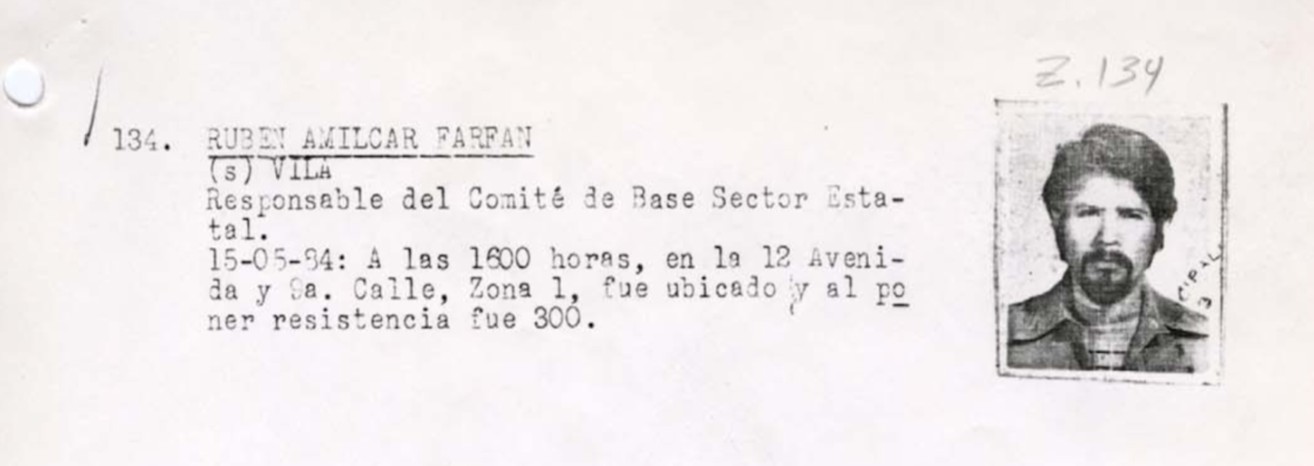
It has been reported that Rubén Amilcar “always thought about the common good and the vindication of labor rights [and] almost from the moment he started working, he was a member of the Road Workers’ Union” and that the first time he was arrested by security forces was “in 1980, while negotiating the Collective Agreement on Working Conditions with his union colleagues.”
Agencia Ocote further reports: “On May 15, 1984, Rubén Amílcar Farfán was kidnapped by state security forces on the corner of 12th Avenue and 9th Street, in Zone 1 of Guatemala City. He was a trade unionist, a student of Humanities and a proofreader at the University of San Carlos press. …Since then, his family, especially his sister Aura Elena Farfán, has dedicated themselves to seeking justice for Rubén and the thousands of disappeared during the war.”
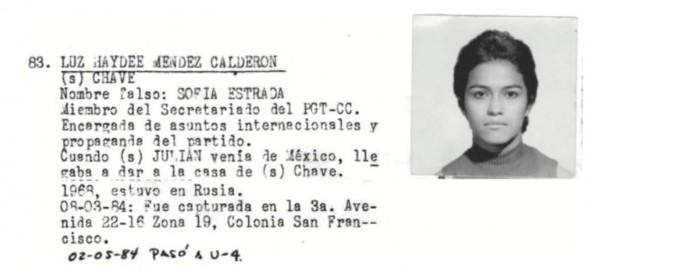
And No-Ficción has reported: “Aura Elena Farfán became involved in the search for the disappeared in March 1984, after the kidnapping of Luz Haydeé Méndez Calderón, her cousin’s partner. Armed men broke into her home and Luz Haydeé was tortured in front of her two children, whom they held for two days.”
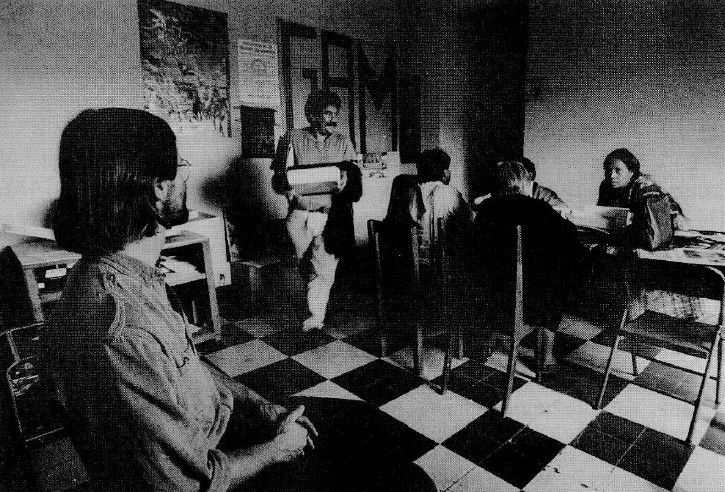
That article continues: “Two months later, on May 15, 1984, Aura Elena’s brother, Rubén Amilcar Farfán, was disappeared… A month later, on June 4, Aura Elena Farfán became one of the founders of the Mutual Support Group [GAM]…”
Photo: PBI-Guatemala began accompanying GAM office in April 1985.
Prensa Comunitaria has reported: “The Public Prosecutor’s Office directly accused Alix Leonel Barillas Soto of having participated in the capture of Rubén Amílcar Farfán, who was transferred to the former facilities of the Polytechnic School that were used as a detention and torture center.”
At the hearing that PBI-Guatemala accompanied on October 14, the Public Prosecutor Officer now recommends closing the case against Alix Leonel Barillas Soto.
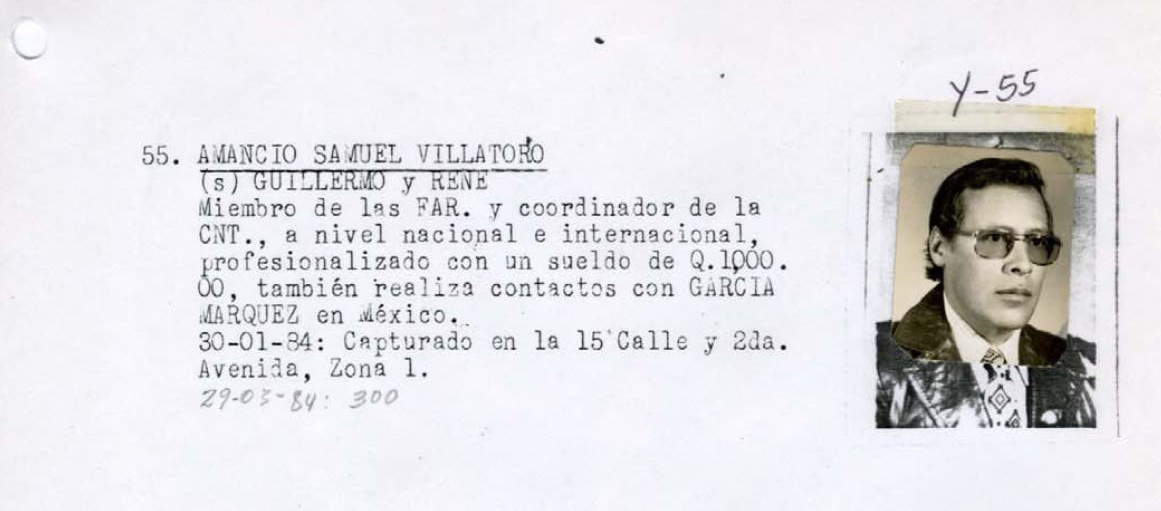
Union activists Álvaro René Sosa Ramos and Amancio Samuel Villatoro
No-Ficción has reported: “Álvaro René Sosa Ramos was Secretary of Organization of the Diana company union during 1979 and 1980, years of intense repression against the union movement. …Captured by the authors of the Military Diary on March 11, 1984, he escaped two days later. …In 2007 he told the Public Prosecutor’s Office that during his captivity he heard other kidnapped people.”
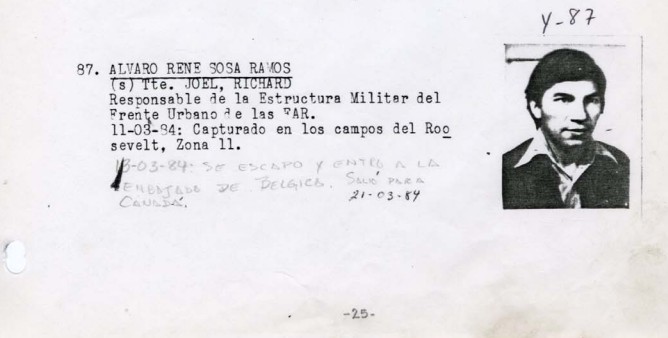
The article continues: “They showed him Amancio Samuel Villatoro, general secretary of the Adams factory union, kidnapped for a month and a half and whose body, located in the old San Juan Comalapa detachment, was identified in November 2011.”
Next hearing
The next hearing in the Military Diary Case is scheduled to be held on January 14, 2026.
We continue to follow this.

