

In an interview published in La Republica on December 19, Charle Gamba, the Chief Executive Officer of Calgary-based Canacol Energy Ltd., comments on fracking in Colombia.
Gamba says, “Colombia is a little behind on the issue of fracking, as there are communication problems between the industry, the Government and the communities.”
He adds, “We must wait for the fracking regulation to come out and after this it will take at least two more years to plan and make the pilots. So if the regulation comes out in 2020, the industry will need two more years to do the design, the import of the equipment and everything to do the pilots, then the first pilot would be in 2022.”
Canacol’s Piranga and Plata fracking projects
In December 2015, Reuters reported, “U.S.-based ConocoPhillips and CNE Oil and Gas, a subsidiary of Canada’s Canacol Energy, have both signed non-traditional exploration agreements with the national hydrocarbons agency [ANH]…”
In March 2019, Reuters noted that Colombian environmental licencing authority ANLA had shelved the proposed fracking projects in northern Cesar province because they failed to meet minimum environmental requirements.
That article explains, “The companies did not meet minimum conditions for the Piranga project, a source from the licensing authority said, while the Plata project raised possible water protection concerns.”
Notably, that article also highlights, “U.S.-based ConocoPhillips and Canada’s Canacol can request to re-open the licensing process for the projects in the future, the source said, adding the decision is not a definitive no.”
A new gas pipeline to Medellin
In La Republica, Gamba says the Canadian company will invest “US $114 million [next year] and three quarters of this money will go to the drilling of exploratory gas wells.”
The company will also spend on “the construction of the gas pipeline that will connect our fields with the interior of Medellín.”
The Canacol website notes that it has convention gas wells (in its Esperanza block) in production in the Lower Magdalena Basin.
Gamba further explains, “This is a three-year project, in which we will invest more than US $400 million from the budget, it will have a 300-kilometer pipeline and we hope that by the end of 2023 we can start transporting 100 million cubic feet of gas.”
Hidroituango
In the La Republica interview, Gamba also comments, “Gas consumption in Colombia rose 5% this year, especially in the generation of electricity, this due to the delay in the start of the Hidroituango operation.”
When completed, the Ituango hydroelectric dam on the Cauca River in northwest Colombia will be 225-metres (738 feet) tall.
Isabel Cristina Zuleta of the Rios Vivos movement in Colombia has stated, “Since its launch in 1997, this megaproject has been imposed by violence and the forced displacement of the population, victims of the armed conflict.”
The Caisse de dépôt et placement du Québec [the second largest pension plan in Canada] and Export Development Canada are financing this project.
Megaprojects and human rights
The UN Special Rapporteur on the human rights to safe drinking water and sanitation Léo Heller recently released his thematic report The Impact of Mega-Projects on The Human Rights to Water and Sanitation.
That report notes, “Human rights defenders advocating the rights of those affected by mega-projects have faced harassment, physical assault, bodily injuries, and even death.”
And the UN Special Rapporteur on the situation of human rights defenders Michel Forst has commented, “[The killing of human rights defenders is] an epidemic which is spreading as business tries to conquer new markets, as natural resources are found in areas that had been until then untouched.”
Forst highlighted, “Many positive measures have been taken [but] this is not enough to turn around the trend. States must go to the root of environmental conflicts, such as imbalance of power, making nature into a commodity, impunity and the current development model in order to ensure long-term solutions.”
As noted on the Canacol website, the company has “adopted and implemented the Global Compact on Human Rights and Voluntary Principles as outlined by the United Nations.” Groups such as Corporate Accountability International have been critical of the Global Compact, including calling it a “PR scheme”.
This past November, Peace Brigades International organized a tour in Canada with Julia Figueroa and Andrea Nocove from the legal collective CCALCP and Ivan Madero from the human rights group CREDHOS.
Both organizations are opposed to fracking in Colombia given concerns about human rights violations, climate breakdown, the impacts commonly associated with extractivist projects on local communities, and popular opinion rejecting fracking.
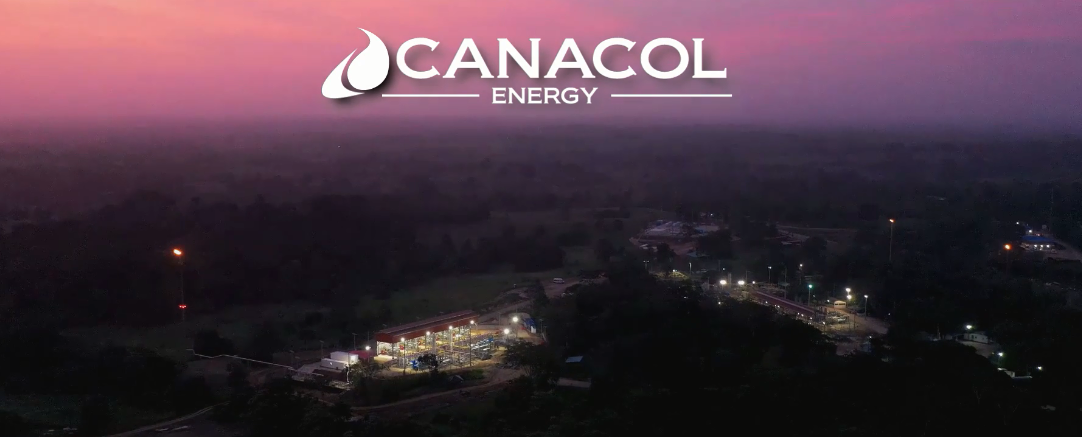
Photo from Canacol promotional video.
