
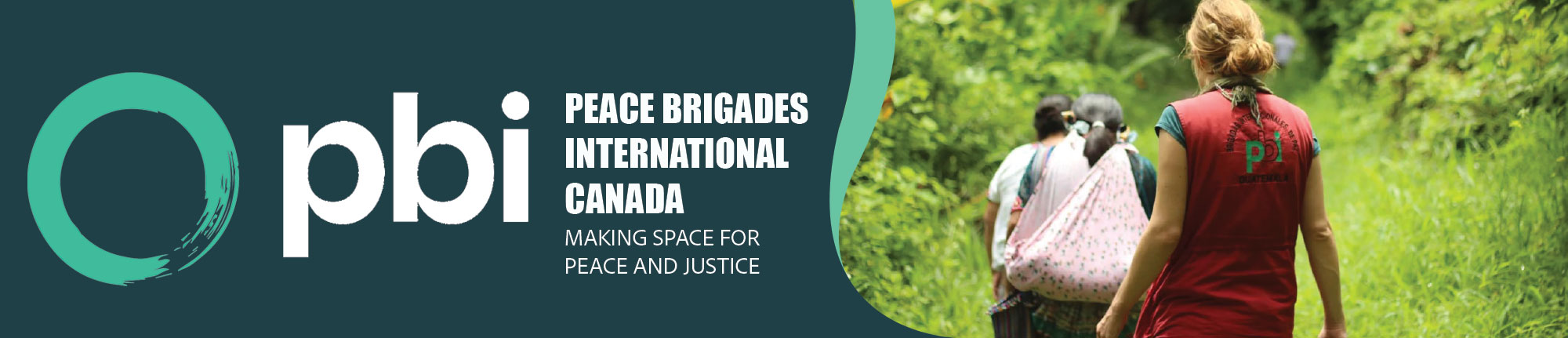


PBI-Guatemala accompanies CCDA Verapaz land and territory defenders at their sentencing

On October 30, the Peace Brigades International-Guatemala Project posted on Facebook that it had accompanied CCDA Verapaz land and territory defenders Marcelino Xol and Jorge Coc at court for their sentencing.
In response to their sentencing, the Campesino Committee of the Highlands CCDA Verapaz posted, “Urgent! Sentence of 35 years in prison to land and territory defenders. The crime is to defend life, defend the rights of mother earth.”
UDEFEGUA (the Protection Unit for Human Rights Defenders) adds, “We express our solidarity with the human rights defenders Marcelino Xol and Jorge Coc who were sentenced to 35 years in prison for crimes of homicide and attempted murder…”
“Both defenders were criminalized by the Chilté Cooperative, in the village Choctun Basilá, a company that is depriving them of their territory and has been involved in the murder of community leaders in the area.”
UDEFEGUA comments, “The co-optation of the justice system and the criminal policy of the State to demobilize and repress the defense of human rights in the country, mainly defenders of the territory, is evidenced once again.”
PBI-Guatemala has previously explained, “Jorge has declared that on the day of the events he was at his home in Las Pacayas taking care of his sick father. Marcelino says that on July 13, 2017 he was teaching in a community in Chisec, several hours from the scene of the crime. Despite their testimonies of innocence, the inconsistencies in the testimonies from the witnesses to the crime and the failure of the accusers to individualize the crimes both men were formally charged and imprisoned.”
After the sentencing, PBI-Guatemala posted, “This sentence will be appealed. This case is an example of the criminalization and decriminalization of agricultural conflict in the Verapaces. We express our solidarity with the defenders and their families.”
PBI-Guatemala began accompanying the Campesino Committee of the Highlands (CCDA), a campesino organization that accompanies and advises mostly Indigenous communities on land rights issues, in July 2018.
For more on this, please see PBI-Guatemala accompanies CCDA Verapaz leaders Marcelino Xol and Jorge Coc at hearing (October 17), PBI-Guatemala attends court hearing for two criminalized members of CCDA Verapaz (October 5), PBI-Guatemala accompanies Indigenous CCDA Verapaz land defenders at court hearings (August 23) and PBI-Guatemala accompanies Marcelino Xol Cucul and Jorge Coc from the CCDA at a court hearing (June 18).
PBI-Honduras accompanies CEHPRODEC at forum on the impact of mining in Yoro

On October 29, the Peace Brigades International-Honduras Project posted on its Facebook page that, “Last week, PBI-Honduras attended the ‘Local Forum on the Situation of the Municipalities of Victoria, Sulaco and Yorito in the Department of Yoro’, where Donald Hernández, the director of CEHPRODEC, spoke before 250 attendees about the impacts of mining in other municipalities of Honduras.”
PBI-Honduras has explained that CEHPRODEC (the Honduran Centre for the Promotion of Community Development) is focused on “the defence of human rights, in particular on economic, social, cultural and environmental rights.”
Canadian connection
Numerous concerns have been raised about the role that the Canadian government played in the mining law adopted in Honduras in January 2013.
Nobel Peace Prize winner Jody Williams has commented, “The Honduran government has bent over backwards to meet the needs of Canadian and other mining companies but has carried out almost no consultations with Honduran civil society and community organizations.”
She highlighted concerns about the law accelerating the licensing process for new mines, simplifying the rules for mining companies, reducing environmental standards, and privileging water use by mining companies.
The Justice and Corporate Accountability Project report The Canada Brand: Violence and Canadian Mining Companies in Latin America found that between 2000-2015 there was 1 death related to a Canadian mine in Honduras, 10 injuries, and 85 instances of “criminalization”, including arrests, detentions and charges.
PBI-Honduras accompaniment of CEHPRODEC this year
On October 23, PBI-Honduras was present at a CEHPRODEC town hall meeting in the municipality of Gualaco, Olancho when the community declared itself free of mining.
On October 17, PBI-Honduras accompanied CEHPRODEC on a march in Tegucigalpa with members of the National Coalition of Environmental Networks and Organizations of Honduras opposed to mining and making visible their work in defence of water.
On August 30, PBI-Honduras posted, “Yesterday we accompanied CEHPRODEC to an annual march in which hundreds of people from the communities protested against the extractivism that, they say, threaten the territories and natural resources.”
In early August, PBI-Honduras observed with CEHPRODEC a census in the community of Namasigüe in the department of Choluteca intended to support a more open consultation on future mining and solar project concessions in the area.
In March, PBI-Honduras accompanied alongside CEHPRODEC and C-Libre (the Committee for Freedom of Expression) the trial of 13 water defenders from Guapinol opposed to a mine on their territory that has polluted the river.
And in May, PBI-Honduras accompanied CEHPRODEC to San Estebán, a municipality 285 kilometres north-east of Tegucigalpa, for an “assembly on the care of the environment, natural resources and mining” that discussed the impacts of mining on human rights.
PBI-Honduras has accompanied CEHPRODEC since May 2014.
PBI-Guatemala observes first declaration court hearing on genocide against the Maya Ixil

On October 29, the Peace Brigades International-Guatemala Project posted, “On Monday we observed the hearing of the first statement of the Genocide Ixil case.”
PBI-Guatemala adds, “Manuel Benedicto Lucas García, Manuel Antonio Callejas y Callejas and César Octavio Noguera Argueta, all senior officers of the Army during the presidential term of Romeo Lucas García, are tried for crimes of genocide and forced disappearance.”
It also notes, “The hearing was postponed for today, so Lucas García can be defended by the lawyer of his choice.”
Plaza Publica has reported, “The defendants are three military elders, they are accused of having devised a campaign to exterminate the indigenous population during the presidency of Fernando Romeo Lucas García.”
That article adds, “The investigation prepared by the Human Rights Prosecutor’s Office together with AJR [the Association for Justice and Reconciliation], the complainant representing the victims, puts the focus on the three years and nine months that Fernando Romeo Lucas García ruled, from July 1978 to March 1982…”
“During that period, the researchers say, 31 massacres were committed, there were 1421 victims, 23 villages razed, 97 selective deaths, 117 forced displacement deaths, 26 cases of sexual violence and 53 forced disappearances.”
Last week, CMI-Guatemala commented, “The arrest of Noguera Argueta occurs in a context of setback in the fight against impunity and corruption, led by retired military, economic elites, and conservative politicians.”
That article adds, “Last month they managed to close the International Commission Against Impunity in Guatemala (CICIG) after 12 years of work dismantling structures of corruption and abuse of power.”
“In turn, they have promoted a proposal for an amnesty law that would end all investigation and prosecution of cases of serious human rights violations, and immediately release all those who have been convicted or are in prison awaiting trial in these cases.”
For further context, please see the International Justice Monitor article: Former Chief of Military Operations Arrested in Maya Ixil Genocide Case.
Human rights speaking tour in Canada follows local and regional elections in Colombia

Bucaramanga, Colombia
Three Colombian human rights defenders – Ivan Madero, Julia Figueroa and Andrea Nocove – will be visiting Canada just days after regional and local elections in Colombia.
Aljazeera reports that 32 governors, more than 1,000 mayors and thousands of regional and local legislative legislators were elected this past Sunday October 27 in the first regional and local level elections since the signing of the peace deal between the government and the Revolutionary Armed Forces of Colombia (FARC).
Ivan, Julia and Andrea can speak to the implications of these elections on human rights and the environmental agenda in Colombia.
Bogota
The BBC reports, “Claudia López, a gay politician [and a member of the Green Alliance Party] who advertises herself as ‘incorruptible’, has become the first woman to be elected mayor of Colombia’s capital, Bogotá.”
That article highlights, “The Mayor of Bogotá is widely considered the second-most important political post in Colombia after the presidency.”
Barrancabermeja
Alfonso Eljach, a businessman and lawyer, was elected the Mayor of Barrancabermeja.
Blu Radio reports, “On the issue of fracking, the elected mayor of the oil port said that ‘at the moment it is not clear if that practice affects the environment and aquifers, if so, I strongly oppose it.’”
Bucaramanga
W Radio reports, “With 37,982 votes, the Anti-Corruption League was leading the election of councillors in the capital of Santander. This list was created by Bucaramanga’s ex-president, Rodolfo Hernández.”
That article adds, “The Green Alliance party was the second most voted movement in Bucaramanga with 35,056 votes and 12.31 per cent of the vote.”
Election violence
The BBC also reports, “Seven candidates were killed, a dozen were attacked and more than 100 received threats across the country, according to the electoral observation mission. Despite the violence, the head of the national registry office said the polls were the most peaceful of recent local and regional elections.”
Speaking tour

Ivan Madero from the human rights group CREDHOS and Julia Figueroa and Andrea Nocove from the CCALCP legal collective will be in Ottawa (November 4), Vancouver (November 6) and Nanaimo (November 8) to speak on the current political situation in Colombia. Click on the links above for details on those public forums.
PBI-Guatemala accompanies Chinautla right to water group at Poqoman festival

On October 28, the Peace Brigades International-Guatemala Project posted, “Yesterday we accompanied the Chinautla Multisector Urban Platform in the celebration of the 2nd Festival for Life, Dignity and the Territory of the [Indigenous Maya] Poqoman people.”
PBI-Guatemala adds, “Particularly, in the absence of water in the municipality they reinvidicated [insist on the recognition of] the right to water.”
The Chinautla Multisector Urban Platform advocates for the human right to water to be respected and raises concerns about the nearby resource (sand) extraction that endangers homes and a massive garbage dump that pollutes water.
PBI-Guatemala has previously explained, “Since 1989, the Chinautla Multisector Urban Platform has defended its right to be consulted on the projects of several sand companies operating in its territory.”
They add, “The region has been a sand area for decades, but it was in 1995 when large-scale sand extraction began with heavy machinery” with major consequences.
In May 2018, the Guatemalan newspaper Prensa Libre reported that the extraction of sand from the channel of the Chinautla River and the confluence of the Tzaljá and Las Vacas tributaries, in an area where there are already geological faults, accelerates the cracking of walls and the sinking of some homes in the community.
Chinautla Multisector Urban Platform member Martín Catalán has stated that the group had called for the extraction of the sand to be moderated to stop the erosion of the soil, but that their proposals were not taken into account by local authorities.
Prensa Libre has also noted that the residents of Santa Cruz Chinautla are additionally impacted because during rainy season the floods from three rivers drag trash from (the dump in zone 3 in) Guatemala City into their community.
The human right to water
The Urban Platform has stated, “There is no will to administer and distribute to guarantee the human right to water” and that the cause of this is the “corruption of authorities”.
Their proposal is to “Create a water law and government and municipal agreements that guarantee community and indigenous peoples’ participation to guarantee equal rights to water” within a two year period.
This demand has a constitutional context.
In August 2017, Oxford Human Rights Hub explained, “Guatemala’s constitution has several provisions that provide for or implicate the right to clean and safe water. Despite this, Guatemala remains the only country in Central America, along with El Salvador, not to have proper legislation that protects the right to water access and that regulates its use.”
That article adds, “In April 2016 there was nationwide mobilization by rural and indigenous communities to demand a stop to the theft and contamination of water. This led to a proposal for a new law (5070) which seeks to give the greatest possible power to communities to manage their water resources and to enforce the right of communities to be consulted on any agribusiness or mining project in their area.”
Furthermore, the degradation of the Chinautla river basin has also been characterized as an “eco-ethnocide” against the Poqomam people.
The PBI-Guatemala Project has accompanied the Chinautla Multisector Urban Platform since December 2018.