Home Blog Page 363

PBI-Guatemala accompanies BDH law firm at hearing on the Hogar Seguro shelter fire

On January 11, the Peace Brigades International-Guatemala Project posted: “Today PBI accompanied the Human Rights Law Firm at the 4th Criminal Sentencing Court to the hearing of testimonial statement as an advance of evidence in the Safe Home case. The hearing is suspended due to non-appearance of all the parties.”

In February 2019, 12 people were detained on charges of abuse of minors, breach of duties, abuse of authority, accidental injuries, and manslaughter. Among those charged were the Secretary and Sub-Secretary for Social Welfare at the time of the fire, the director of the Hogar Seguro shelter, and the police officer in charge on the day of the fire. Eight of them have been ordered to face trial for these crimes.

PBI-Guatemala has regularly accompanied BDH at these hearings including on December 14, July 1, February 17, and January 7, 8 and 9 of last year.

Forty-one girls, who were 14 to 17 years of age, died as a result of a fire at the state-run Hogar Seguro Virgen de la Asuncion shelter south-east of Guatemala City on March 8, 2017. Fifteen girls were also seriously injured in the fire.

The Guardian has reported: “It has emerged that 56 girls had been locked inside a room measuring 6.8 metres by 7 metres as punishment for organizing a protest the day before against cramped conditions and abuse by staff. More than 700 children lived at the home, which had capacity for 400-500.”

That article adds: “The fire, which began in the early hours, [has prompted anger] over the government’s failure to protect young people in its care. Complaints about abuse at the centre had been made, but not followed up. A month before the fire, Guatemala’s human rights commission had asked for it to be closed.”

In March 2019, Al Jazeera reported: “Several government employees, including police, are now on trial for their role in the fire. The girls were locked in a room and shelter officials waited for nine minutes as the girls burned before they unlocked the door.”

“Some of the victims of the March 8, 2017 fire in the Hogar Seguro Virgen de la Asuncion shelter had run away from home, fleeing abuse and sexual assault by relatives. But many faced more of the same inside the shelter.”

That article adds: “For years, girls reported being raped and forced into prostitution inside the state-run facility, but their protests were ignored.”

PBI-Guatemala has previously explained on its website: “Édgar Pérez Archila and BDH provide pro-bono [free] legal representation to victim organizations in judicial proceedings for human rights violations committed during the internal armed conflict and other human rights violations past and present.”

PBI-Guatemala has accompanied Édgar Pérez Archila since August 2010 and then extended that accompaniment to the other lawyers at BDH in 2013.

PBI-Guatemala has also regularly attended commemorations for the girls who died in the fire, including this ceremony in September 2019.

PBI-Mexico accompanied ASMAC supports the fight for Indigenous land rights against mining concessions in Chihuahua

Isela González, director of ASMAC. Photo by Thom Pierce/ The Guardian.

The Peace Brigades International-Mexico Project has accompanied the Sierra Madre Alliance (Alianza Sierra Madre, A.C. or ASMAC) since 2018.

In turn, ASMAC accompanies Indigenous communities such as Coloradas de la Virgen in the Sierra Tarahumara region in the northwestern state of Chihuahua.

That is where Julián Carrillo Martínez was killed on October 24, 2018.

In a December 2020, Graciela Martinez of Amnesty International wrote: “Indigenous Rarámuri defender Julián Carrillo [was] murdered two years ago in the Sierra Tarahumara in northern Mexico after expressing his opposition to a mining concession in his community’s territory because of its social and environmental impacts.”

Kathy Price at Amnesty International Canada has further specified: “The assassination came just a week after Julian spoke out against the environmental impacts of a mining concession awarded by authorities to a Canadian mining company without the free, prior and informed consent of the Indigenous people whose lands would be impacted.”

Aristegui Noticias/Mexicans Against Corruptions and Impunity (MCCI) have also noted: “When he was killed, Julian was the president of communal property. Its function was to take care of everything that is of the community: trees, water and territory.”

“Julian was murdered shortly after he and his companions in defending the forests of Coloradas de la Virgen began to denounce the existence of these mining concessions for the exploration and exploitation of minerals in their community.”

That article adds: “If the areas where there is a mining concession are painted red on a map of the Sierra Tarahumara, much of the territory would be scarlet.”

The mines in Chihuahua include at least two Vancouver-based mining companies: Pan American Silver Corporation (and its Dolores mine) and Minefinders Corporation Ltd. (that some suspect displaced 60 families to open a silver and gold mine in Madera).

The Aristegui Noticias/MCCI article also notes the Calgary-based TransCanada (now renamed TC Energy) pipeline in the north of Tarahumara.

In December 2019, Martha Pskowski wrote: “Several indigenous activists, including Carrillo and Isidro Baldenegro López, a 2005 recipient of the prestigious Goldman Environmental Prize, were killed [in October 2018 and January 2017 respectively] after standing up to criminal organizations that traffic drugs and illegally harvest timber in the area.”

Pskowski comments: “Those acts of intimidation discouraged some Rarámuri people from speaking out when the energy company TransCanada began building a natural gas pipeline through the area.”

In the coming weeks PBI-Canada and PBI-Mexico plan to organize a webinar that will feature the director of ASMAC, Isela González, along with another defender opposing a Canadian mine in the state of Oaxaca. More details on that coming soon.

For more on González, please see The Guardian feature: ‘A hitman could come and kill me’: the fight for indigenous land rights in Mexico.

PBI-Mexico accompanied PODER notes Canadian energy companies in report opposed to Mayan Train megaproject

On January 11, Peace Brigades International-Mexico posted: “In this report, the newspaper El País returns to the #ElNegocioDelTrenMaya (Mayan Train Business) investigation into the indigenous fight against the Mayan Train by the NGO PODER.”

The non-governmental organization Project on Organizing, Development, Education and Research (PODER) is a member of the Focal Group on Business and Human Rights (Focal Group) that PBI-Mexico has accompanied since 2015.

El Pais reports: “The railway will travel 1,500 kilometers through the states of Chiapas, Tabasco, Campeche, Yucatan and Quintana Roo, but the project is much more than a passenger train. It is estimated that 70% of revenues result from freight transport, largely from fuels (to service the six pipelines in the southeast of the country) and products from the region’s thriving agribusiness, such as soybeans or pigs.”

In November 2020, PODER published The train of the elites that lists the companies and energy projects that would benefit from this megaproject.

As noted in El Pais, this report highlights (on page 34): “The main source of income for the Mayan Train will be the transportation of fuels, it seems clear that the Mayan Train will function as a platform infrastructure for the energy sector.”

It then notes: “If this is consolidated, the construction of the train will favor extractive energy projects in the region that have led to environmental and social conflicts and are largely owned by companies with Spanish, Canadian and US capital.”

The charts above from the report notes Vancouver-based Renaissance Oil Corp. and the Regina-based provincial Crown corporation Sask Energy Incorporated.

It is not clear if any other Canadian companies are involved in this megaproject, but EFE and Milenio have reported that several had expressed interest in it.

Those entities include: the Montreal-based train manufacturer Bombardier Inc.; the Quebec City-based pension fund La Caisse dé depot et placement du Québec; and the Toronto-based Canadian bank Scotiabank.

In July 2019, Scotiabank denied a media report that it had withdrawn from the project and stated: “[Scotiabank] carefully analyzes the opportunities in public and private projects that are presented exclusively according to business criteria. This process in the project in question continues its course.”

Many organizations have signed this open letter that states the consultation of Indigenous peoples on this megaproject did not meet international standards.

Among the groups that signed that letter are PBI-Mexico accompanied Frente de Pueblos en Defensa de la Tierra y Agua Morelos, Puebla y Tlaxcala; Casa del Migrante Saltillo; Centro Diocesano para los Derechos Humanos “Fray Juan de Larios”, A.C.; Proyecto de Derechos Económicos, Sociales y Culturales (ProDESC); Familia Pasta de Conchos; Centro de Derechos Humanos de la Montaña, Tlachinollan, A. C.; and Comité Cerezo.

The Mayan Train megaproject is expected to be completed by October 2022.

Secwepemc land defender Kanahus Manuel expresses solidarity with Mapuche traditional leader Alberto Curamil

On January 11, Kanahus Manuel tweeted: “This Mapuche freedom fighter Alberto Curamil spent time in my home and Secwepemc Territory with me and my family. This is major Indigenous Human Rights violation how he is being treated.”

Manuel’s tweet included this short video of Curamil being arrested on April 7, 2020.

Curamil is an indigenous Mapuche lonko (traditional leader) and a member of the Alianza Territorial Mapuche (Mapuche Territorial Alliance) that works for the right to water and food, land and environmental rights in southern Chile.

In this series of tweets, journalist Marianela González explains the context of his arrest last year. It appears that Curamil was supporting a protest to contain the spread of COVID-19 on an international route that joins Chile and Argentina.

González notes: “Curamil was going to the Las Raíces d Lonquimay Tunnel where Mapuche and non-Mapuche neighbors met (from Lonquimay to Curacautín) to close the passage and call the authorities to be present in the area [and] apply sanitary barriers.”

Curamil stated: “The communities decided to close the tunnel, in order to control the free access that tourists and international transport trucks have.”

He added: “[The police] distort the action of the Pewenche [Indigenous peoples in south central Chile and adjacent Argentina] who protect themselves against this pandemic and that is why they did not let me pass.”

Indigenous rights and the pandemic

In May 2020, the UN Special Rapporteur on the rights of Indigenous peoples, José Francisco Cali Tzay, stated: “Governments worldwide should support indigenous peoples to implement their own plans to protect their communities and participate in the elaboration of nationwide initiatives to ensure these do not discriminate against them.”

The Chair of the UN Permanent Forum on Indigenous Issues, Anne Nuorgam, has also noted that Indigenous peoples are “at disproportionate risk in public health emergencies” and that in response some are “sealing off their territories”.

Historical context, the struggle to defend Mapuche territory

Toward Freedom has noted: “In 1883, after defeat at the hands of the Chilean state during the ‘Pacification of the Araucanía’, Mapuche communities were forced onto reservations that made up only six percent of their original territory.”

The Mapuche people had about 10 million hectares of land before they were invaded, now they have as little as 400,000 hectares of land.

Front Line Defenders has noted: “Lonko Alberto Curamil has worked tirelessly to defend and protect the environment in Curacautin, in the Mapuche region of Araucanía, particularly from destructive logging activities.”

“Alberto’s leadership has led to the cancellation in 2016 of two hydroelectric projects that would have negatively impacted the sacred Cautín River.”

Their post also notes: “He is the winner of the Goldman Environmental Prize for South and Central America 2019.”

Front Line Defenders has also noted that Curamil was arrested in 2014 in reprisal to his opposition to the two hydroelectric dams.

He was arrested again in August 2018 possibly to remove him from the popular mobilizations against the second hydroelectric dam. He was held in pre-trial detention for more than a year and finally acquitted in a court ruling in December 2019.

Curamil and many other Indigenous peoples around the world face criminalization and repression for their defence of territory and Indigenous rights.

Photo: Kanahus Manuel, Miguel, Wolverine, Beverly Manuel, Alberto Curamil; Neskonlith Unceded Secwepemc Territory, 2015.

PBI-Mexico accompanied People’s Front and Otomi peoples protest PIM “death project” in defence of the Cuautla River

Photo by La Jornada.

On January 10, La Jornada reported that the People’s Front in Defence of the Land and Water of Morelos, Puebla and Tlaxcala (FPDTA-MPT) along with Indigenous Otomi peoples held a rally against the construction of a thermoelectric plant In Huexca.

Huexca is a small Indigenous community near the Cuautla River situated within the rural municipality of Yecapixtla in the central Mexican state of Morelos.

The rally was held outside the Federal Electricity Commission (CFE), the state-owned electric utility building the thermoelectric plant.

The plant is part of the Morelos Integral Project (PIM) that also consists of a 171-kilometre gas pipeline that would cross the states of Morelos, Puebla and Tlaxcala and a 12-kilometre aqueduct that would divert water from the Cuautla River.

The water from the river would reportedly be used to cool the turbines of the thermoelectric plant which could be operational by December 2021.

The 40-minute protest linked their shared opposition to megaprojects like the PIM and the Mayan Train (a tourist train now being constructed without consent through Indigenous territories), to demand the return of the 43 students from a politically radical, poor, mostly Indigenous teachers’ college who were disappeared in 2014, and to demand justice in the murder of Indigenous Nahuatl land defender Samir Flores Soberanes.

Flores, a member of the FPDTA-MPT and a vocal opponent of the PIM, was killed on February 20, 2019 in the town of Amilcingo in Morelos. The FPDTA-MPT described his murder as “a political crime for the human rights defence that Samir and the FPDTA carried out against the [project] and for people’s autonomy and self-determination.”

The La Jornada article quotes Teresa Castellanos, the coordinator of the Huexca Resistance Committee, who says: “[We oppose the PIM] because in Morelos there is not enough water for this megaproject, since the Cuautla River and its tributaries barely supply the 32 ejidos and 12 properties that make up the Association of Users of the Cuautla River that has been granted since 1926.”

Ejidos refer to communally held plots of farmland granted to poor often Indigenous farmers following the Mexican Revolution (that lasted roughly from 1910 to 1920).

Castellanos adds: “I hope that [Mexican] president (Andrés Manuel López Obrador) will reconsider and not continue to impose this death project that will end the water of Morelos and the peasant life of all.”

The FPDTA-MPT has also stated: “Lopez Obrador [supporting the PIM] betrays the peasant and the promise of change of his government, to favour transnational corporations [including] Canadian miners like Alamos Gold, among others.”

Last year, Toronto-based Alamos Gold reactivated work on their Esperanza open-pit gold mine near the community of Tetlama (about 60 kilometres due west of Huexca). Mines can be energy-intensive and could use electricity generated by the plant.

El Sol de Cuautla further reports: “In addition to the [protest held on January 9], opposition to the PIM plans a new mobilization for January 17; a caravan that will depart from Huexca and arrive in Tenextepango, in the municipality of Ayala.”

Map.

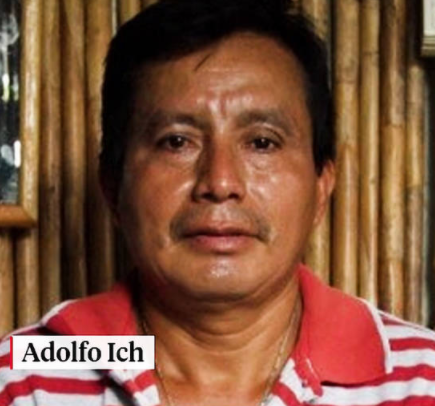
PBI-Guatemala posts update on Maya Q’eqchi’ land defender Adolfo Ich Chamán killed for his opposition to a Canadian mine in 2009

On January 8, the Peace Brigades International-Guatemala Project posted on their Facebook page a Toronto Star article that reports: “On Wednesday [January 6], the former head of security for a subsidiary of the Toronto-based mining company Hudbay Minerals officially pled guilty in a Guatemalan court to killing a local Indigenous community leader and paralyzing another Indigenous man [in September 2009].”

“Mynor Padilla, the former security chief of CGN, a Guatemalan nickel-mining company that was owned by Hudbay between 2008 and 2011, pled guilty to the crimes … as part of an agreement struck between Padilla and his victims, among them Angelica Choc, the widow of slain community leader Adolfo Ich, and German Chub, who was paralyzed.”

The Guardian has reported: “The nickel mine had previously operated [from 1960 to 1980] under other Canadian ownership [Toronto-based Inco Ltd.] during the country’s 1960–96 civil war… Corporate land and mining rights acquired under military rule sparked decades of conflict and opposition from local Indigenous communities.”

In 2004, Vancouver-based Skye Resources (later bought by Hudbay Minerals in August 2008) acquired the rights to the mine and sought to revive it in the predominantly Maya Q’eqchi’ region outside the town of El Estor in the department of Izabal.

Significantly, The Intercept has reported: “The Canadian embassy in Guatemala had lent Skye a helping hand.”

That article then quotes an email from a counselor from the Canadian embassy who wrote in December 2004: “After months of negotiation, during which the Embassy played a strong supportive role, the Guatemalan Ministry of Energy and Mines has issued a 3 year exploration licence to Skye Resources.”

Dawn Paley has reported: “In mid-September 2006, after years of living five or more families to a lot in the overcrowded town of Chichipate — located just west of El Estor — six groups comprising more than 400 families moved onto [those] lands…”

The Intercept adds: “They argued that they were reclaiming lands that [Toronto-based] INCO had stolen from them over 40 years ago [when the mine first began operating]. Over the next two months, these groups grew to nearly 1,000 families.”

That article further notes how Skye Resources/CGN then engaged in tactics to dispossess at least 19 Maya Q’eqchi’ communities from these lands.

It reports: “The campaign culminated in two waves of evictions targeting several Indigenous villages on January 8, 9, and 17, 2007. Eleven women from Lote Ocho were allegedly gang-raped by police officers, soldiers, and CGN’s security during the last eviction.”

Padilla shot and killed Ich in September 2009.

In 2017, CTV reported: “Padilla, a former ranking member of the Guatemalan military [a lieutenant colonel in the army], was arrested almost three years after Ich’s death even though a warrant for his arrest was issued soon after. He remained on the payroll of Hudbay’s Guatemalan subsidiary until he was taken into custody but it would take another three years to stand trial, which lasted a further two years.”

Padilla was acquitted by a Guatemalan court at that time.

Now, Padilla will be formally sentenced on January 13 but does not face jail time. His sentence of 20 months has already been commuted to fines.

Guatemalan human rights lawyer Ramon Cadena says: “[This] is a reflection of the impunity in Guatemala.”

There are currently two ongoing lawsuits in Ontario including one launched by Ich’s widow and Chub in 2010 that alleges Hudbay was negligent in how it managed the private security of its subsidiary CGN in relation to these incidents.

Hudbay sold the Fenix mine to the Solway Group in September 2011.

The mine re-opened in July 2014.

Human rights defenders in Guatemala continue to oppose the mine. The militarization of the area to quell dissent against the mine has also continued.

Q’eqchi’ fisher Eduardo Bin Poou has been criminalized for his opposition to the mine and its impact on Lake Izabal. The PBI-Guatemala accompanied Human Rights Law Firm (BDH) has represented him in court.

The Fenix mine is situated near the town of El Estor on the shores of Lake Izabal, Guatemala’s largest freshwater lake.

Where does the Canada stand on the Escazú Agreement for environmental defenders in Latin America?

Canada has free trade agreements with at least seven countries in Latin America (including Colombia, Honduras and Mexico) and billions of dollars of direct investment in the region (for instance, $22.5 billion in Mexico, $5.12 billion in Colombia, $96 million in Honduras and $18 million in Guatemala).

About 41 per cent of the large mining companies in Latin America are Canadian. 70 per cent of foreign-owned mining companies operating in Mexico are based in Canada. And Canada has also been one of the largest investors in the oil and gas sector in Colombia.

Despite or perhaps because of this, it does not appear that Canada has made a public statement on the Escazú Agreement.

On January 7, Genevieve Glatsky explained in Mongabay: “An unprecedented and innovative legal mechanism is making its way through Latin America in an effort to protect social leaders in the world’s deadliest region for environmental activists.”

She adds: “The Escazú Agreement guarantees access to environmental information, ensures public participation in the approval process for environmental projects, and requires states to take measures to protect environmental and human rights defenders.”

Peace Brigades International accompanies environmental defenders in Mexico, Colombia, Guatemala and Honduras.

Mexico has ratified the agreement (but not yet formally deposited their ratification), Colombia and Guatemala have not ratified the deal, and Honduras (with the highest per capita number of environmental defenders killed) has refused to sign it.

Glatsky adds: “In Colombia, massive protests against President Iván Duque prompted the conservative leader to sign the agreement in December 2019, becoming the last country to join Escazú. But both houses of Congress must now approve it, before it then faces a Constitutional Court review, a process that has been delayed by the pandemic.”

Mary Lawlor, the United Nations Special Rapporteur on the situation of human rights defenders, supports the agreement.

Lawlor says: “The agreement isn’t against development, it’s for sustainable community-led development that respects human rights, including the right to a healthy environment. It in no way undermines the sovereignty of nations in Latin America, it rather strengthens the protection of the rights of the people themselves.”

Peace Brigades International first endorsed the Escazú Agreement in September 2018 as “a means to guarantee a safe environment in which individuals, groups and organizations that promote and defend human rights related to the environment can act without facing threats, restrictions, attacks or danger.”

Given the level of Canadian involvement in mining and oil and gas operations with environmental implications in Latin America, PBI-Canada is calling on the Canadian government to publicly express its support for the legally binding Escazú Agreement.

To date we have not received a response to our inquiries and can find no public statement of Canadian government support for the agreement.

To read the full article by Genevieve Glatsky, please see: For Latin America’s environmental defenders, Escazú Agreement is a voice and a shield.

PBI-Canada begins to plan for the COP26 climate summit in Scotland this November

The United Nations Conference of Parties (COP26) climate summit will take place this coming November 1-12 in Glasgow, Scotland.

Despite criticisms of the COP process, COP26 is seen as the crucial follow-up to the COP21 summit that took place in Paris in December 2015.

Under the Paris Agreement reached at COP21, countries committed to a long-term goal of limiting the global temperature increase to below 2C above pre-industrial levels and to pursue efforts to limit it even further to 1.5C.

It also included a clause in which countries agreed to ratchet up their emission reduction targets five years later at COP26.

COP26 was originally going to take place last October, but because of the pandemic has been postponed until this November.

Because of that delay, a Climate Ambition Summit was convened by the UN, United Kingdom and France this past December in which countries were expected to announce their strengthened emission reduction targets.

Seventy-five leaders announced new commitments, including the European Union pledge to reduce GHG emissions by at least 55% from 1990 levels by 2030 and the United Kingdom promise of a reduction of at least 68% by 2030.

Canada said it would strive for the upper end of a range of a 17.7 to 27.4% reduction by 2030 (32-40% below 2005 levels by 2030).

Tim Gore, head of climate policy at Oxfam, commented: “The Climate Ambition Summit lacked real ambition. World leaders must step up in the next 12 critical months to pull the world back from the brink of catastrophic climate change. Commitments to near-term emissions cuts are still insufficient to limit warming to the 1.5C Paris goal.”

Beyond climate change impacting human rights on a global scale, more specifically human rights defenders remain at profound risk.

Global Witness has documented that on average four land and environmental defenders have been killed every week since COP21. More than one-third of those fatal attacks have been against Indigenous land defenders and water protectors.

The United Nations has recognized the dangers faced by defenders.

The UN Human Rights Council passed this resolution explicitly calling for the protection of environmental human rights defenders due to the crucial role they play in protecting vital ecosystems and addressing climate change. You can also read more about the resolution from the International Service for Human Rights.

And yet, this language (and language more broadly about human rights) has not been reflected in the climate agreements reached at the COP summits.

COP26 in November provides a pivotal moment for countries to commit to protection measures for land defenders as part of an overall climate agreement that recognizes the urgency of climate breakdown and its impact on all human rights.

PBI-Canada and other PBI entities are currently planning on how to strategically intervene at COP26. We will be posting more on this as the year unfolds.

2021 will see the 10th anniversary of the Guiding Principles and the 7th session on a Binding Treaty

Photo: Bertha Zúñiga Cáceres, the general coordinator of the PBI-Honduras accompanied Civic Council of Popular and Indigenous Organizations of Honduras (COPINH), is part of the campaign supporting the creation of a Binding Treaty.

Peace Brigades International has long supported a Binding Treaty on transnational corporations and human rights as an instrument that would offer more leverage and protection to human rights defenders, notably land and environmental rights defenders.

This past October 26-30, the United Nations open-ended intergovernmental working group (OEIGWG) held its 6th session on the second revised draft of the Binding Treaty.

In terms of key dates for the Binding Treaty process in 2021:

February – States have been asked to fill in two matrix templates that ask for: 1) concrete textual suggestions and expressions of support, and 2) general comments and requests for clarification.

March – The two template matrices noted above will be compiled and distributed by the Secretariat no later than the end of March.

July – The Chair-Rapporteur has been requested to prepare a third revised draft by the end of July to serve as the basis for the 7th session of the OEIGWG.

October – While it does not appear a specific date has been set yet, previous sessions of the OEIGWG have taken place in October.

The Binding Treaty faces obstacles.

On a PBI-United Kingdom webinar this past July, PBI-Colombia accompanied Yessika Hoyos from the Jose Alvear Restrepo Lawyers Collective (CCAJAR) commented: “Many companies together with the states have been blocking this issue.”

Those countries reportedly include Canada, the United States, the United Kingdom, Japan, Australia, Brazil, Russia and China.

PBI & the Binding Treaty

Speaking in March 2018, prior to the 4th session on the Binding Treaty, PBI-Switzerland stated: “PBI reiterates the importance of the participation of civil society and human rights defenders as crucial to the success of the process.”

In June 2018, PBI-UK launched a Human Rights Defenders Toolbox with PBI-Colombia accompanied CCAJAR “to address the fact that, despite the existence of [the UN’s Guiding Principles], gaps in their implementation mean that human rights defenders confronting corporate interests still face escalating violence.”

And in September 2018, PBI-Mexico commented: “After 7 years of the Guiding Principles being in force, PBI has not witnessed an improvement in the situation of risk for human rights defenders on the ground.”

They added: “PBI believes that a Binding Treaty could potentially lead to greater protection of human rights defenders working on business and human rights cases.”

The Guiding Principles on business and human rights were endorsed by the Human Rights Council through resolution 17/4 on June 16, 2011.

With the 10th anniversary of the Guiding Principles in June and the 7th session of negotiations on the Binding Treaty in October, PBI-Canada will continue to support a legally-binding Treaty that recognizes the important role played by human rights defenders.

PBI-Honduras shares Mario Benedetti poem ‘Don’t Give Up’ with hope for a better 2021

On January 4, the Peace Brigades International-Honduras Project posted that it “continues working to achieve a 2021 full of social justice and respect for human rights.”

Its new year’s greeting included an excerpt from a poem by the late Uruguayan journalist, novelist, and poet Mario Benedetti who wrote:

“Don’t give up that life is that,

continue the journey,

pursue your dreams,

unlocking time,

run the rubble and uncover the sky.”

The full poem can be read in Spanish here.

Benedetti lived in political exile from 1973 to 1985 in Argentina, Peru, Cuba and Spain.

Those were the years of the authoritarian military dictatorship that followed the US-backed coup in Uruguay. The period was marked by violations of human rights, torture, and the enforced disappearance of many Uruguayans.

Similarly, Peace Brigades International has followed with growing concern the serious deterioration of human rights in Honduras following the coup in June 2009.

PBI studied the situation of human rights defenders in Honduras in 2012 and then opened a protective accompaniment project there in 2013.

In 2019, 14 environmental defenders were killed in Honduras, making it the most dangerous country per capita for environmental activists.

2020 ended with the murder of two Indigenous land defenders in Honduras: Felix Vasquez on Saturday December 26 and Adan Medina on Sunday December 27.

We share PBI-Honduras’ desire to see a more hopeful 2021.

For more on the life and politics of Benedetti, there is this article from NACLA: A Lifetime Believing the Unbelievable.