Home Blog Page 357

CADSI announces “Canadian Defence Marketplace” as virtual alternative to CANSEC arms show

Protest against CANSEC in Ottawa on May 29, 2019.

On February 10, the Canadian Association of Defence and Security Industries (CADSI) tweeted: “Face-to-face meetings won’t resume for a while, but we’ve got the next best thing – no commute required! Introducing Canadian Defence Marketplace [via] virtual B2B/G meetings. May 6 & Nov 4.”

The previous day CADSI had tweeted: “#CANSEC will be back – just not as soon as we hoped. Mark your calendars for June 1-2, 2022. In the meantime, we have your B2B/B2G needs covered for 2021.”

The Canadian Defence Marketplace, which is “proudly created and hosted by CADSI”, “is a new and innovative global platform bringing industry and government leaders together for virtual business-to-business and business-to-government meetings.”

Its website highlights “virtual and unlimited 20-minute B2B & B2G meetings” and “secure and private networking through video conferencing”.

Global Affairs Canada and the Canadian Commercial Corporation are among the entities endorsing this virtual platform.

On March 23, 2020, UN Secretary-General António Guterres stated: “The fury of the virus illustrates the folly of war. Silence the guns; stop the artillery; end the airstrikes. It is time to put armed conflict on lockdown and focus together on the true fight of our lives.”

That same day, CADSI tweeted: “We are communicating with the Province of Ontario & the Gov’t of Canada regarding the critical role of the defence & security sector with respect to national security during this unprecedented time.”

It also tweeted: “[The Government of Quebec] has confirmed defence manufacturing & maintenance services are considered essential services, may remain in operation.”

As such, while Guterres was calling for a global ceasefire, CADSI was lobbying to ensure that military production would continue during the pandemic.

Last year, more than 7,700 people signed this World Beyond War petition that stated: “CANSEC is a public health threat and the weapons it markets endanger all people and the planet. CANSEC must be cancelled – and Canada should ban all future weapons shows.”

This year, we encourage you to register for the #NOWAR2021 VIRTUAL CONFERENCE: From Weapons Fairs to War Zones that will take place from June 4-6.

UN Special Rapporteur Mary Lawlor calls for action after the murder of Indigenous land defender Nacilio Macario in Nicaragua

On February 1, United Nations Special Rapporteur on the situation of human rights defenders Mary Lawlor condemned the murder of Indigenous environmental defender Nacilio Macario in Nicaragua and called on the government to investigate his death.

This UN Human Rights media release notes: “Mr. Macario, an indigenous Mayangna, was originally from the Autonomous Region of the Northern Caribbean Coast and campaigned against illegal gold mining and logging taking place in his community. He was allegedly killed by settlers on 14 November 2020 while taking water and food to members of communities protecting their land.”

Lawlor says: “The Government has a duty to ensure a safe and supportive environment for those who defend the environment and the rights of indigenous peoples in Nicaragua.”

“This time it was Mr. Macario who stood up for his land against the illegal exploitation of people associated with the extractive industry, but if those responsible are not duly investigated and brought to justice, these murders will continue to be carried out with impunity.”

Lawlor adds: “I would like to echo High Commissioner’s recommendation and request the Government of Nicaragua to guarantee the exercise of freedoms of peaceful assembly, expression and association; and publicly condemn and sanction any attack or intimidation against human rights defenders and community leaders, among others.”

Despacho 505 has reported: “Human rights agencies in Nicaragua recorded 49 indigenous killings in 2020.”

More than 100,000 people have left Nicaragua since 2018 in the context of a worsening human rights crisis in that country.

In March 2020, the Peace Brigades International-Nicaragua Project was established in Costa Rica to provide accompaniment, psychosocial support, networking facilitation and security workshops to Nicaraguan human rights defenders living in exile.

Cacerolazo against fracking pilot projects to take place in Puerto Wilches, Colombia on February 11

On February 9, Caracol Bucaramanga tweeted: “Environmentalists from Magdalena Medio are calling for a cacerolazo after Ecopetrol’s announcement of the beginning of socialization with the communities about the Kalé fracking pilot.”

A cacerolazo is a form of popular protest that involves people banging pots and pans to draw attention to a concern.

Caracol Radio has also reported: “This Thursday [February 11] the dialogues with the communities will be held in Puerto Wilches in the company of several ministers. This is the formal start of the pilot project.”

The first licence for a fracking pilot project was awarded by the National Hydrocarbons Agency (ANH) on November 25, 2020 to the Colombian state-owned oil company Ecopetrol for its Kalé project near Puerto Wilches, Santander.

The ANH has set a second-round deadline of March 8 for companies to submit proposals. Three more contracts are expected to be awarded on March 30.

One of those contracts could go to ExxonMobil in partnership with Toronto-based Sintana Energy Inc. (and its Colombian subsidiary Patriot Energy) that would likely involve the VMM-37 block also situated near Puerto Wilches.

Petroguia has reported: “[Fracking this block could involve] the cutting of 109 hectares of forest, the capture of an average of more than six daily pools of water in the Magdalena and Sogamoso rivers, and a polygon area comparable to 21,655 soccer fields, which will impact five townships.”

Late last year, 18 social and environmental defenders in the Middle Magdalena region were threatened by a paramilitary group called the Black Eagles. Six of those threatened are members of the Alliance for a Colombia Free of Fracking.

PBI-Canada continues to be concerned about the increased threats that will be faced by environmental human rights defenders as contracts are awarded and the fracking pilot projects begin to be implemented later this year.

In November 2019, PBI-Canada and PBI-Colombia collaborated on an advocacy tour in Canada featuring Julia Figueroa and Andrea Nocove from the Luis Carlos Perez Lawyers’ Collective (CCALCP) and Ivan Madero from the Regional Corporation for the Defence of Human Rights (CREDHOS) who highlighted their concerns about fracking in Colombia.


Sierra Club highlights threat faced by anti-fracking activist Carlos Andrés Santiago in Colombia

On February 8, the Sierra Club published this article about the rising levels of violence against environmental defenders, notably in Colombia.

Their article reported:

“Carlos Andrés Santiago is the director of ‘No Fracking’, an environmental group that organizes against fracking efforts in San Martín, Colombia. He describes a state that seems unwilling to address a worsening cycle of violence.

He first started receiving threats against his life and those of his family members five years ago. He even provided the names and phone numbers of those responsible to local police.

“All this time, and there have been no consequences,” he told Sierra. “I regularly called the prosecutor to check on the cases. This year they told me the cases had been closed and refused to provide further information.”

In 2019, while Santiago was visiting Bogotá for a conference on alternative energy, he was approached in his car on the highway by a man who pointed a pistol in his direction and yelled threats. Despite the fact that he reported the incident and the license plate of the man’s vehicle, the police have made no progress in identifying his assailant.

“The state now provides me with bodyguards,” he said. “But they don’t address the underlying issues. There are no consequences for those who commit these threats, or even most of those who commit violence. It is a common denominator across the region.”

He continues to report threats not because he hopes the Colombian government will take action, but so that he has official documentation that they are happening.”

The first licence for a fracking pilot project was awarded by the National Hydrocarbons Agency (ANH) on November 25, 2020 to the Colombian state-owned oil company Ecopetrol for its Kalé project near Puerto Wilches, Santander.

The ANH has set a second-round deadline of March 8 for companies to submit proposals. Three more contracts are expected to be awarded on March 30. One of those contracts could be in the proximity of San Martin, Cesar.

Late last year, 18 social and environmental defenders in the Middle Magdalena region were threatened by a paramilitary group called the Black Eagles. Six of those threatened are members of the Alliance for a Colombia Free of Fracking.

PBI-Canada continues to be concerned about the increased threats that will be faced by environmental human rights defenders as contracts are awarded and the fracking pilot projects begin to be implemented later this year.

For more, you can also read this CIVICUS interview with Carlos Andrés Santiago: Colombian activists: ‘We are paying with our lives to defend water’.


Article 6: A focal point for human rights concerns at the COP26 summit this November

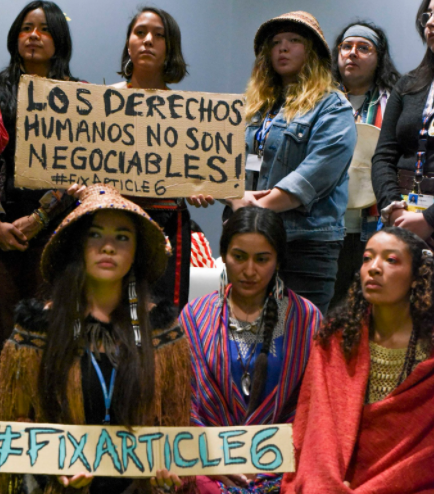
Protest at COP25 in Madrid. Ta’Kaiya Blaney of the Tla A’min Nation (in Canada) is holding the #FixArticle6 sign. Photo by Haylee Koroi.

The Paris Agreement reached at the United Nations COP21 climate summit in December 2015 includes this reference to human rights in preamble:

“Parties should, when taking action to address climate change, respect, promote and consider their respective obligations on human rights, the right to health, the rights of indigenous peoples, local communities, migrants, children, persons with disabilities and people in vulnerable situations and the right to development, as well as gender equality, empowerment of women and intergenerational equity.”

This is the only reference to human rights in the Paris Agreement (it doesn’t appear in its key operative provisions) and reportedly even then there was an effort to remove it.

Human rights concerns have also notably emerged in the negotiations related to Article 6, which contains three key subsections:

Article 6.2: This would allow countries to strike bilateral and voluntary agreements to trade carbon units (broadly referred to as internationally traded mitigation outcomes).

Article 6.4: This would create a centralized governance system for countries and the private sector to trade emission units in a system known as the Sustainable Development Mechanism (referred to as a carbon market).

Article 6.8: This would develop a framework for cooperation between countries to reduce emissions outside market mechanisms, such as development aid.

Significantly, the Sustainable Development Mechanism (SDM) in Article 6.4 is the successor to the Clean Development Mechanism (CDM) in the Kyoto Protocol.

The CDM has been linked to human rights violations because it allows countries to ‘reduce’ their carbon emissions by buying offsets from projects, notably major hydroelectric dams that displace communities and harm the environment.

For instance, despite human rights concerns the Santa Rita dam near the Q’eqchi Maya community of Monte Olivo in Alta Verapaz, Guatemala was registered in June 2014 under the CDM allowing it to earn carbon offset credits for the electricity it would generate that could then be traded on the European Union’s emissions trading system.

The Indigenous Environmental Network (IEN) has stated: “After decades of carbon trading failure, dispossession and human rights abuses, the continuation of market-based neoliberal policies for climate change must end now.”

The IEN has tweeted #NixArticle6.

It has also been argued to #FixArticle6 that it needs to include language on human rights, requirements to consult impacted communities, and grievance mechanisms.

But during the discussions at COP25 in 2019 in Madrid on Article 6.4, some parties opposed the inclusion of human rights references.

While initial language for 6.4 noted that countries should “respect, promote and consider their respective obligations on human rights” that was replaced with text noting the need for countries to address “negative social and environmental impacts.”

On this crucial point relating to Article 6, the Center for International and Environmental Law (CIEL) has cautioned: “When those rules do not adequately safeguard human rights and the environment, the damages can be significant.”

Article 6 is scheduled to be discussed again at COP26 in Glasgow this November.

At COP25, Mary Robinson, the former UN High Commissioner for human rights, stated: “Human rights and gender equity are at the heart of what we are talking about on the climate. If we don’t have these issues included, we are going to make enormous mistakes.”

In the lead up to COP26, PBI-Canada has also been amplifying the UN Human Rights Council resolution that affirms: “Human rights defenders, including environmental human rights defenders, must be ensured a safe and enabling environment to undertake their work free from hindrance and insecurity, in recognition of their important role in supporting States to fulfil their obligations under the Paris Agreement.”

Given four environmental defenders have been killed every week on average since the Paris Agreement was reached in December 2015, and more than one-third of those fatal attacks have been against Indigenous land defenders, we believe it is imperative that the role of defenders is recognized at COP26.


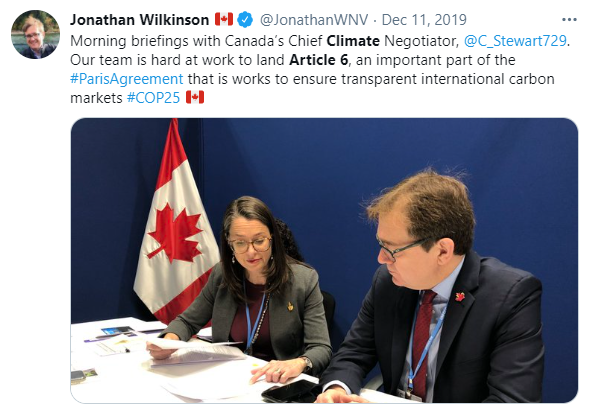
Tweet from Jonathan Wilkinson, Canada’s Minister of the Environment and Climate Change:

Opposition to Line 5 pipeline in Michigan grows over concerns for Great Lakes and treaty rights

Photo: A protest against the Line 5 pipeline on January 27, 2020 in Lansing, Michigan. Photo by Craig Mauger/The Detroit News.

The Enbridge Line 5 pipeline moves about 540,000 barrels per day of oil and natural gas liquids from Superior, Wisconsin to Sarnia, Ontario.

Crucially, the pipeline runs underwater for 7.2 kilometres at the Straits of Mackinac, which connect Lake Michigan and Lake Huron.

The Line 3 pipeline (which starts in Alberta) feeds Line 5 via a terminal in Superior, while Line 5 feeds the Line 9 pipeline that begins in Sarnia, Ontario.

Indigenous land defenders have been mobilizing in Minnesota to stop construction of the new Line 3 pipeline, while the Chippewas of the Thames have opposed the Line 9 pipeline on their traditional territory in Ontario.

Significantly for all concerned, a study by the University of Michigan Water Center several years ago found that if the Line 5 pipeline were to leak at the Straits it could affect 1,160 kilometres of Great Lakes shoreline and that an oil slick could travel as far as Manitoulin Island and the South Bruce Peninsula on Lake Huron.

In November 2020, Michigan Governor Gretchen Whitmer gave notice to Calgary-based Enbridge that it must shut down the Line 5 pipeline by May 2021.

Then last month, Michigan environmental regulators approved permits for Enbridge to build a tunnel to house the pipeline where it runs under the Straits of Mackinac. That tunnel still needs several more permits but is scheduled to be built by 2024.

The Michigan-based Oil & Water Don’t Mix campaign has warned: “Enbridge’s latest move is to claim Canada has authority over oil pipelines in Michigan. Canadian officials are trying to enlist President Biden’s help.”

Prime Minister Justin Trudeau has stated: “Line 5 is a vital source of fuel for homes and businesses on both sides of the border. That is something we have argued strongly and will continue to argue strongly with members of the U.S. administration.”

And the Traverse City Record Eagle has reported: “Tribal nations in Michigan point out that any oil spill along the length of Enbridge’s pipeline could threaten to harm their rights to hunt and fish in the area as well as the Great Lakes as a whole. Those same rights are guaranteed under the 1836 Treaty of Washington.”

Four Native American tribes in Michigan – Bay Mills Indian Community, Grand Traverse Band of Ottawa and Chippewa Indians, Little Traverse Bay Bands of Odawa Indians, and Nottawaseppi Huron Band of the Potawatomi – have opposed the pipeline.

Last summer, Bay Mills Indian Community Tribal Chairman Bryan Newland stated: “Enbridge’s Line 5 pipeline puts our treaty rights and our way of life at risk every single day. We are going to continue to fight to protect our rights, our waters, and our way of life.”

The Indigenous Environmental Network has also called on US President Joe Biden to “put an end to ALL fossil fuel infrastructure and projects, making the ones that are near or on indigenous territories of top priority.”

The construction of pipelines and fossil fuel infrastructure relate to numerous human rights including the right to a safe and healthy environment, the Indigenous right to free, prior and informed consent, and the right to water.


With Canada’s initial evaluation of fighter jet bids to be completed this spring, Saab adds space radar proposal to its bid

Saab Gripen E fighter jet.

The Government of Canada plans to spend $15 billion to $19 billion to purchase 88 new fighter jets for the Royal Canadian Air Force.

Three transnational corporations submitted bids for this contract on July 31, 2020: Lockheed Martin (F-35), Boeing (F/A-18) and Saab (Gripen E).

Public Services and Procurement Canada has stated: “The initial evaluation of proposals is anticipated to be completed by spring 2021, at which point Canada may choose to enter into dialogue with two or more compliant bidders and request revised proposals.”

That media release adds: “Canada will finalize terms with the preferred bidder prior to the contract award, which is anticipated in 2022.”

Skies has also reported: “Canada will select a winner by late 2021.”

Given this shortening timeline, the bidding appears to be intensifying.

On January 19, Wings reported: “At the AIx Space 2021 Conference, Saab outlined a proposed plan to establish a new facility in Canada as part of its offer for Canada’s Future Fighter Capability Project (FFCP).”

That article explains: “The facility would be known as the Saab Sensor Centre, located in Vancouver, British Columbia, with a focus on sensor technologies such as radar. …One of the proposed projects is to develop a Space Surveillance Radar (SSR) in Canada, in co-operation with other companies within the Canadian space industry. It is envisaged that this surface radar will target the global market for greater awareness of objects in the Earth’s orbit.”

What is space surveillance radar and does it have military applications?

Airforce Technology has reported that a “space surveillance radar” site on the Marshall Islands “[tracks] commercial and military satellites, depleted rocket boosters, as well as space debris primarily across the low earth orbit.”

Space News further explains: “Space domain awareness is the military term used to describe the ability to monitor and identify natural objects and satellites in orbit around the Earth and also in the lunar sphere”

At the virtual Halifax International Security Forum last November, U.S. General John Raymond, Chief of Space Operations, said technologies that contribute to space domain awareness are a pressing need for the U.S. Space Force.

And in their pitch for the research centre in Vancouver as part of their offer for the fighter jet contract , Saab Canada President Simon Carroll highlighted: “So much of modern life and military capability depends on space-based assets.”

The Saab webpage for its fighter jet bid can be read at: Gripen for Canada.

The Lockheed Martin pitch for its bid can be read at: F-35: The Right Choice for Canada. The Boeing pitch can be read at: The Complete Solution for Canada.

While the Government of Canada has priced the purchase of fighter jets at up to $19 billion, and the three corporations have highlighted the economic benefits, this No Fighter Jets campaign report has pegged the life cycle costs of the fighter jets at $76.7 billion.

The campaign argues that these public funds would be better spent on healthcare, education, housing, and clean water.

The Parliamentary Budget Officer is not expected to conduct an official evaluation of the actual cost of the fighter jets until the Government has chosen which fighter it intends to buy, which various reports suggest will be this year.

You can find the No Fighter Jets campaign on the web, Twitter and Facebook.


PBI-Canada notes one year anniversary of RCMP raid on Wet’suwet’en territory and the arrest of 22 land defenders

Photo of RCMP arresting Unist’ot’en and defender Freda Huson on February 10, 2020 by Amber Bracken/The Narwhal.

Today, February 6, is the first anniversary of the second RCMP raid on Wet’suwet’en territory to allow the Coastal GasLink fracked gas pipeline to proceed.

The police arrested 22 land defenders and allies from February 6-10, 2020.

The TC Energy-owned pipeline would cross 190 kilometres of Wet’suwet’en territory without the free, prior and informed consent of the Wet’suwet’en peoples.

The first police raid on Wet’suwet’en territory took place on January 7, 2019.

Following that first raid, the United Nations Committee on the Elimination of Racial Discrimination passed a resolution in December 2019 calling for the RCMP to be withdrawn from Wet’suwet’en territory, but within weeks the British Columbia government approved the funds for the second RCMP raid against the land defenders.

After that second raid, the UN Committee stated: “The Committee regrets that the State party has provided no information on measures taken to address the concerns raised by the Committee in its decision of 13 December 2019.”

Last summer, after the charges against the Wet’suwet’en land defenders and allies were dropped, the Wet’suwet’en stated: “Coastal Gaslink continues to trespass on our lands under the escort of the RCMP, who maintain an illegal remote police detachment on Wet’suwet’en territory. We are treated as criminals on our own land.”

They added: “We will continue to uphold Wet’suwet’en law. We have a responsibility to protect our water for future generations and to protect our territory from unlawful trespass and destruction. We will continue to protect what is ours.”

The total length of the Coastal GasLink pipeline is 670 kilometres. Yesterday, the CBC reported that “more than 140 kilometres” of the pipeline has been laid.

Radio-Canada adds: “The pipes were first buried near Kitimat and Dawson Creek at both ends of its 670-kilometre route, and clearing and drilling work is underway near Houston, where opponents were arrested last February.”

That article also notes: “An application for a judicial review of environmental permits granted to Coastal GasLink, submitted by the chiefs, was heard last fall by the Supreme Court of British Columbia, which is expected to issue a decision shortly.”

The UN Committee on the Elimination of Racial Discrimination has also called on Canada to provide updated information on the concerns expressed by the Committee in their two letters by November 15 of this year.

PBI-Canada is helping to promote an online film festival on March 20-21 that will include a discussion with Wet’suwet’en land defenders Freda Huson (Unist’ot’en) and Jen Wickham (Gidimt’en) and PBI-Honduras accompanied Civil Council of Grassroots and Indigenous Organizations in Honduras (COPINH) coordinator Bertha Zúniga Cácere

More on that film festival and panel here.

On January 12, 2019, just days after the first RCMP raid on Wet’suwet’en territory, Bertha and other members of COPINH posted this photo in solidarity with their struggle.

How could climate financing protect environmental human rights defenders on the frontlines of the climate crisis?

Four defenders have been killed on average every week since the Paris Agreement was reached in December 2015, including Berta Caceres in March 2016.

The Feminist Foreign Policy Working Group recently noted: “Human rights defenders advocating for environmental protection and in support of their rights to territory, land, and water – often in the face of intensive resource development projects – face increasing criminalization, threats, and violence around the world.”

The Working Group then recommends: “Climate financing initiatives must recognize the threats to these activists and must include direct support to them. [Funding should] enable these courageous activists to carry out their work in safety and dignity.”

Climate financing, primarily intended to support developing countries build resilience to climate impacts and align their development strategies to a net zero carbon future, was discussed at the United Nations COP15 climate summit in Copenhagen in 2009.

The COP16 Accord stated: “Developed country Parties commit, in the context of meaningful mitigation actions and transparency on implementation, to a goal of mobilizing jointly USD 100 billion per year by 2020 to address the needs of developing countries.”

The Climate Action Network has suggested that Canada’s fair share of the $100 billion amount is $4 billion a year. To date, Canada has announced over $1.7 billion worth of initiatives (not on an annual basis), but none of this funding appears to be directed to the protection of environmental human rights defenders.

The UN Human Rights Council has passed this resolution that stresses:

“Human rights defenders, including environmental human rights defenders, must be ensured a safe and enabling environment to undertake their work free from hindrance and insecurity, in recognition of their important role in supporting States to fulfil their obligations under the Paris Agreement.”

The need to support defenders is evident.

Global Witness has highlighted: “On average, four defenders have been killed every week since the creation of the Paris Climate agreement in December 2015. Countless more are silenced by violent attacks, arrests, death threats or lawsuits.”

How climate financing can support defenders in relation to States fulfilling their obligations under the Paris Agreement remains to be more fully articulated.

Two key dates this year will be the world leaders’ summit on the climate that will be convened by US President Joe Biden on April 22 and the COP26 climate summit in Glasgow, Scotland scheduled for November 1-12.

PBI-Canada is committed to tracking these issues and developing advocacy strategies in the lead-up to COP26 to support the environmental human rights defenders facing harassment, criminalization, judicialization and death for their crucial work.

Colombian regulator says three new contracts for fracking pilot projects to be awarded on March 30

Video: A 2-minute video in which a resident of Campo Duro (a community in Puerto Wilches, Santander) tells representatives from Colombian regulator ANH and Ecopetrol about the dangers of fracking.

UPDATE: The National Hydrocarbons Agency (ANH) has extended the deadline for companies to submit proposals for fracking pilot projects in Colombia. The new deadline is March 8 with contracts to be awarded on March 30.

BNAmericas reports that four companies have prequalified for the second round of licencing for fracking pilot projects in Colombia: ExxonMobil, Ecopetrol, Drummond and Tecpetrol.

That article notes: “ANH [the National Hydrocarbons Agency] has said it hopes to award an additional three contracts in the second round, which will include acreage in the Cesar Ranchería and Middle Magdalena Valley basins.”

The article also notes the timeline for this second round:

February 15 – deadline for interested companies to present proposals

March 1 – a preliminary order or eligibility is to be announced

March 5 – a definitive list of eligibility is to be announced

March 8 – the new contracts for the fracking pilot projects are to be announced.

The first licence for a fracking pilot project was awarded by the National Hydrocarbons Agency (ANH) on November 25, 2020 to the Colombian state-owned oil company Ecopetrol for its Kalé project near Puerto Wilches, Santander.

On January 27, the Colombian Minister of Mines and Energy, Diego Mesa, said that two more contracts for fracking pilot projects will be signed in the coming weeks.

The BNAmericas article suggests it will be three contracts.

One of those contracts could go to ExxonMobil in partnership with Toronto-based Sintana Energy Inc. (and its Colombian subsidiary Patriot Energy) that would likely involve the VMM-37 block in Puerto Wilches, Santander.

On January 29, United Nations Special Rapporteur on human rights and the environment David Boyd called on Colombia to prohibit fracking.

Boyd stated: “In light of its obligations under constitutional, international, human rights and environmental law, fossil fuels must be replaced by renewable energies. I respectfully maintain that the government of Colombia must pass a law to prohibit fracking.”

Environmentalists have also called for a global ban on fracking given it “torpedoes our global efforts to tackle climate change and violates basic human rights.”

It has been estimated that the commercial development of fracking could release 12 billion barrels of oil and 100 trillion cubic feet of natural gas.

PBI continues to follow this situation in Colombia.