
Home Blog Page 347

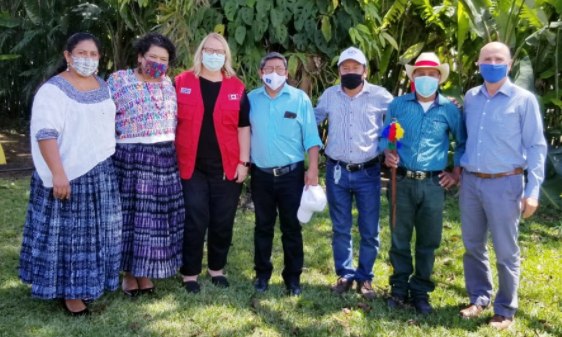
PBI-Guatemala accompanied Maya Q’eqchi’ defender Lesbia Artola meets with Canadian Ambassador

On March 12, the Canadian Ambassador to Guatemala met with Maya Q’eqchi’ defender and CCDA coordinator Lesbia Artola.

Ambassador Rita Rudaitis-Renaud tweeted: “The work of women human rights defenders such as Lesbia Artola, @CCDA_Guatemala with whom I had the pleasure of meeting today, is vital in the construction of a peaceful and inclusive society.”

The Canadian Embassy also tweeted: “We appreciate the work of human rights defenders like Lesbia Artola of the CCDA in #Coban, sometimes putting themselves or their loved ones at risk. This work is essential for building an inclusive and peaceful society.”

The CCDA challenges dispossession and megaprojects

PBI-Guatemala has explained: “The CCDA accompanies more than 150 Maya Q’eqchi’ communities who have been repressed and stripped of their land or are immersed in conflicts regarding land tenure. Due to their work many of their members have faced threats, criminalization processes, kidnappings, and murders.”

The Guardian has reported: “A peace agreement in 1996 should have led to land redistribution, but a handful of powerful families still dominates the economy, and Guatemala remains one of the world’s least equal and most violent countries, with the largest 2.5% of farms occupying more than 65% of the land.”

That article highlights that foreign-backed mining, dams and other extractive industries have meant the continued evictions of Indigenous peoples.

While campesinos are branded as land invaders, Artola says the invaders are the large land-owning families and corporations occupying Indigenous territories.

Attacks against CCDA members

In 2018, five CCDA members were killed in the Verapaz region. PBI-Guatemala has accompanied the organization since July 2018.

For the past four months, PBI-Guatemala has noted in their monthly information packages that Artola and CCDA colleague Imelda Teyul have faced ongoing security incidents.

Prior to that, PBI-Guatemala also noted: “Lesbia and Imelda have confirmed that there are three criminalization processes against them. The Indigenous Peoples Law Firm (BPI) is providing them with legal accompaniment. PBI is very concerned about the physical, psychological and emotional wellbeing of both human rights defenders.”

Voices at Risk, Escazu Agreement

The Voices at Risk guidelines for Canadian embassies notes: “Through engagement with affected Indigenous individuals and communities, where appropriate, missions should encourage prompt investigations into alleged acts of intimidation, threats, violence and other abuses against Indigenous HRDs.”

Earlier this month, Canada’s Ambassador to the UN Leslie E. Norton also stated: “Some states have established specific protection mechanisms to prevent risks and attacks against HRDs and to intervene when need be. Canada wants to stress these important milestones such as the Escazu Regional Agreement in Latin America and the Caribbean.”

While Guatemala has signed this Agreement, it has not ratified it.

PBI-Guatemala continues to closely monitor the security situation of the CCDA through regular telephone contact and in-person visits.

The role of a plantón (blockade) in PBI accompanied resistance struggles in Latin America

“We are all La Puya”

There are numerous examples of PBI accompanied human rights defenders having engaged in peaceful non-violent direct action, notably in a plantón (blockade).

This includes:

– The Peaceful Resistance of La Puya in Guatemala set up a blockade of the entrance of the Vancouver-based Radius Gold Inc. El Tambor gold mine. While the police evicted that blockade, a camp has been maintained there for the past eight years.

– The People’s Front in Defence of Land and Water in Mexico maintained a blockade for four years on both sides of the Cuautla River to stop water from the river being diverted by an aqueduct to cool the turbines of the PIM thermoelectric plant.

– The Guapinol defenders in Honduras established a blockade after a company began building an access road to a mine and water from the Guapinol River became muddied. The police expelled that camp and the criminalization of those defenders began.

– The Inter-Church Justice and Peace Commission in Colombia supported the blockade of the port of Buenaventura that stopped goods and cargo reaching the terminals. The Commission has linked the expansion of the port to human rights violations.

There are several other examples, including the blockade of the oil field owned by Toronto-based Frontera Energy in the community of San Luis de Palenque in Colombia that led to the jailing and ongoing judicialization of eight social leaders.

It would also include the encampment in 2009 against the Toronto-based Fortuna Silver mine in the Zapotec community of San Jose del Progreso in Mexico. Police used violence to end that blockade, but the resistance continues to this day. A recent highway blockade protested against the proposed expansion of the mine.

Plantón literally translates as a seedling but refers to an obstruction or blockade.

Canadian author Naomi Klein has commented: “Blockadia is a term that was first coined by activists fighting the Keystone XL pipeline in Texas. People tried to stop it with their bodies. And they called their camps Blockadia.”

Klein adds: “Blockadia is really this transnational space, roving space, where regular people [particularly Indigenous peoples] are stepping in where our leaders are failing, and they are trying to stop this era of extreme extraction.”

The human rights organization Global Witness recently highlighted governments should “safeguard the rights of defenders and protesters to free assembly and speech, as well as potential recourse to civil disobedience.”

To the contrary, governments – including in Canada – are proposing and passing legislation that imposes stiff fines and imprisonment against peaceful protest.

At least three of the eleven founders of PBI (including Charles Walker, Lee Stern and Gene Keyes) who were at the meeting in 1981 that established the organization had previously spent time in prison for participating in non-violent direct action.

That meeting included readings of passages by Martin Luther King, Jr. (who was arrested many times for “disturbing the peace”), Mohandas Gandhi, and Leo Tolstoy (who believed the state is intrinsically an institution of violence).

This may be why the PBI founding statement says: “We are building on a rich and extensive heritage of nonviolent action, which no longer can be ignored.”

As we mark our 40th anniversary this year, we reflect on that founding statement and the continuing role of the plantón in the struggle for social justice.

Peaceful Resistance member Yolanda Oquelí urges the riot police not to use violence against the La Puya plantón; May 2014.

Braided Warriors blockade rail line in solidarity with resistance to Line 3 in Minnesota

On March 12, Siiam Hamilton tweeted: “Indigenous youth collective @BraidedWarriors have shut down the railway tracks beside Renfrew Skytrain in Vancouver, BC to show solidarity with @GiniwCollective battle against Line 3 pipeline!”

Later that evening, Global News reported: “Two people were arrested Friday, as police and protesters clashed in East Vancouver after a group of demonstrators blockaded a rail line next to the Renfrew Skytrain Station.”

The Line 3 pipeline, approved by the Trudeau government in 2016, is now being built by Calgary-based Enbridge on Indigenous lands in Minnesota.

On March 2-3, the Braided Warriors also blockaded a major intersection for 24 hours to protest a 90-day jail sentence imposed on Indigenous Elder Stacy Gallagher for smudging within a pipeline construction site on unceded territories in violation of a court order.

Four people were arrested at that intersection blockade.

On February 7, the Braided Warriors were at the gate to the mansion of Dave Lede, CEO of the Ledcor Group of Companies. The Kiewit Ledcor Trans Mountain Partnership (KLTP) is constructing the Lower Mainland portion of the Trans Mountain pipeline expansion, including 35 kilometres of the pipeline from Langley to Burnaby, the Burnaby Terminal, Burnaby Mountain Tunnel, Westridge Marine Terminal and Sumas Terminal in Abbotsford.

The Braided Warriors have also been drawing attention to the corporations that are insuring the Trans Mountain pipeline being built on unceded territories.

They drummed in the lobbies of Liberty Mutual Group on February 17 and the Chubb Insurance Co. of Canada on February 18.

They were then violently attacked by Vancouver police while in ceremony in the lobby of the Vancouver branch of AIG Canada on February 19.

On March 1, the Braided Warriors returned a space near AIG Canada to film this testimonial of their experiences of police violence on February 19 that they will submit to the UN Committee on the Elimination of Racial Discrimination.

That UN Committee has previously called for construction of the Trans Mountain pipeline to stop until it secures free, prior and informed consent.

You can follow the Braided Warriors on Twitter, Facebook and Instagram.

Secwepemc land defender tweeted this video of the Vancouver police arrests of the two Braided Warriors. There is also this still from a Global News video. 

ASMAC and CEDEHM comment on “historic sentence” in the killing of Rarámuri land defender Julian Carrillo

The PBI-Mexico accompanied Sierra Madre Alliance (ASMAC) and the Centre for Women’s Human Rights (CEDEHM) have commented on the “historic sentence” for the killing of Indigenous human rights defender Julián Carrillo Martínez.

This statement notes that “the Mina Judicial District in Chihuahua issued the sentence for the murders of Julián Carrillo Martínez and his son Victor Carrillo Carrillo, which occurred in October 2018 and February 2016, respectively.”

“The sentence imposed 48 years in prison for one of the material perpetrators of the two killings.”

“During the trial, it was established that the human rights of the community were violated and that the State had failed to provide protection to defenders.”

It also recognized that the acts of violence perpetrated against the community defending their territory, people had been forcibly displaced from their homes.

“Therefore, authorities at different levels of government, will be asked to take efficient public security actions to eradicate the criminal group operating in the area and thus ensure the dignified and safe return of families to their place of origin.”

The judgment also contemplated reparation of “moral damage”, recognition of Julián Carrillo Martínez as a human rights defender, and “compensation measures were ordered in favour of those who prove that they had suffered economically.”

“This judgment is a unique reference in the country when considering the systematic context of violence suffered by the community in defence of its territory, recognizing the impacts of the community on the basis of the murder of one of its leaders.”

“Above all, it recognizes human rights violations and contemplates comprehensive redress measures by state authorities.”

The statement also notes that ASMAC and CEDEHM “recognize that this judgment sets a precedent at the national level and we hope to serve as a reference for other indigenous communities that face the same obstacles in their worthy struggle for respect for their ancestral territory.”

To read the full statement in Spanish, please click here.

ASMAC director Isela Gonzalez and community members Otón Portillo and Celestino Carrillo participated in a webinar on March 11 organized by Peace Brigades International and Amnesty International-Canada.

For more on that webinar, click here.

The day prior to the webinar, Gonzalez also spoke about the situation in Coloradas de la Virgen with seven Global Affairs Canada officials based in Ottawa.


Law professor Shin Imai files suit against Canada’s foreign minister over redacted documents on mine in Guatemala

Communities affected by the Marlin mine demonstrate at the Canadian embassy in Guatemala City. Photo by Projet Accompagnement Québec Guatemala.

Canadian Lawyer magazine reports: “Osgoode Hall professor Shin Imai has filed suit against the federal foreign affairs minister contending that Canada has improperly withheld information about its diplomatic interventions on behalf of Goldcorp, a Canadian company accused of human rights abuse at its mine in Guatemala.”

The Goldcorp Marlin mine operated in northwestern Guatemala from 2005 to 2017.

Imai alleges that the federal government redacted information that Canadians have a right to see in documents that detail communications among Canadian officials, Guatemala, Goldcorp, and the Inter-American Commission on Human Rights (IACHR).

The article adds: “The portions of the documents released suggest that Canadian officials quickly intervened on Goldcorp’s behalf, including through lobbying decision-makers in Guatemala and in the commission, the suit alleged.”

Imai says: “The Canadian government’s decision to go to court rather than disclose this additional information raises the question: what else did it do to support Goldcorp? The public should be able to scrutinize the government’s actions here, to assess the extent to which it undermined Indigenous communities’ efforts to defend their rights.”

Emily Dwyer of the Canadian Network on Corporate Accountability adds: “Canadian officials including ambassadors and cabinet ministers went to great lengths to present Goldcorp’s position to the Guatemalan government and the IACHR. We are concerned that Canadian officials may have tried to improperly influence decision makers.”

Three years ago, Imai also requested Canada’s public sector integrity commissioner to investigate events relating to the death of Mexican human rights defender Mariano Abarca Roblero who opposed Calgary-based Blackfire Exploration’s open-pit La Revancha barite mine in the southern Mexican state of Chiapas.

Abarca Roblero was killed on November 27, 2009.

Among Imai’s stated concerns: “The Canadian Embassy ignored warnings that Mr. Abarca’s life and safety were in danger, while actively advocating on the company’s behalf with the government of the State of Chiapas.”

MiningWatch Canada also highlighted: “Access-to-information requests showed that the embassy intervened with Mexican government officials to support the company even when it knew about conflict over Blackfire’s project in Chiapas, Mexico, including the risks that Mr. Abarca was facing.”

Peace Brigades International accompanies human rights defenders impacted by Canadian corporations in Colombia, Honduras, Guatemala, and Mexico.

PBI-Canada is following Professor Imai’s suit against the Canadian Minister of Foreign Affairs with great interest.

Professor Shin Imai.

PBI-Colombia accompanied CREDHOS activist on fracking, water, and threats against environmental defenders

Image: Héctor David Suárez speaking on a Human Rights Council side event on the water crisis in Colombia organized by Peace Brigades International and the International Human Rights Network (RIDH) on March 4.

This coming April 8, the National Hydrocarbons Agency (ANH) is expected to award a second round of contracts for fracking pilot projects in Colombia.

One of the corporations that has pre-qualified for a contract is the US transnational ExxonMobil most likely for its VMM-37 block near the community of Puerto Wilches, Santander in the Magdalena Medio region of Colombia.

Toronto-based Sintana Energy owns a 30 per cent stake in that block.

That operation reportedly could include the consumption of more than six pools of water each day from the Magdalena and Sogamoso rivers. One pool could amount to as much as 2.5 million litres (660,000 gallons) of water.

Corporacion Podion has noted: “This possible pilot project will extract more water than oil, discarding between 4,000 and 6,500 barrels.”

Puerto Wilches is situated on the riverbanks of the Magdalena River.

Geneva Solutions recently reported: “Despite being next to one of Colombia’s main arteries, the rural town of 30,000 inhabitants has no access to clean water.”

Héctor David Suárez of the Regional Corporation for the Defence of Human Rights (CREDHOS) and the Alliance for a Colombia Free of Fracking recently spoke with Michelle Langrand for this feature article in Geneva Solutions.

Suárez says: “Experiences in other countries have shown that the gas and chemicals used can leak and can pollute underground water bodies. Puerto Wilches depends on underground water for drinking.”

He further noted: “Magdalena Medio’s ecosystems are extremely fragile.”

Suárez also told Langrand that anti-fracking activists in Magdalena Medio have been subjected to threats and intimidation.

In November 2020, eighteen social leaders in Magdalena Medio were threatened with death through a pamphlet signed by the Black Eagles paramilitary. Six of those threatened are members of the Alliance for a Colombia Free of Fracking.

Earlier this month, Alfredo Molano Jimeno wrote in El Espectador about the threats faced by opponents of fracking in the Magdalena Medio including Yuli Velasquez, Luis Alberto González and 20-year-old Yuvelis Natalia Morales, a member of the Committee for the Defence of Water, Life and Territory of Puerto Wilches (AguaWil).

AguaWil is accompanied by CREDHOS.

Despite Canada explicitly recognizing the human right to water, the commitments it has made to environmental defenders in its Voices at Risk guidelines, and now its signalling of support for the Escazu Agreement, Canada’s senior trade commissioner in Colombia has uncritically highlighted the opportunities related to “the development of unconventional resources, like fracking and deep-water exploration.”

Following the visit by CREDHOS president Ivan Madero along with representatives from the CCALCP legal collective to Canada in November 2019, PBI-Canada has monitored the concerns they raised at meetings across this country about fracking.

In late April or early May, following the ANH awarding of the fracking pilot project contracts expected on April 8, PBI-Canada and allies will be holding a webinar that focuses on Canadian oil and gas interests in Colombia (including Sintana/Patriot in Puerto Wilches and Parex Resources in Simacota), the threats against environmental defenders in the Magdalena Medio, and Canada’s obligations and commitments in this situation.

Image: Podion.

European legislation on due diligence expected in June as civil society calls for enforcement mechanisms, a Binding Treaty

On March 12, Euractiv reported: “MEPs have urged the European Commission to table an ambitious due diligence law obliging EU companies to address all aspects of their value chains that could affect human rights, the environment and good governance.”

Another article in Euractiv further explains: “EU lawmakers backed a legislative initiative report by 504 votes to 79 on Wednesday (10 March), hoping that their proposals will feed into legislation that is due to be tabled by the European Commission.”

Civil society calls for stronger European legislation

In response, this civil society statement signed by Global Witness and Amnesty International calls for stronger legislation that would include:

“Enforcement mechanisms (through both public/administrative and private/civil enforcement mechanisms) in case of non-compliance with the due diligence obligations or for harm caused [to] provide an effective deterrent. In this regard, we expect the Commission to consider criminal liability or equivalent instruments.”

Caution from the Global Campaign for a Binding Treaty

And the Global Campaign for a Binding Treaty has cautioned that the European Parliament’s resolution “falls short of the needed binding norms for transnational corporations and human rights that we have been demanding for two decades.”

It further comments: “The proposal is too focused on due diligence, a concept linked to the self-regulation of corporations. ‘Mandatory’ due diligence is a legal sophistication of the UN Guiding Principles that have proved to be inefficient in holding transnational corporations accountable for the violation of human rights.”

The call for due diligence legislation in Canada

University College London law professor Barnali Choudhury has argued that Canada should adopt due diligence legislation. She has noted that this would be a better approach than the “ombudsperson for responsible enterprise, which given its relative lack of powers, has been branded by critics as toothless.”

The Canadian Network on Corporate Accountability adds that due diligence legislation must include “meaningful consequences for non-compliance, including liability for harm and effective enforcement mechanisms.”

Due diligence and Indigenous rights

Secwepemc land defender Kanahus Manuel on the frontlines of the resistance to a pipeline on her territory has tweeted: “[Due diligence] could be a very interesting tool to fight against projects threatening Indigenous Peoples’ territories.”

There is also the caution that without stringency the language of due diligence can be misused to undermine Indigenous rights.

For example, the Canadian government’s export credit agency, Export Development Canada, signed an agreement last year to lend up to $500 million to TC Energy to build the Coastal GasLink fracked gas pipeline on unceded Wet’suwet’en territory (in the province of British Columbia) without free, prior and informed consent.

Le Devoir reported: “EDC says it carried out ‘rigorous due diligence’ before granting the loan.”

EDC’s funding decision summary says: “[EDC recognizes that] the project continues to be opposed by a group of hereditary chiefs from the Wet’suwet’en First Nation, who claim to be the legitimate decision-makers of this nation, not to have been duly consulted and not to have consented to the project. [However, EDC believes TC Energy] has demonstrated a great ability to manage environmental and social risks.”

Furthermore, BMO Global Asset Management has signed this statement in support of governments enforcing mandatory human rights due diligence requirements. BMO is also financing the TC Energy Coastal GasLink pipeline.

Next steps

The full resolution passed by the European Parliament can be read here.

The European Commission is expected to table a law in June based on this resolution passed by Members of the European Parliament.

The next round of talks on the Binding Treaty on transnational corporations and human rights is expected to take place in October.

The Global Campaign notes: “The UN and the European processes are neither in opposition nor in contradiction, on the contrary, they should complement each other and evolve together to ensure high levels of prevention, administrative, civil and criminal liability of the corporations, as well as the remedy for affected communities as soon as possible and at all levels.”

PBI-Canada will follow both processes.

PBI accompanied defenders speak about the impacts of Canadian mining in Mexico

More than 120 people took part in a webinar today on the impacts of Canadian mining companies on Indigenous rights in Mexico. Nearly 70 percent of foreign-owned mining companies operating in Mexico are based in Canada.

To watch the video of the webinar, click here.

The webinar featured Isela Gonzalez from the Sierra Madre Alliance (ASMAC) in Chihuahua and Neftali Reyes from Services for an Alternative Education (Educa) in Oaxaca. Both organizations are accompanied by PBI-Mexico.

It also featured Otón Portillo and Celestino Carrillo from the community of Coloradas de La Virgen in Chihuahua as well as Pedro Máximo Aquino, Efrén Jacinto Sánchez, and Rubén Flores speaking from Magdalena Ocotlán in Oaxaca.

The webinar was jointly organized by Peace Brigades International and Amnesty International and was moderated by Ailish Morgan-Welden (a PBI-Canada Board member and the national action coordinator with AI-Canada). Amnesty campaigner Tara Scurr also spoke on the webinar as did PBI-Mexico advocacy coordinator Lena Weber.

The two situations highlighted in the webinar were:

Coloradas de La Virgen

ASMAC accompanies the Indigenous community of Coloradas de la Virgen in the Sierra Tarahumara region in the northwestern state of Chihuahua.

Indigenous Rarámuri defender Julián Carrillo spoke against the environmental impacts of a concession near his community granted to a Canadian mining company without free, prior and informed consent just a week before he was murdered in October 2018.

This civil society statement highlights that the concession was given to Vancouver-based Evrim Resources Corp (now named Orogen Royalties). And Proceso recently reported on concessions in the area granted to individuals that involved Canadian capital.

Celestino, who spoke on the webinar, is Julian’s son. And Isela joined the webinar after having attended a sentencing hearing of one of the perpetrators who was convicted just last week in the killing of Julian more than two years ago.

Magdalena Ocotlán

Neftali highlighted that twelve communities, including Magdalena Ocotlán and San Jose del Progreso, have rejected the San Jose mine in the southern state of Oaxaca.

That mine is owned by Vancouver-based Fortuna Silver Inc.

This mine was first developed in 2009 without free, prior and informed consent. In March of that year, residents set up an encampment at the entrance to the mine. By May, 1,000 state and federal police evicted the camp using helicopters, tear gas and dogs.

There have been four deaths in direct relation to opposition to this mine, including Bernardo Vásquez who was killed on March 15, 2012.

Now, Fortuna Silver is seeking a massive expansion of that mine. It has submitted an environmental impact assessment (MIA) for approval by the Ministry of the Environment and Natural Resources (SEMARNAT).

Neftali noted on the webinar that a decision from SEMARNAT on the San Jose II mine is expected by the end of March.

Next steps

Isela highlighted the importance of continued solidarity, visibilizing and not turning our backs on the situations in Magdalena Ocotlán and Coloradas de la Virgen. She also highlighted the need to advocate with governments to stop the killing of human rights defenders (19 human rights defenders were killed in Mexico in 2020).

And Neftali noted that on July 22 there will be a day of action against toxic mega-mining as well as a day of resistance on July 23. More on these dates soon.

There will also be further discussions among the speakers in the coming week about follow-up actions and next steps.

To watch the video of the webinar, click here.

Julian Carrillo, Bernardo Vasquez

PBI-Mexico accompanied ASMAC and Educa Oaxaca meet with Global Affairs Canada officials

On March 10, PBI-Canada organized a virtual meeting for Isela Gonzalez of the Sierra Madre Alliance (ASMAC) in Chihuahua, Neftali Reyes of Services for an Alternative Education (Educa) in Oaxaca, and Rubén Flores from the community of Magdalena Ocotlán.

The defenders spoke about Canadian mining concessions in these communities:

Coloradas de La Virgen

ASMAC accompanies the Indigenous community of Coloradas de la Virgen in the Sierra Tarahumara region in the northwestern state of Chihuahua.

Indigenous Rarámuri defender Julián Carrillo spoke against the environmental impacts of a concession near his community granted to a Canadian mining company without free, prior and informed consent just a week before he was murdered in October 2018.

This civil society statement highlights that the concession was given to Vancouver-based Evrim Resources Corp (now named Orogen Royalties). And Proceso recently reported on concessions in the area granted to individuals that involved Canadian capital.

Magdalena Ocotlán

Educa Oaxaca accompanies Indigenous communities, including Magdalena Ocotlán and San Jose del Progreso, that have rejected the San Jose mine in the southern state of Oaxaca.

That mine is owned by Vancouver-based Fortuna Silver Inc.

This mine was first developed in 2009 without free, prior and informed consent. In March of that year, residents set up an encampment at the entrance to the mine. By May, 1,000 state and federal police evicted the camp using helicopters, tear gas and dogs.

There have been four deaths in direct relation to opposition to this mine, including Bernardo Vásquez who was killed on March 15, 2012.

Fortuna Silver is now seeking a massive expansion of that mine. It has submitted an environmental impact assessment (MIA) for approval by the Ministry of the Environment and Natural Resources (SEMARNAT). That decision is expected at the end of March.

PBI accompaniment

PBI continues to monitor these situations closely, particularly in relation to the security of defenders participating in the court hearings of those convicted in the killing of Julian Carrillo as well as the ongoing mobilizations against the expansion of the San Jose mine.

PBI-Mexico has accompanied ASMAC since 2018 and Educa Oaxaca since 2013.

Canada appears to back the Escazu Agreement for environmental defenders, but key countries have not ratified the deal

On March 5, Special Rapporteur Mary Lawlor presented to the UN Human Rights Council on the threats against and killings of human rights defenders.

During that session, Canada’s Ambassador to the UN Leslie E. Norton stated: “Some states have established specific protection mechanisms to prevent risks and attacks against HRDs and to intervene when need be. Canada wants to stress these important milestones such as the Escazu Regional Agreement in Latin America and the Caribbean.”

This may have been the first public expression by Canada of support for this agreement.

It follows hundreds of people sending an email to the Prime Minister via this PBI-Canada urgent action calling on Canada to support the agreement.

Significantly, the Escazú Agreement is the first legally binding treaty to include specific provisions to protect environmental defenders.

Article 9 includes the obligation for States to: “guarantee a safe and enabling environment for persons, groups and organizations that promote and defend human rights in environmental matters, so that they are able to act free from threat, restriction and insecurity.”

Article 9 also mandates States to: “prevent, investigate and punish attacks, threats or intimidations that human rights defenders in environmental matters may suffer while exercising the rights set out in the present Agreement.”

Now that 12 countries have formally ratified the Escazú Agreement it will enter into force on Earth Day, April 22, 2021.

And while Mexico deposited their ratification of Escazu with the UN on January 22 of this year, neither Guatemala nor Colombia have ratified agreement.

Honduras has not signed it.

Last month, Front Line Defenders released this report that documented that at least 331 HRDs were killed for carrying out their peaceful human rights work in 2020 and that 69 per cent of those killed worked on land, environmental or indigenous peoples’ rights, while 26 per cent were working specifically on Indigenous peoples’ rights.

The most recent Global Witness report also found that 64 land and environmental defenders were killed in Colombia, 14 in Honduras and 12 in Guatemala in 2019.

That report further highlighted: “In Honduras killings rose from four in 2018 to 14 last year, making it the most dangerous country per capita for land and environmental defenders in 2019. It is the country with the greatest percentage increase in lethal attacks against activists.”

PBI-Canada continues to call on Canada to utilize its diplomatic channels to call on Honduras, Colombia and Guatemala to ratify the Escazu Agreement. And as attention turns to whether or not the agreement is effectively implemented, we further call on Canada to advocate for its full implementation in Mexico.