“From the PBI Honduras Project we are looking for new volunteers to join our team on the ground. To apply, it is essential to have a nationality other than Honduran and to have a high level of Spanish spoken, written and read.
You can consult requirements, benefits and application process in the following pdf document and send the documentation to formacion@pbi-honduras.org until October 30, 2026, inclusive.”
With this slogan, family, friends and fellow students honour the memory of Alan Valencia, the 17-year-old murdered in the Los Pinos neighbourhood of Buenaventura on 11 September 2025.
A year on from this tragic event, the question remains: why? And although there may be no answer, our quest is for memory in resistance. We will not bow to oblivion, let alone to an oblivion devoid of justice and truth.
We remain standing in a place where joy, a love of life and dignity prevail, every single day, over violence and death.”
Accompaniment
Peace Brigades International has accompanied the Association for Research and Social Action (NOMADESC) since 2011 and its president Berenice Celeita since 1999.
As noted in this media release: “The report identifies patterns of violent repression against peaceful protests led by Indigenous movements, including criminalization, stigmatization, and the persecutory use of administrative, financial, and legal measures against human rights defenders and civil society organizations.”
That report further highlights that Ecuadorian president Daniel Noboa has prioritized economic, trade, military and security agreements (with countries including Canada), and that questions have been raised about transparency and participation in the negotiation of trade agreements with Canada, the United States, the United Arab Emirates and China. It also notes “outright apathy” on the part of the government of Ecuador to international scrutiny of human rights violations within Ecuador.
Security assistance
The report was released the day after France 24 reported that US Secretary of State Marco Rubio stated that he would seek $45 million in additional security funding for Ecuador and provide military equipment.
Only a few weeks prior to this, Canadian Defence Minister David McGuinty commented that there’s “really little daylight” between Canada and the United States on military and intelligence affairs.
Professor Patricia L. Sullivan at the Department of Public Policy, Curriculum in Peace, War, and Defense, University of North Carolina, has noted: “Between 2002 and 2019, US$300 billion in US security assistance flowed to foreign governments and at least one million foreign nationals received US military training.”
Professor Sullivan adds in her Sage Journals article: “Does American military aid increase the risk of civilian harm? …Until very recently, there have been few systematic attempts to evaluate the effects of security sector assistance. …The results of this study suggest [there] is strong evidence that ‘lethal’ aid—military equipment, weapons, military training, and combat assistance—increases extrajudicial killings by security forces in states without effective institutions to constrain executive authority.”
Canadian military exports
In March 2026, Project Ploughshares reported that the value of contracts concluded between the Canadian Commercial Corporation and the U.S. Department of War in fiscal year 2025 totaled $2.07 billion.
That means Canadian components could be in the military equipment that Rubio is seeking to send to Ecuador.
And while the direct export of “military goods” from Canada to Ecuador appear to be minimal (according to government figures, $60,675.74 in 2025), the Trade Commissioner Service of Canada has highlighted that “Ecuador is an attractive market for industries such as… Defence and security…” The Canadian government has also stated its intention through the Defence Industrial Strategy to increase “defence exports by 50 per cent” and expand “into new markets”.
Ecuador is also present at CANSEC, described by the Canadian Association of Defence and Security Industries as “Canada’s largest defence, security & emerging tech tradeshow where $1B+ in business deals happen every year.”
On July 24, 2026, Canada and Ecuador signed the Canada-Ecuador Free Trade Agreement (FTA) in part to “create new opportunities for Canadian businesses”. The intention of Canada is to bring “the agreement into force as soon as possible”.
Canadian civil society groups have denounced the free trade agreement, commenting: “Its main purpose is to attract and protect Canadian investment in Ecuador’s mining sector. The agreement is massively opposed by a large share of Ecuadorian civil society and Indigenous groups.”
The civil society statement of concern further notes: “Ecuadorian and international human rights organizations have documented widespread, systematic human rights violations, including increasing militarization, repression of dissent, the criminalization of environmental defenders, and the imposition of executive decrees that undermine the rule of law. Much of this is exacerbated by – or in support of – existing Canadian mining investment in the country.”
The Peace Brigades International-Guatemala Project has posted on social media:
“Yesterday [September 9], #PBI joined Famdegua Guatemala [the Association of Relatives of the Detained and Disappeared of Guatemala] and the @Human Rights Law Firm at an interim hearing in the #DiarioMilitar case against Toribio Acevedo, Malfred Orlando Pérez, Edgar Virgilio de León and Alix Barillas (the latter did not appear at the hearing, so the judge gave him 24 hours to appear or he would be declared in contempt of court), who are charged with the offences of unlawful detention, torture, enforced disappearance, murder and sexual violence against approximately 195 people during the de facto government of General Óscar Humberto Mejía Víctores.
At the start of the hearing, the lawyer representing several complainants requested that the hearing be suspended because there is a court order requiring the Public Prosecutor’s Office to appoint a new prosecutor to the case; this is because the human rights prosecutor’s office, which had previously been handling the proceedings in the hearings towards the end of last year, had requested that the charges against these defendants be dismissed. This action led to mistrust amongst the complainants, which is why, in October 2025, through their lawyers, they requested that the human rights prosecution unit be removed from the case, on the grounds that it could not act with the necessary impartiality in the proceedings.
Despite strong opposition from Toribio Acevedo’s defence team, High-Risk Court D, presided over by Judge Abelina Cruz, accepted the request, adjourned the hearing and asked the Public Prosecutor’s Office to appoint a new prosecutor to appear at the next hearing on 21 September at 9.00 am.”
Additional reading on the court hearing this week:
“The Diario Militar case, also known as the ‘Dossier de la Muerte’ (Death Dossier), originates from a Guatemalan Army intelligence document that chronologically details how state security forces allegedly committed a series of crimes during the internal armed conflict.
These include kidnappings, transfers to clandestine detention centers, torture, sexual violence, and murders.
According to the Human Rights Prosecutor’s Office, the archive, made public in 1999, collects records of murders and forced disappearances of at least 183 people between 1983 and 1985.
On May 27, 2021, the prosecutor’s office reported on the capture of 11 military personnel accused of the illegal detention, torture, forced disappearance, murder, and sexual violence of approximately 195 people during the de facto government of General Óscar Humberto Mejía Víctores.”
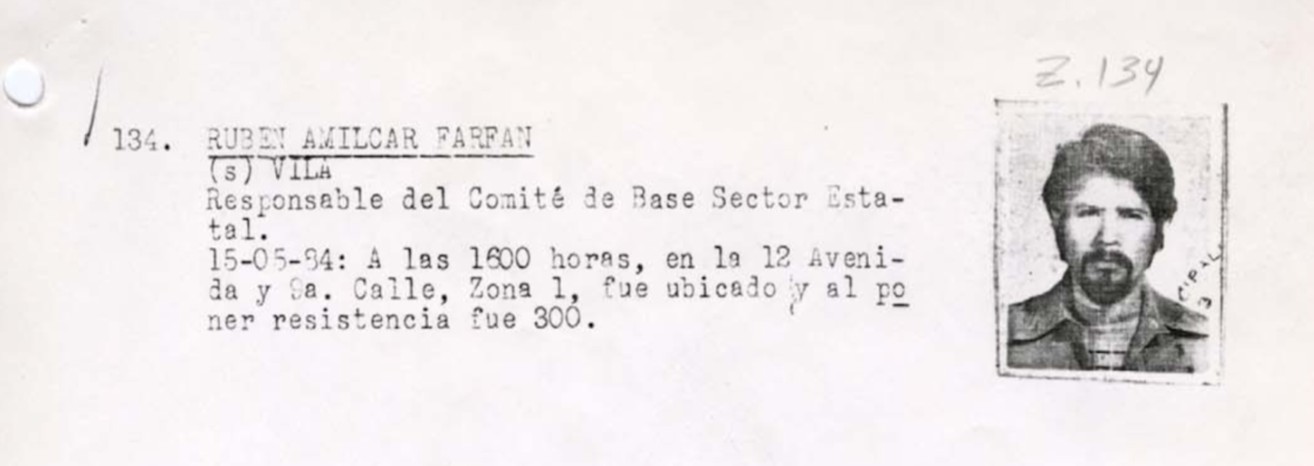
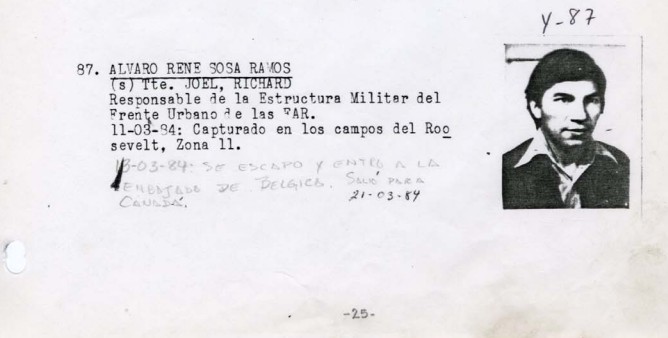
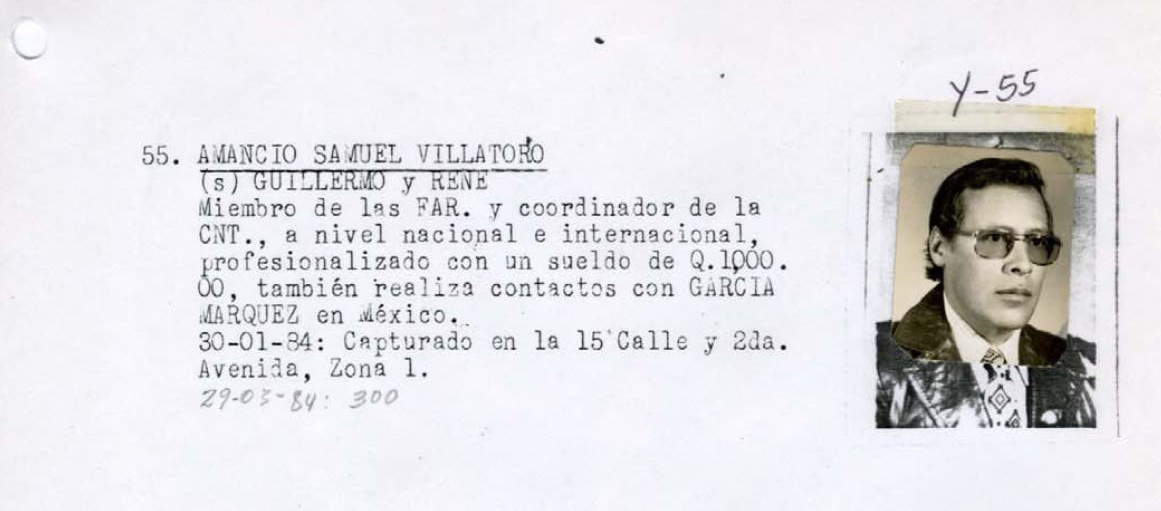
The Military Diary includes trade unionists
Ruda has explained: “The [Military Diary] list includes students, university professors, trade unionists, and members of social organizations that the Army identified as allies of the guerrillas.”
Rubén Amílcar Farfán
It has been reported that Rubén Amilcar “always thought about the common good and the vindication of labor rights [and] almost from the moment he started working, he was a member of the Road Workers’ Union” and that the first time he was arrested by security forces was “in 1980, while negotiating the Collective Agreement on Working Conditions with his union colleagues.”
Álvaro René Sosa Ramos
No-Ficción has reported: “Álvaro René Sosa Ramos was Secretary of Organization of the Diana company union during 1979 and 1980, years of intense repression against the union movement. …Captured by the authors of the Military Diary on March 11, 1984, he escaped two days later. …In 2007 he told the Public Prosecutor’s Office that during his captivity he heard other kidnapped people.”
Amancio Samuel Villatoro
The No-Ficción article continues: “They showed him Amancio Samuel Villatoro, general secretary of the Adams factory union, kidnapped for a month and a half and whose body, located in the old San Juan Comalapa detachment, was identified in November 2011.”
Accompaniment
PBI-Guatemala has been accompanying the Military Diary Case court hearing process since May 2021
Peace Brigades International began to accompany Human Right Law Firm (BDH) lawyer Édgar Pérez Archila in August 2010 due to several security incidents he had faced in relation to the high-profile judicial processes he was working on. At the end of 2013, PBI-Guatemala extended its physical accompaniment to the other lawyers of the BDH who work in high-profile trials to fight against impunity and in defending criminalized human rights defenders.
Following an observation visit by human rights organizations including Peace Brigades International, a joint report has been issued that “warns of the rapid deterioration of the human rights and environmental situation in Ecuador.”
As noted in this media release: “The report identifies patterns of violent repression against peaceful protests led by Indigenous movements, including criminalization, stigmatization, and the persecutory use of administrative, financial, and legal measures against human rights defenders and civil society organizations.”
It further notes: “The visit documents an alarming rate of violence and attacks against human rights and environmental defenders and civil society organizations [and a lack of] effective measures to prevent these violations and protect defenders.”
Ecuador and Canada
The report states: “Whilst Daniel Noboa’s government projects an image of commercial expansion and strength in multilateral forums, prioritising economic, trade, military and security agreements with other countries (particularly those in the Global North, such as Canada, the United States and countries of the European Union), it has also initially adopted a defensive stance in the face of international scrutiny over human rights, which has subsequently shifted towards outright apathy. This has led to a weakening of the institutional framework needed to address the risks in this area.”
It furthermore notes: “Questions have also been raised regarding the levels of transparency and participation in the negotiation processes for trade agreements signed or promoted by the Ecuadorian State with countries such as the United States, Canada, the United Arab Emirates and China. The organisations consulted by the Mission stated that a large part of the negotiations took place under confidentiality clauses, with limited access to the texts under discussion and few opportunities for participation by indigenous peoples, potentially affected communities and civil society organisations.”
The report then calls on Canada to:
1-Strengthen oversight of compliance with international human rights standards by Canadian companies operating in Ecuador.
2-Encourage Canadian extractive companies to adopt effective mechanisms for due diligence, conflict prevention and the participation of affected communities, ensuring respect for the rights of indigenous peoples and human rights defenders.
3-Encourage companies domiciled in or operating in the Canadian market Canada to implement effective human rights and environmental due diligence processes in relation to their operations, supply chains and investments in Ecuador, in accordance with relevant international human rights standards.
4-Maintain dialogue with civil society organisations and communities affected by projects linked to Canadian companies, as part of Canada’s foreign policy on responsible business conduct.
“The EU-LAT Network and 39 organisations, including PBI, have signed an open letter calling for greater safeguards in EU-backed investments to prevent human rights violations.
This report highlights recurring concerns about the unlawful and unpunished use of resources originally intended for development. In the current context of the growing roll-out of #GlobalGateway Initiative projects, the structure of economic power must not be built at the expense of human rights.
Therefore, the Network and the signatory organisations urge the EU to support the implementation of the following recommendations:
-to urge the Honduran State to implement the GIEI [the Interdisciplinary Group of Independent Experts] recommendations to ensure justice, guarantees of non-repetition and redress.
-Binding due diligence rules for all Global Gateway Initiative projects.
-Independent monitoring and complaints mechanisms for affected communities and human rights defenders.
-Effective reparation mechanisms where development finance institutions have contributed to human rights violations.
-Full public letter available via the profile link and on the website.”
That letter notes: “One of the main international financiers of the Agua Zarca project was FMO, a Dutch development bank, which is mainly publicly owned by the State of the Netherlands.”
It also calls on the European Union and its Member States to: “Ensure that development financial institutions, including FMO, provide effective reparation mechanisms when their actions or omissions have contributed to negative impacts on human rights.”
Canada and the European Union
Just yesterday, the Canadian Press reported: “The European Union’s ambassador to Canada says the bloc is crafting a new partnership with Ottawa unlike anything that currently exists. …Prime Minister Mark Carney said last month he was pursuing even deeper ties with Europe after signing a defence-industrial pact in addition to the existing strategic partner agreement and a free-trade deal.”
Prime Minister Carney will address the 720-member the European Parliament in Strasbourg, France on Thursday September 17, and will host the EU-Canada summit on October 29-30 (location to be announced) welcoming European Commission President Ursula von der Leyen and European Council President Antonio Costa.
Politico adds: “The European Commission and the European Council jointly presented preparations for a landmark summit with Canada on Oct. 29-30, committing to explore new areas where they will step up their partnership. That includes sectors like technology, research and innovation, as well as mining for valuable rare metals and breaking down trade barriers, those involved said.”
Poster: Secwepemc-Ktunaxa land and water defender Kanahus Manuel will be speaking at the Confront Carney’s CEO Summit rally at Nathan Phillips Square at 6pm, which will then march to the CEO summit.
Secwepemc-Ktunaxa land and water defender Kanahus Manuel will be speaking at the protest against the Canada Investment Summit in Toronto. That summit will take place on September 14-15 at the Four Seasons Hotel in Toronto.
On July 2, 2026, the Government of Canada announced it would refer the west coast pipeline project to the Major Projects Office. It notes: “This pipeline would transport one million barrels per day of oil toward global markets” and “largely follow the existing Trans Mountain corridor”.
The current Trans Mountain pipeline crosses about 518 kilometres of unceded Secwepemc territory in northern British Columbia.
In May 2022, CBC News reported: “In a letter dated April 29, [the United Nations Committee on the Elimination of Racial Discrimination] CERD said the governments of Canada and British Columbia ‘have escalated their use of force, surveillance, and criminalization of land defenders to intimidate, remove and forcibly evict Secwepemc and Wet’suwet’en Nations from their traditional lands…’ The letter goes on to name the RCMP [Royal Canadian Mounted Police] Community-Industry Response Group (C-IRG) and private security forces as the perpetrators.”
The pipeline began commercial operations on May 1, 2024.
In August 2026, CBC News reported: “A group that represents numerous First Nations across British Columbia is calling on Ottawa and Alberta’s government to halt efforts to advance the West Coast pipeline, saying expanding the oil industry will accelerate climate change and disasters.”
The West Coast Oil Pipeline is now included on the list of projects highlighted on the Major Projects Office website.
Kanahus Manuel: “Canada must end violence against Indigenous women and 2SLGBTQQIA+ land and water defenders”
Manuel has told Amnesty International Canada: “Violence is perpetuated not just by industry, but also by the Crown and the judicial system. These systems are not protecting Indigenous rights, human rights, or the earth. They are protecting industry by making money for the Government of Canada and bringing more investment into the country. When there are systems that do not care about Indigenous rights and human rights, they are going to try to get rid of us. They are trying to do this by criminalizing Indigenous peoples, by using disinformation and smear campaigns when Indigenous peoples are actually upholding Indigenous and human rights.”
Other recommended major projects
In September 2025, Prime Minister Carney announced five priority major projects including “LNG Canada Phase 2, Kitimat, British Columbia”. Then in November 2025, the prime minister announced another six major projects including “Ksi Lisims LNG – Pearse Island, British Columbia” along with “the 800-kilometre Prince Rupert Gas Transmission Project to supply feed gas for liquefaction, and a 95-kilometre electrical transmission line to supply electricity to the facility.”
These major projects are opposed by Indigenous land and environmental defenders on Wet’suwet’en, Gitxsan and Gitanyow territories.
CTV News has reported that at least nine unnamed investor groups from the United Kingdom will be present at this summit.
On October 21, our colleagues at Peace Brigades International-United Kingdom will be at the Good Business Matters Mass Lobby at the British Parliament to ask Members of Parliament to “hold businesses to account for harms against human rights defenders and communities”.
Investors from Canada (including the Bank of Montreal), the United States, France, Norway, Australia, United Arab Emirates, China, Malaysia, Singapore, and Saudi Arabia will also be at the summit.
Photo by Ali Christie of allies of Wet’suwet’en land defenders occupying the BMO branch in Nelson, British Columbia, February 12, 2020.
“On Wednesday, September 9th, leaders from the affected communities stood in front of the office of the Ministry of the Environment and Natural Resources (SEMARNAT), to protest the announced expansion of the mine in San José del Progreso, Oaxaca.”
“Communal land holders and representatives of the alliance ‘No a la Minería por un Futuro de Todas y Todos’ (No to Mining for a Future for All) also attended the event to condemn the operation.”
Their article further highlights: “The construction of the mine started in 2009, without the consent of the community.”
El Universal Oaxaca reports that the communities and social organizations of the No to Mining Front say: “Authorizing a new expansion will not only deepen the environmental deterioration that we are already experiencing; it would legitimize an activity that has operated for 17 years without our consent, on communities such as those whose lives depend directly on their territories and specifically on water.”
Libertad Oaxaca also notes: “Community, agrarian and municipal authorities of Zapotec communities in the Central Valleys pointed out that the request presented by the company does not represent a new project, but a new stage of expansion of a mining activity that, they say, has been operating in their territories for 17 years.”
And Imparcial Oaxaca reports: “At a press conference in front of the Semarnat facilities in the city of Oaxaca, the representatives explained that the mining company should have closed in 2021, however, the federal government authorized the renewal of the concession for another 12 years, even though the communities have demonstrated against it.”
Accompaniment
Peace Brigades International, through its accompaniment of Services for Alternative Education A.C. (Educa Oaxaca), has long followed the situation of Vancouver-based Fortuna Silver mining operation in San José del Progreso, Mexico.
In November 2012, PBI-Mexico accompanied a “Misión Civil de Observación” that included two future members of the PBI-Canada team (Meera Karunananthan and Brent Patterson). Karunananthan told CBC News: “This is part of an international pattern with Canadian mining companies violating human rights in communities abroad.”
PBI-Canada continued to monitor this struggle and in November 2018 organized an advocacy tour to Toronto and Ottawa, a virtual meeting with Global Affairs Canada officials in March 2021, then a webinar in collaboration with Amnesty International in November 2021, as well as posting regular updates on our website and social media
On January 15, 2025, Promineria reported: “Fortuna Mining has signed a binding agreement to sell its 100% stake in Minera Cuzcatlán to Mexico’s Minas del Balsas.
By May 2025, JRC Investments acquired Compañía Minera Cuzcatlán S.A. de C.V. At that time Cuatrecasas commented: “It includes the signing of a management contract and a mining royalty contract with the seller Fortuna Mining Corp.”
Fortuna Mining Corp. additionally noted: “Fortuna retains a 1.0 percent net smelter royalty on production from the San Jose Mine concessions payable after the first 6.1 million ounces of silver and the first 44,000 ounces of gold or 119,000 gold equivalent ounces have been mined or extracted from the property.”
“’In contexts marked by historical processes of dispossession and injustice, states are obligated to drive agrarian reforms that ensure equitable access to land,’ asserts the peasant, Indigenous, and grassroots alliance of Honduras, which continues to seek justice in line with rulings by the Inter-American Commission on Human Rights.
During a press conference in front of the INA [National Agrarian Institute] headquarters in Tegucigalpa, the Agrarian Platform and OFRANEH [the Black Fraternal Organization of Honduras] pointed out that the Agro-industrial Law and related decrees ‘could become new tools for the persecution of human rights defenders, Indigenous peoples, and peasant communities in a country marked by decades of the criminalization of struggles for land rights.’
PBI expresses its concern regarding the difficulties organizations have faced in exercising their right to freedom of expression—difficulties we witnessed firsthand during the peaceful protest.”
The Agro-Industrial Law
The Center for the Study of Democracy (CESPAD) has noted: “On February 10, 2026, a draft law aimed at granting preferential legal and administrative protection to the agro-industrial sector was presented in the National Congress.”
Then on June 10, Criterio.hn reported: “In a clear violation of parliamentary regulations, the National Congress of Honduras expanded the scope of the Law … to include the energy and tourism areas.”
And on June 15, Criterio.hn further reported: “Not satisfied with the legislative shield granted to sectors such as agribusiness, energy and tourism, the liberal deputy for Puerto Cortés, Alex Berrios Lamothe, promoted the initiative called the Safe House Law. Presented as a response to crime, the initiative deepens the protection of private property by expanding the cases of legitimate defense, even in situations where the protected legal asset is not life but property.”
Canada and the Agro-Industrial Law
It does not appear that the Government of Canada has commented publicly on the human rights implications of the Agro-Industrial Law.
Canada congratulates Asfura
On December 24, 2025, the Government of Canada posted on social media: “Canada congratulates President-elect Asfura and commends the Honduran people for participating in the democratic process. We look forward to advancing shared priorities, including justice, democracy, and tackling corruption.”
Canada abstains on the rights of peasants
PBI-Honduras has previously noted that the United Nations Declaration on the Rights of Peasants and other people working in rural areas recognizes key elements such as “the right to land, to natural resources and to food sovereignty, based on the principle of equality between men and women.”
Canada abstained in the vote on that was adopted by the UN General Assembly in December 2018.
Canada-Honduras relations
The Government of Canada has stated: “Canada works with Honduras on gender equality, economic opportunities, governance, including strengthening of justice and democracy, irregular migration, and the fight against impunity and corruption. In doing so, Canada contributes to the protection and promotion of the rights of the most vulnerable, including women and girls, Indigenous people, Afro-descendants and rural communities. Honduras is also an important bilateral trading partner in Central America. Looking to the future, Canada remains committed to support Honduras’ efforts towards building a more inclusive, democratic and secure society.”
Trade and economic relations
The Government of Canada has also noted: “The Canada-Honduras Free Trade Agreement entered into force in October 2014. The annual bilateral merchandise trade between Canada and Honduras in 2025 was $735.5 million, compared with $423 million in 2020. …In 2019-2020, Canada contributed CAD$ 33.5 million in international assistance from all aid channels to Honduras.”
Canada imports Honduran coffee
The Observatory of Economic Complexity notes that in 2024 Honduras exported $339 million of goods to Canada. The top export product was coffee at $67.2 million. With respect to growth, in June 2026 the rise in Canada’s imports from Honduras was mainly attributed to imports of Coffee (C$15.8M or 53.5%), Insulated Wire (C$822k or 12%), and Non-Retail Synthetic Filament Yarn (C$822k or 292%).
Trading Economics further documents: “Canada Imports from Honduras was US$465.82 Million during 2025, according to the United Nations COMTRADE database on international trade.” In 2025, this included: Coffee, tea, mate and spices ($127.49 million); Edible fruits, nuts, peel of citrus fruit, melons ($49.97 million); and Edible vegetables and certain roots and tubers ($27.82 million).
Canadian tourism to Honduras
Roatan Online indicates: “In 2025, Honduras achieved a historic milestone in tourism, welcoming 3.1 million visitors nationwide, the highest figure ever recorded. This represents an 11.6% increase compared to 2024, confirming the country’s consolidation as one of the most dynamic tourism destinations in Central America. At the heart of this growth stands Roatan, the undisputed leader of Honduras’ tourism performance and the main gateway for international visitors.”
Roatan Vacation Rentals adds: “Canadians travel to Roatan for many different reasons, but most seem to stay on the island for a love of the lifestyle…. No more snow tires! Canadians are not hard to find on Roatan and neither are Canadian owned businesses! The most widely known Canadian owned business on Roatan is Sundowners in West End. Here you will find many other Canadians along with travellers from all other parts of the world. Other Canadian owned businesses include the Hangover Hut and JavaVine in West Bay as well as Gran Bleu Diving in Sandy Bay.”
As many as 65,000 Canadians may be visiting Honduras each year.
Roatan is situated on Garifuna territory.
Canadian mining and energy projects in Honduras
In April 2016, CBC News reported that the Canadian mining company Aura Minerals was affecting the health of the Honduran village of Azacualpa by exposing them to cyanide leaching and from its open-pit gold mine.
In 2009, The Guardian reported concerns about Toronto-based Goldcorp killing livestock and making people sick by polluting land and rivers in the Siria valley because the San Martin opencast mine discharged highly acidic and metal-rich water in 2008. Goldcorp shut the decade-old San Martin mine after extracting nearly 12,000 tonnes of ore from its forested slopes.
And Manitoba Hydro International (MHI) has previously noted: “MHI has kicked off a 7-year supervisory project in Honduras, which will run until 2024. Working with the Honduran utility, the National Company of Electric Energy (ENEE), MHI will act as the project supervisor to oversee the operations of Empresa Energía Honduras (EEH). MHI will provide oversight and reporting on the main activities of the operator on the distribution system and customer service of the ENEE.”
Canada and ZEDEs
The “Zones for Employment and Economic Development” (ZEDEs) have been controversial in Honduras.
On July 30, 2009, about a month after the coup, The Globe and Mail reported: “Canada is still providing training to members of the Honduran army.”
By February 17, 2015, Sandra Cuffe reported in Ricochet: “Militarization, impunity, and human rights abuses have dominated Honduras since the coup. …Canadian aid to security forces and investigative units has picked up, but some of it has produced more concerns than results.”
Canada does not appear to export a large amount of “military goods” to Honduras. Canada exports approximately $1 billion to $2 billion in “military goods” to the United States each year. The United States has provided well over $114 million in security assistance to Honduras between 2008 and 2014. In 2017, Global Witness documented that at least $18 million in U.S. aid was sent to Honduran police and military “in spite of their abuse against activists.”
Text: “The struggle of women searchers is recognized. At Peace Brigades International, we welcome the UN’s recognition of women searchers and the designation of 19 December as International Women Searchers’ Day.”
“At Peace Brigades International, we welcome the UN’s recognition of women searchers and the proclamation of December 19 as the International Day of Women Searchers.
This recognition is, above all, the result of years of struggle, organizing, and advocacy by the women searchers themselves, who have transformed the search for their loved ones into a collective fight for truth, memory, justice, and dignity.
We especially acknowledge the path taken by the @fundacionnydiaerikabautista [the ‘Nydia Erika Bautista’ Foundation] and the National Network of Women Searchers—initiatives accompanied by PBI—which have sustained and championed this demand in international arenas, advocating for political recognition of women searchers and their vital role in defending human rights.
Their struggle paves the way.”
The Instagram image adds: “We would like to acknowledge FNEB and the National Network of Women Searchers, who have championed the call for this recognition to reach the UN.”
The Nydia Erika Bautista Foundation has posted the resolution proposed by the Syrian Arab Republic here.
“The struggle of women searchers is recognized by the world!
At the Nydia Erika Bautista Foundation, we celebrate the United Nations’ declaration of December 19 as the International Day of Recognition for Women Searching for Missing Persons.
This achievement acknowledges decades of struggle by women who transformed absence into a quest, organizing themselves and demanding truth and justice.
We celebrate this alongside the National Network of Women Searchers and all the women who have never stopped asking: Where are they?
December 19 is a victory for women searchers and an acknowledgment that searching is a right.
We continue to search. Until we find them.”
Infobae further reports: “The General Assembly of the United Nations (UN) proclaimed December 19 as the International Day of Recognition of Women Searchers for Disappeared Persons, a date that seeks to make visible and recognize the work of thousands of women in different countries who have assumed the search for relatives and other people whose whereabouts are unknown.”
That article adds: “The resolution not only sets a new date in the international calendar, but also includes a series of recommendations addressed to member states, international organizations, civil society, academic institutions, the media and the private sector. Among the approaches is the promotion of events and activities aimed at highlighting the work carried out by women searchers in different parts of the world. The international organization also invited to promote measures to prevent and combat discrimination and violence against women who participate in the search for missing persons, in addition to promoting and protecting their human rights.”
The Mexican newspaper Mileno also notes: “Grace Fernández of the Búscame … search collective in Mexico expressed the importance of recognizing the work of women searchers, when there are currently 131,974 missing or unlocated people in the country, according to the National Registry of Missing and Unlocated Persons, of the Ministry of the Interior (RNPDNO-Segob).”