

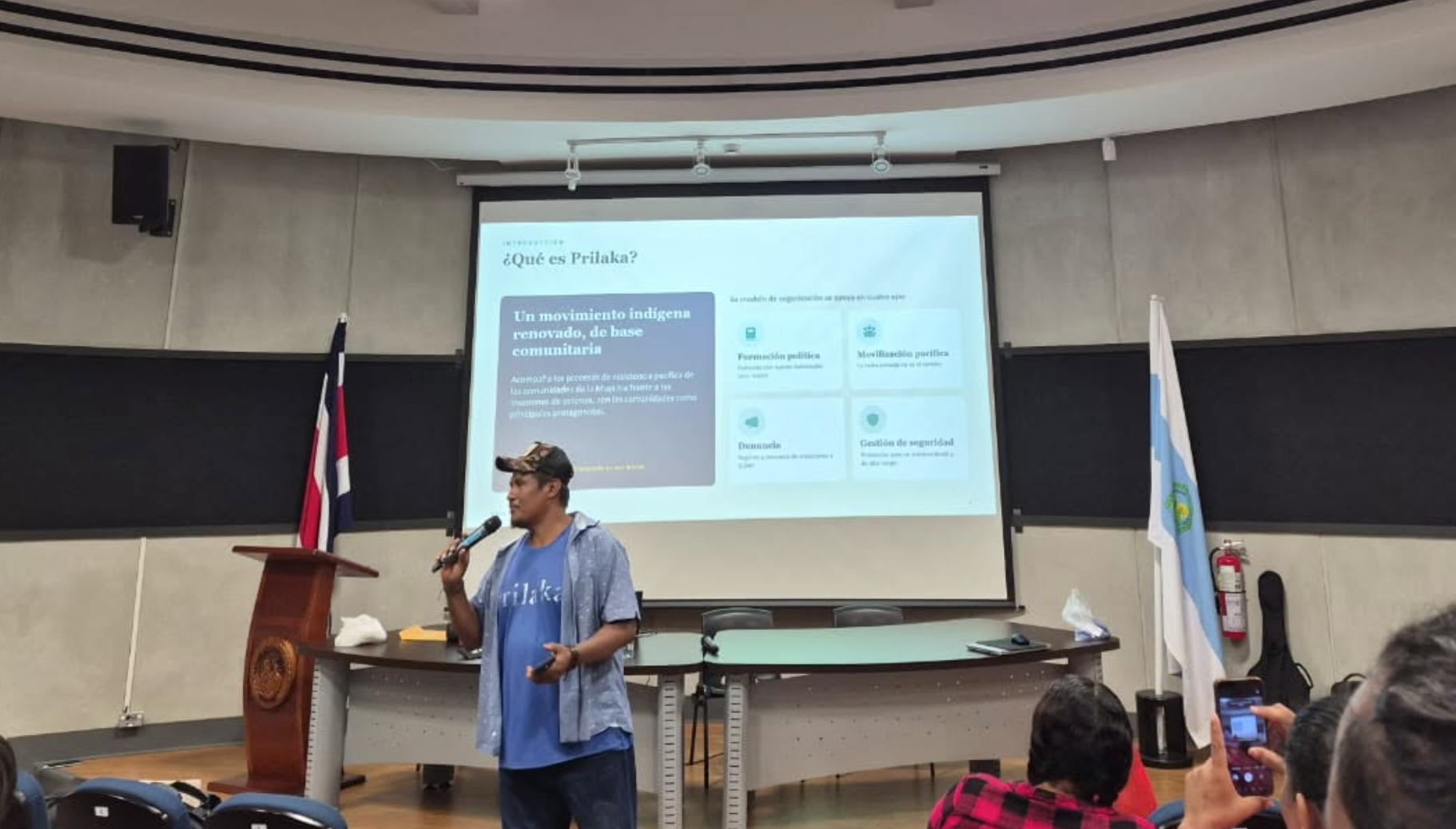
The Peace Brigades International-Nicaragua team has posted on social media:
“We congratulate Prilaka, which marked the 10th anniversary of its founding yesterday, November 26.
Miskitu leader Limi recalled that in 2016, at an assembly attended by more than 350 people from indigenous communities in the Nicaraguan Muskitia, it was decided to establish the organization Prilaka—a name that means ‘Freedom’ in the Miskitu language.
Today, the organization defines itself as a community-based indigenous movement that faces many challenges. These include continuing to defend indigenous territories in Nicaragua, while simultaneously strengthening Miskitu culture in exile and advocating for the rights of indigenous people who have been displaced to Costa Rica due to violence in their territories and the occupation of their lands by settlers.
‘The culture that is sustained in exile is not merely nostalgia; it is the organizational foundation for the present and the future’, the Miskitu leader stated.
PBI has been accompanying Prilaka since 2025; we are grateful for the tremendous work they do and for the opportunity to stand by their side and offer our support.”

The Prilaka Community Foundation
Prilaka describes itself this way on social media: “It is a community-based organization that has long worked for the collective rights of Indigenous communities in the Muskitia region.”
The Land Portal has also noted: “Prilaka is a social movement defending the rights of indigenous communities in Nicaragua, mainly the right to self-determination, with an active presence in the indigenous communities of the northern Caribbean coast of Nicaragua, ancestrally known as Muskitia or Toguzgalpa.”
The Muskitia region
As noted above, the Muskitia region is located on the northern Caribbean coast of Nicaragua. The Wildlife Conservation Society adds: “La Moskitia is the forest shared between Nicaragua and Honduras, covers around 22,568 km2.”
And PBI has explained: “Nicaragua’s Caribbean region is made up of two autonomous regions: the South Caribbean Coast Autonomous Region and the North Caribbean Coast Autonomous Region [RACN], formerly known as the North and South Atlantic Regions, and historically known as the Mosquito Coast, or La Mosquitia.”
The Mayangna peoples
At PBI-Canada, we recall that the Mayangna peoples of Nicaragua mainly live in villages along the rivers of the North Caribbean Coast Autonomous Region (RACN). With the support of PBI, Indigenous defender Lusben Taylor, a leader of the Mayangna Association for Social Development (AMDES), presented to the United Nations Human Rights Council in Geneva in September 2026.
In November 2024, El Faro reported: “In recent years, gold has become Nicaragua’s top export commodity, surpassing coffee and beef in 2020 thanks to lax government regulations, substantial tax incentives, and what the former CEO of Canada’s Calibre Mining —the largest mining company operating in Nicaragua, with concessions covering nine percent of the country’s total land mass— described as the ‘rule of law and order.’ …Canada’s Calibre Mining [recently purchased] the Eastern Borosi open-pit complex, located in the heart of the North Caribbean Autonomous Region.”
In June 2025, Vancouver-based Equinox Gold acquired Calibre Mining “with an implied transaction value of approximately $2.56 billion”.
Prilaka: ’10 Mayangna killed’ in 2023
In August 2023, the Associated Press (AP) reported: “According to the Prilaka Community Foundation, a nongovernmental conservation organization operating in the region, 10 Mayangna were killed by settlers between January and July, nine of whom were forest rangers. …A leader of the Mayangna people, who spoke on condition of anonymity out of fear of reprisals from the government of President Daniel Ortega, said his people suffer ‘a continuous colonization’ from the land invaders.”
Displacement to Costa Rica
PBI-Nicaragua has previously explained: “In the last ten years, Indigenous and Afro-descendant peoples in Nicaragua have been forced to move to Costa Rica fleeing violence, land invasions and socio-political crisis. For Indigenous and Afro-descendant peoples, forced migration implies losing territory and community life, traditions, language, economic activities and traditional forms of organization.”
Accompaniment
In March 2020, PBI launched an accompaniment project for Nicaraguan organizations, social groups and individual human rights defenders exiled in Costa Rica. You can find PBI-Nicaragua on Instagram and Facebook.

