
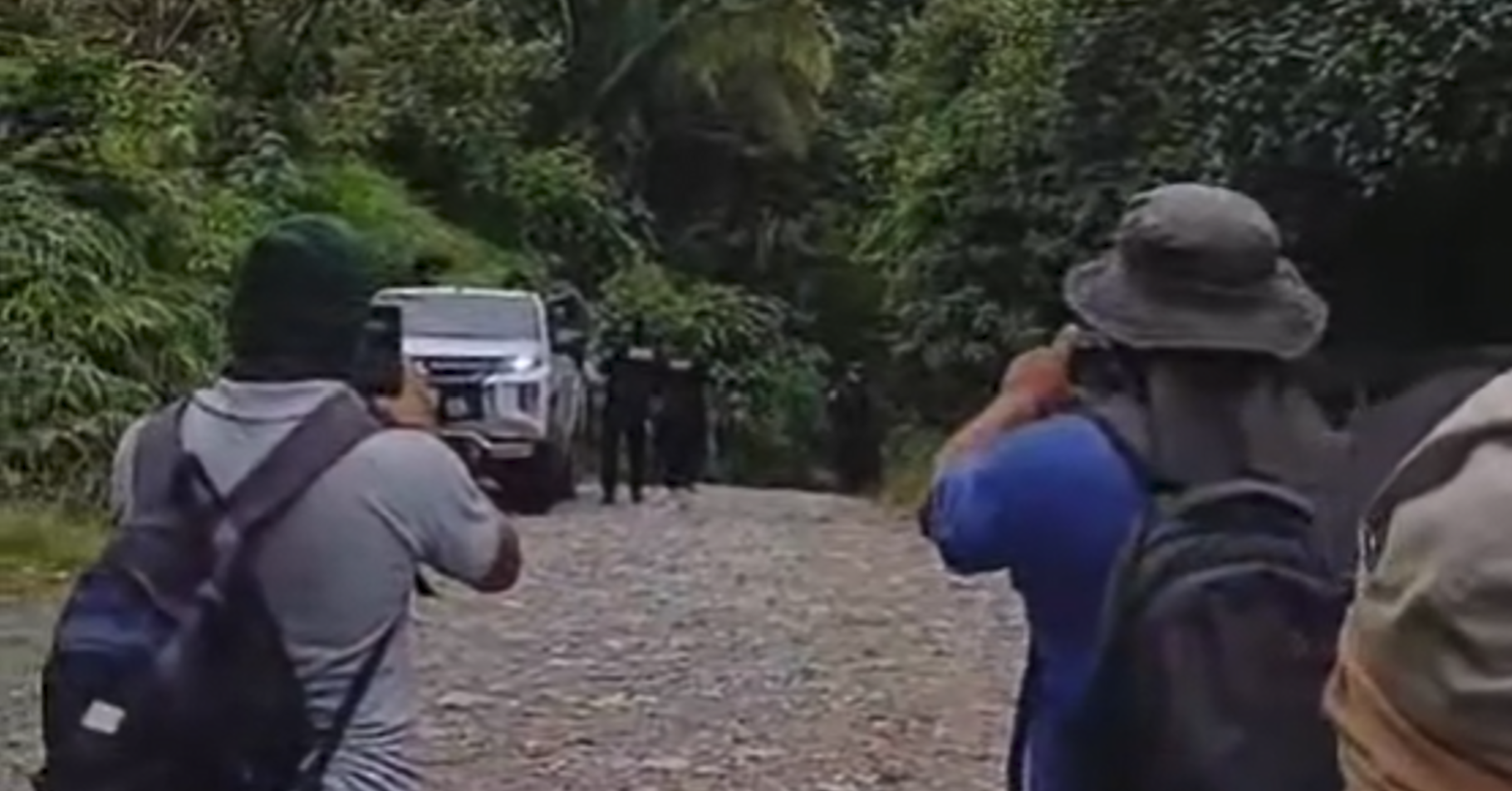
Video still from Aj ral ch’och’ community journalism.
On November 25, journalist Carlos Ernesto Choc reported throughout the day on the situation in Livingston, Izabal, Guatemala.
You can follow his reporting here.
His first report explained:
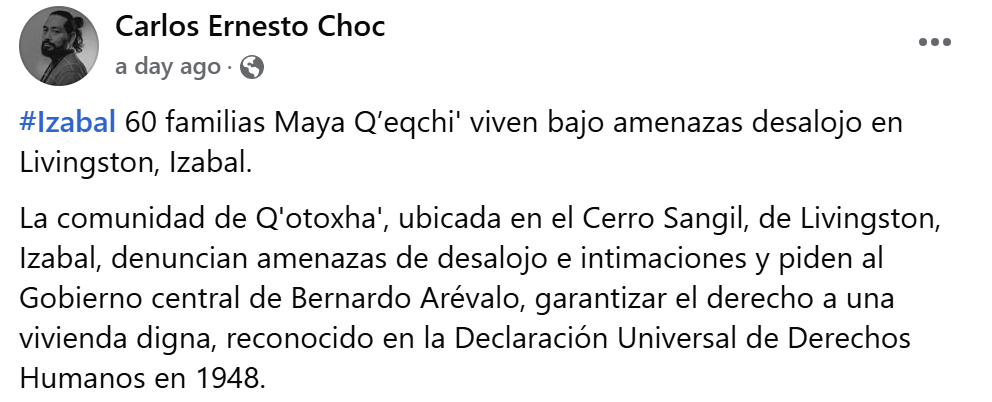
“60 Maya Q’eqchi’ families are facing threats of eviction in Livingston, Izabal.
The Q’otoxha’ community, located on Cerro Sangil in Livingston, Izabal, reports facing eviction threats and intimidation. They are calling on the central government, led by Bernardo Arévalo, to guarantee the right to decent housing—a right recognized in the 1948 Universal Declaration of Human Rights.
The risk of eviction for several communities in Izabal has increased following the declaration of a “state of siege” on November 15. The Q’otoxha’ community is among those affected, and they have brought these threats and acts of intimidation to the attention of the international community. According to the Office of the Human Rights Ombudsman (PDH), there are pending eviction orders for the Finca Manzanita and Machaca estates.
Families in the Q’otoxha’ community have reported that the former Minister of Communications, Infrastructure, and Housing (2012–2014), Alejandro Jorge Sinibaldi Aparicio, is laying claim to the land, asserting that the community is part of the Finca La Manzanita estate.
Sinibaldi was a fugitive from justice, accused of corruption in 2016. In June 2024, the Constitutional Court (CC) upheld a legal injunction (*amparo*) in his favor, which nullified a previous ruling that would have sent him to trial in connection with the Odebrecht case.
The justice system in the country continues to favor the corrupt, while communities face repression and criminalization. One example is the arrest of Roberto Coc—a community member who defends land and territory in the Río Tebernal community—which took place under this state of siege.”
Choc then reported:
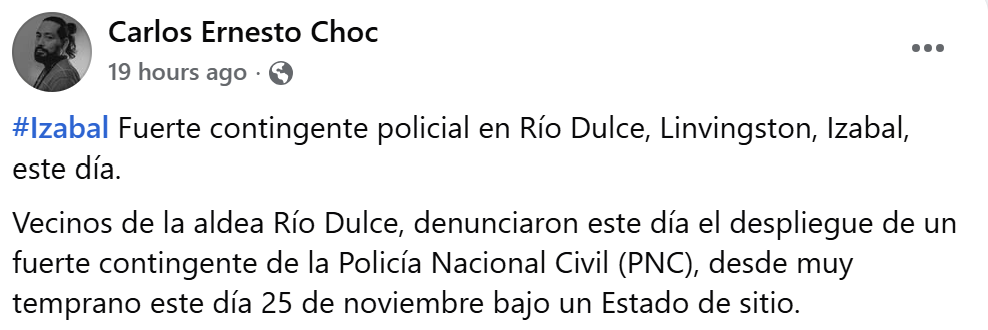
“A large police contingent is present today in Río Dulce, Livingston, Izabal.
Residents of the village of Río Dulce reported the deployment of a large contingent of the National Civil Police (PNC) early this morning, November 25, amid a “state of siege.”
According to ancestral Maya Q’eqchi’ authorities from the communities in Livingston, Izabal, there is deep concern for the families living in the village of Q’otoxha’, who have reported that they could be forcibly evicted today.”
Choc added:
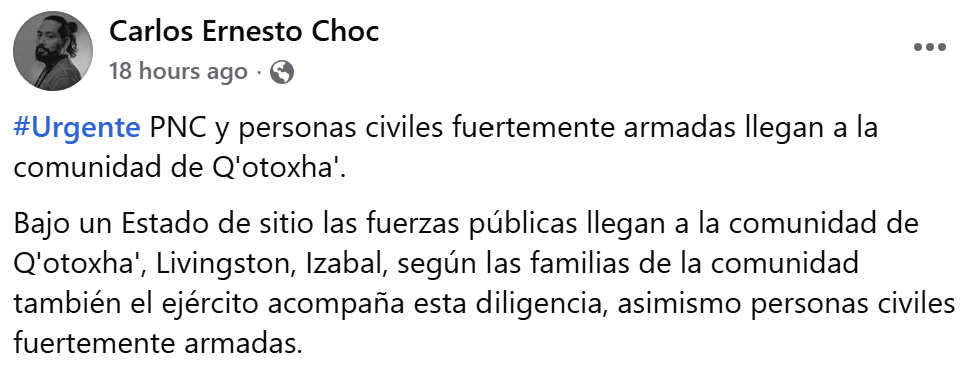
“#Urgent: The National Civil Police (PNC) and heavily armed civilians arrive in the community of Q’otoxha’.
Under a state of siege, public security forces have arrived in the community of Q’otoxha’, in Livingston, Izabal. According to local families, the army is also participating in this operation, alongside heavily armed civilians.
The ancestral Maya Q’eqchi’ authorities of the municipality of Livingston, Izabal, demand that the central government, led by Bernardo Arévalo, guarantee and respect the lives of the women, girls, elderly, and all other individuals living in the community.”
The final post from Choc yesterday noted:
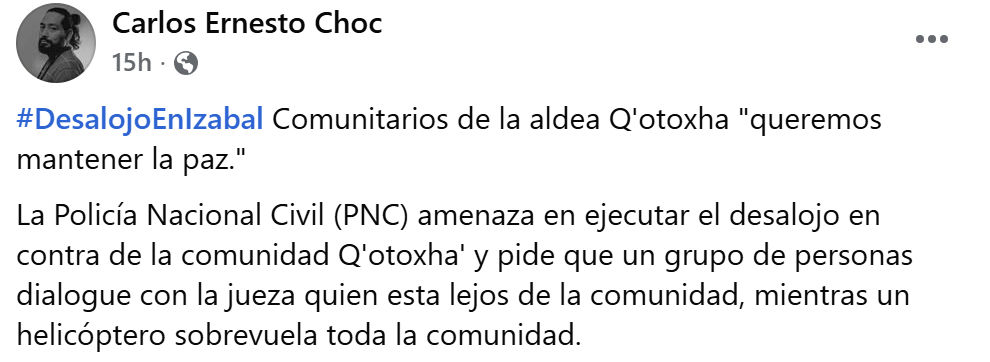
“#Eviction In Izabal Residents of the Q’otoxha’ village state: “We want to maintain peace.”
The National Civil Police (PNC) are threatening to carry out an eviction against the Q’otoxha’ community and are demanding that a group of residents engage in dialogue with a judge—who is located far from the community—all while a helicopter circles overhead.
On this International Day for the Elimination of Violence against Women, the Maya Q’eqchi’ women of the community call upon the State of Guatemala to respect their rights.”
Accompaniment

Carlos Ernesto Choc is a Maya Q’eqchi’ journalist, environmentalist and human rights defender (HRD), born in the municipality of El Estor, in the department of Izabal. He has been criminalized and prosecuted because of his journalistic work, which he has used to report on human rights violations against the Q’eqchi’ people and the environmental pollution caused by the Fenix mine in the El Estor municipality.
Choc requested accompaniment from PBI to be able to continue his work as a journalist. We began accompanying him in April 2025.
At PBI-Canada we continue to follow this.
Image: “People of the land” community journalism.