


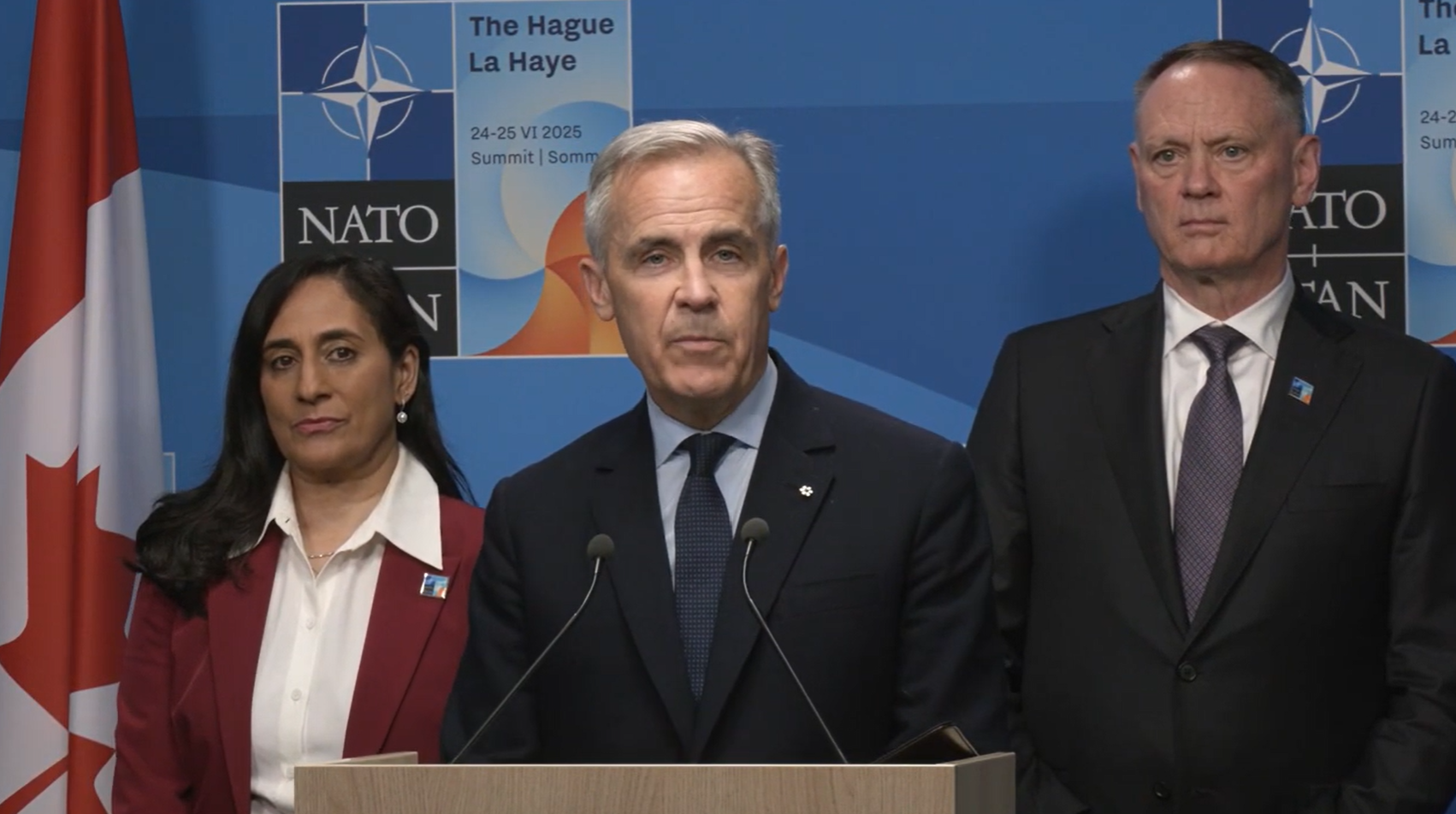
Video still: Canadian Prime Minister Mark Carney with Foreign Affairs Minister Anita Anand and Defence Minister David McGuinty announces Canada’s commitment to the NATO Defence Investment Pledge, June 2025.
Peace Brigades International-Canada is researching and analyzing the implications of increased military spending on the safety and security of human rights defenders, land and environmental defenders, and journalists.
We believe that developing a non-partisan analysis and promoting public awareness of the emerging risks and threats to organizations, defenders and communities is an essential part of providing holistic protective accompaniment.
The NATO commitment
On June 25, 2025, Prime Minister Mark Carney announced that Canada had agreed to the North Atlantic Treaty Organization (NATO) “Defence Investment Pledge” of investing 5% of annual GDP by 2035 into “core military capabilities” (3.5%) and “critical defence and security-related” expenditures (1.5%).
At that time, while in The Hague, the Netherlands, the Prime Minister stated: “Canada is already beginning working towards a target of 3.5% of GDP by 2035, by expanding our plan to invest in the Canadian Armed Forces, to modernize our military equipment and technology, to help build up our own defence and security industries, as well as to diversify our defence partnerships.”
He added: “We’re also working to ensure that we are spending 1.5% of our GDP in defence and security related infrastructure. So, that means ports, airports, infrastructure to support the development and exportation of critical minerals, telecommunications and emergency preparedness systems.”
And just prior to the NATO meeting, Carney commented: “Canada has one of the biggest and most varied deposits of critical minerals, and we’re going to develop those. …Some of the spending for that counts towards that five per cent. In fact, a lot of it will happen towards that five per cent because of infrastructure spending, ports and railroads and other ways to get these minerals.”
The Canadian Press additionally reported: “The prime minister said Canada will reach the [NATO 5% spending] target in part by developing deposits of critical minerals and that some of the work will be done in partnership with the European Union, EU member states, the U.K. and other countries.”
In dollars
In the year before the pledge was made to reach NATO’s 5% target, Canada’s core defence spending was $43.9 billion.
By March 26, 2026, the Prime Minister stated that “Canada has achieved the 2% defence expenditure target”, a first milestone in reaching the 5% target.
Earlier this month, CBC News reported: “Direct spending on the military in the ongoing budget year [April 1, 2026 to March 31, 2027] is expected to ring in at $75 billion (with an additional $50 billion for defence infrastructure).”
In 2027-28, spending is expected to rise again to $89 billion on core capabilities and $52 billion on related expenditures.
CBC News has also reported: “The new federal budget sets Canada on a path to spend slightly more than four per cent of its gross domestic product on defence per year — roughly $157 billion — by the end of the decade. The roadmap forecasts annual direct spending on the military will amount to $99.2 billion by 2030-31, with an additional $58.3 billion for defence infrastructure in the same year.”
The Parliamentary Budget Office has projected that Canada would need to spend $163.6 billion in 2035-36 to meet the NATO spending commitment of 3.5% on “core military capabilities”. The 1.5% “critical defence and security-related expenditures” target could mean another $68 billion to $78 billion in 2035.
This could put total spending at about $233.7 billion.
CANSEC 2027
The “Registry of Lobbyists” published by the Office of the Commissioner of Lobbying of Canada indicates that the Canadian Association of Defence and Security Industries (CADSI) received a total of $284,855.76 from the Government of Canada ‘in the last financial year’ and that ‘funding is expected in the current financial year’. CADSI is the entity that organizes CANSEC in Ottawa.
Arguably, this fits within the NATO Investment Pledge, in the words of the Prime Minister, “to help build up our own defence and security industries, as well as to diversify our defence partnerships.”
Promotion for CANSEC bills it as “Canada’s largest defence, security & emerging tech tradeshow where $1B+ in business deals happen every year”. 100+ international delegations attend CANSEC, including countries considered “not free”. The next CANSEC is scheduled to take place on June 2-3, 2027.
Implications for human rights defenders
1-Indigenous land and environmental defenders peacefully opposing road construction and critical mineral mining on their traditional territories (under the 1.5% category) could face surveillance, restrictions on their right to gather and protest, criminalization, arbitrary detention, forcible removal from their territory, and the armed enforcement of interlocutory court injunctions that can put lives at risk.
2-The procurement of military equipment (e.g., submarines) could include investments in the construction of pipelines (e.g., to Hudson Bay) and purchase agreements (e.g., for LNG exports from the PRGT pipeline) opposed by defenders.
3-The upgrading of military bases (e.g., Goose Bay) to accommodate new combat aircraft (e.g., F-35s), along with the potential for the resumption of flight testing, continues the occupation of territory long-opposed by defenders (e.g., Elizabeth Penashue) that has historically resulted in the arrests of defenders.
4-The pledge to increase arms exports by 50% (made in Canada’s Defence Industrial Strategy) could mean the sale of weapons to States (e.g., the Philippines) known to violate human rights norms with the risk that those military goods could be used to repress organizations, defenders and communities upholding their rights (despite obligations under the UN Arms Trade Treaty).
5-Project Ploughshares has commented that the 50% increase in exports could primarily be reflected in more exports of military goods to the United States. The Defence Production Sharing Agreement (DPSA) between Canada and the United States means a lower standard of accountability for Canadian-made components exported to the US that could go into the military equipment exported by the US to countries implicated in violations against organizations, defenders and communities.
6-As military spending globally drives the development (and export) of technology without binding safeguards, AI-enabled targeting and autonomous/semi-autonomous weapons systems pose new dangers specifically for frontline journalists (who are increasingly being targeted in armed drone attacks).
7-The Business and Human Rights Centre (BHRC) has documented that defenders protesting at arms fairs against weapons companies and arms sales are increasingly being detained and have faced violence in multiple countries.
In this context, we continue to develop our research-based analysis, amplify the voices of human rights defenders concerned about militarism and State violence, educate and build public awareness, and accompany defenders at-risk.
Further reading
–Alternative federal budget 2026-27: Bridge to independence (Canadian Centre for Policy Alternatives, September 16, 2026)
–‘Hard time sleeping’: inside Canada’s emerging military-AI complex (The Breach, November 20, 2026)
–Open letter on the Seventh Review Conference of the Convention on Certain Conventional Weapons and a legally binding protocol on lethal autonomous weapons systems (Canadian Friends Service Committee, November 20, 2026).

