

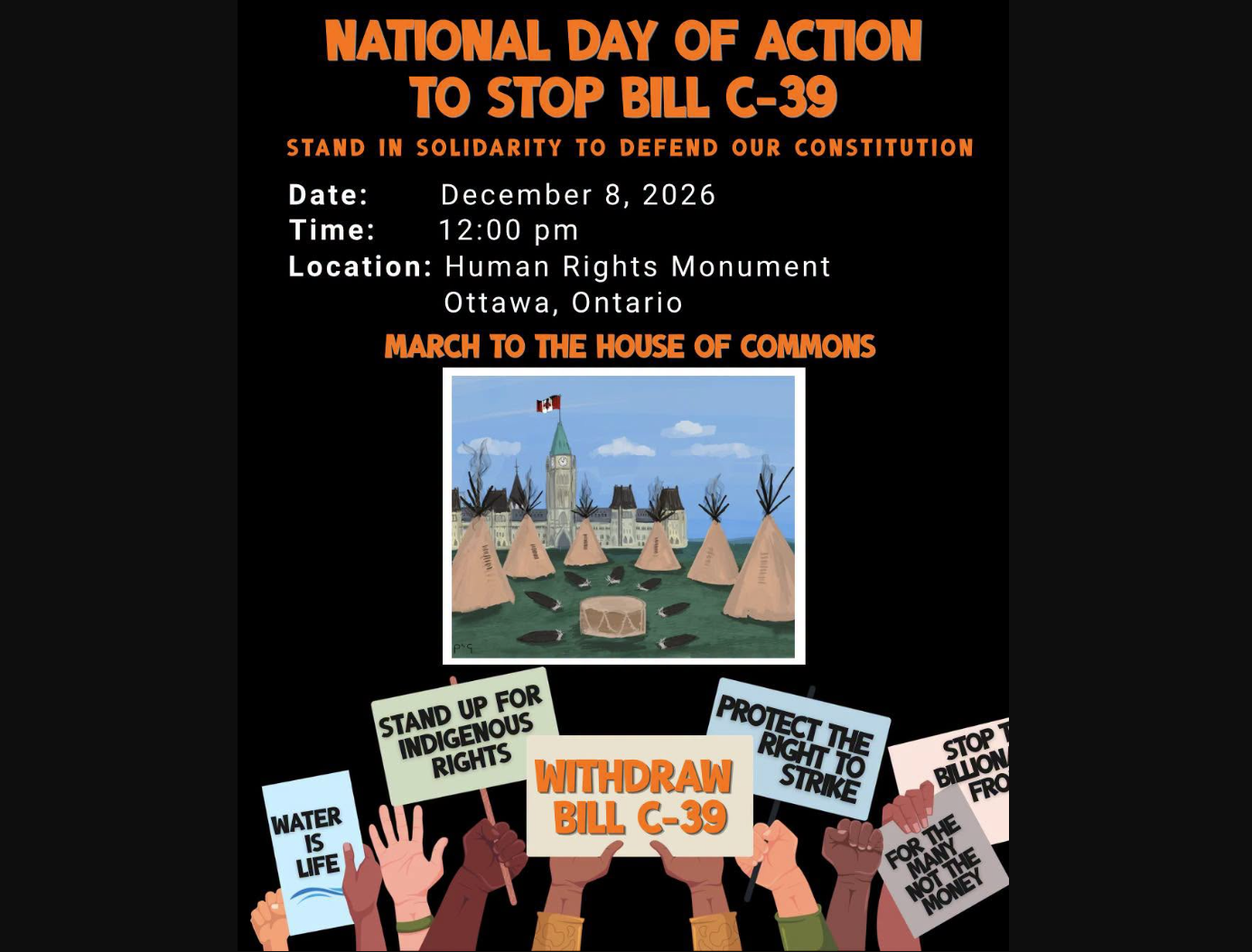
Poster for Tuesday December 8, 2026, protest.
On September 21, 2026, the Canadian government tabled Bill C-39, the Building Canada Strong Act, in the House of Commons with the stated purpose of “speed, certainty, and predictability” to the building of major projects “so investors know that when Canada says it wants something built, Canadians will get it built.”
Indigenous opposition to C-39
On November 17, Indigenous Cree land and environmental defender Ramon Kataquapit from the Attawapiskat First Nation told a Special Senate Committee hearing on Bill C-39: “When it comes to a certain provision with Bill C-39 and establishing a region of national interest without proper consultation with the First Nations or pushing forward without the United Nations Declarations on the Rights of Indigenous People for free and prior informed consent, that is absolutely, that’s utterly stupid. If you’re listening to me, please cut this bill and put a halt to it.”
Earlier this month, Cindy Woodhouse Nepinak, the National Chief of the Assembly of First Nations (AFN), also told the House of Commons Legislative Committee on Bill C-39: “Consistent with resolutions adopted by First Nations-in-Assembly, the Assembly of First Nations opposes legislative measures that weaken environmental protections, compress review timelines, limit meaningful consultation, or fail to uphold Free, Prior and Informed Consent. The AFN therefore does not support Bill C-39 in its current state. …It has become the worst-kept secret in Ottawa that the government plans to ram this omnibus Bill through by Christmas. We hope you prove us wrong.”
The Union of British Columbia Indian Chiefs (UBCIC) has also called on Canada to “immediately pause advancement of Bill C-39.”
Implications of C-39
Kate Gunn, a partner at First Peoples Law LLP, has cautioned: “If passed into law, Bill C-39 will result in dramatic changes to the federal process for the review and approval of major infrastructure projects, including pipelines, highways, and nuclear facilities. …It would also establish a process whereby certain projects can be pre-approved in geographic areas designated as ‘Regions of National Interest’.”
Amnesty International Canada has urged “Canadian lawmakers to reject the bill”, warns it could pose “serious intergenerational and profound human rights risks to Indigenous Peoples’ right to self-determination and consultation to obtain free, prior and informed consent”, and highlights “the bill is strongly opposed by Indigenous organizations and hereditary leaders, Canadian civil society, and trade unions who have re-named it the ‘Bulldoze Nature Bill’.”
Risks to territorial rights defenders
Peace Brigades International-Canada is attentive to the risk of criminalization and attacks against Indigenous land and environmental defenders opposed to major projects – such as Ring of Fire mining in northern Ontario, the PRGT fracked gas pipeline on Gitanyow and Gitxsan territories, LNG Canada Phase 2 compressor stations alongside the Coastal GasLink pipeline on Wet’suwet’en territory, and the Pacific Link oil pipeline on Secwepemc territory in northern British Columbia.
We are currently awaiting the Civilian Review and Complaints Commission (CRCC) systemic investigation of the Royal Canadian Mounted Police (RCMP) Community-Industry Response Group (C-IRG), specifically their activities against those opposed to the construction of the Coastal GasLink pipeline.
We also recall the recommendations of the Ipperwash Inquiry (May 2007) on “policing Aboriginal occupations” following the killing of Indigenous Ojibwa land and environmental defender Dudley George (in September 1995) during the re-occupation of the former Ipperwash Provincial Park by an Ontario Provincial Police (OPP) officer.
As noted above, Bill C-39 could receive Royal Assent as early as December 2026.

