


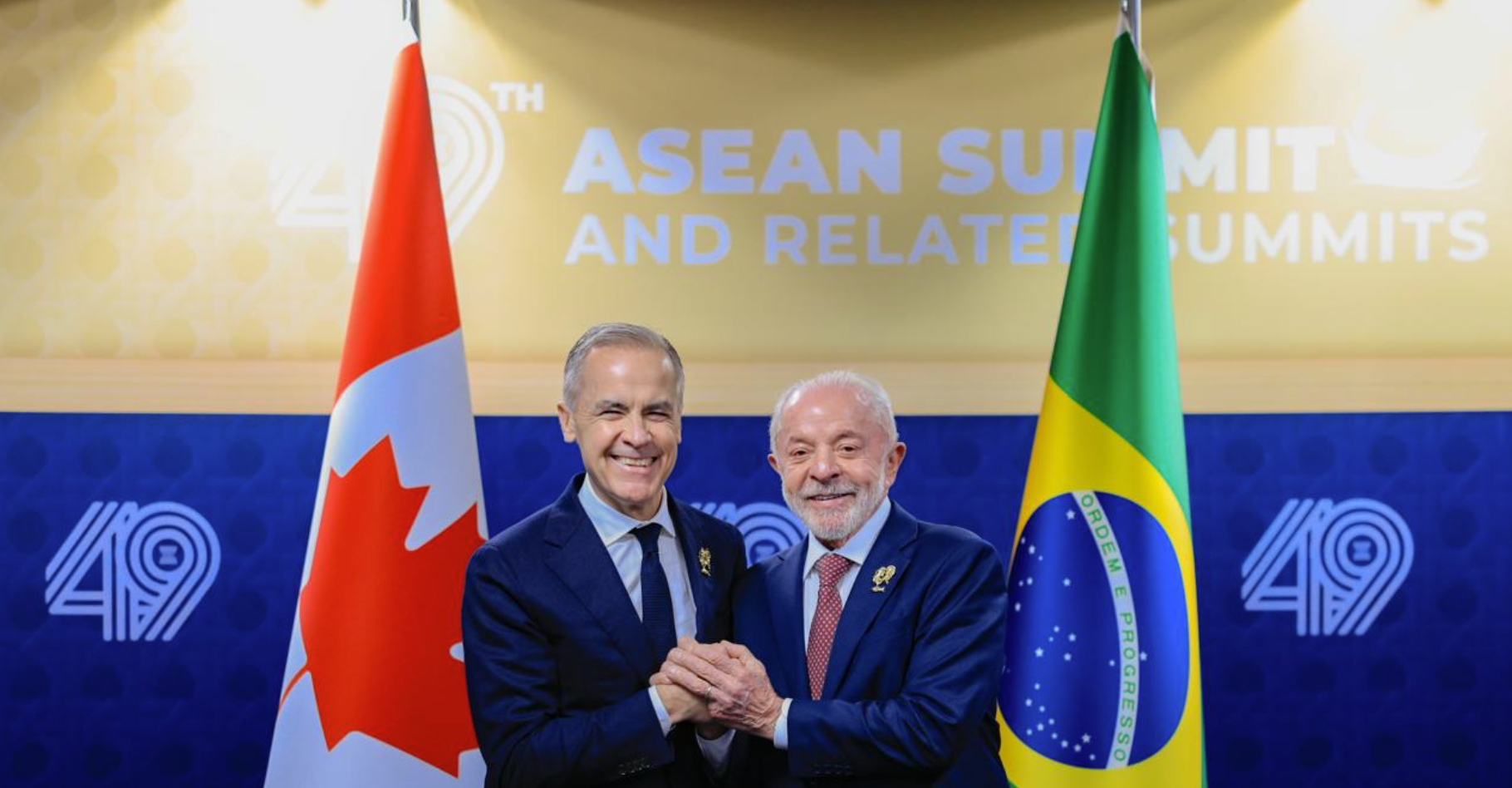
Photo: Canadian Prime Minister Mark Carney and Brazilian President Luiz Inácio Lula da Silva in Manila, Philippines, November 15, 2026.
The Prime Minister’s Office has announced: “The Prime Minister, Mark Carney, met with the President of Brazil, Luiz Inácio Lula da Silva, on the margins of the Association of Southeast Asian Nations (ASEAN) Summit in Manila, Philippines, where he announced an initial contribution of up to $560 million over four years to the Tropical Forest Forever Facility (TFFF). Co-led by Brazil and Norway, this innovative financing mechanism is mobilising public and private investment to protect tropical forests, preserve biodiversity, and support the communities that depend on these vital ecosystems.”
Luciana Téllez Chávez, the Senior Researcher for Environment and Human Rights at Human Rights Watch, is supportive of the TFFF. Last week she wrote: “The Netherlands’ commitment at the United Nations climate change conference (COP31) today that it will invest up to half a billion dollars in the Tropical Forest Forever Facility (TFFF) is a major step towards protecting the world’s most biodiverse ecosystems and the rights and livelihoods of millions of people who depend on them.”
Global Witness has cautions: “While the TFFF could be a transformative lifeline for protecting forests, the entire fund is at risk of being undermined by the continued flow of private finance to companies driving deforestation.”
The Global Campaign to Demand Climate Justice, whose members include Friends of the Earth International, 350.org and the Transnational Institute, is critical of the TFFF. They say: “TFFF is a false solution that deepens the financialisation and commodification of forests rather than protecting them. Behind the rhetoric of conservation, the TFFF hands control of forest governance to global financial actors and institutions like the World Bank, with a documented history of human and environmental rights violations in so-called ‘conservation’ and ‘development’ projects.”
The Global Forest Coalition has also commented: “The current climate and biodiversity finance architecture … is subservient to the extractive economic model. The barriers to accessing funding by Global South countries, such as power asymmetries, debt injustices and challenges in resource mobilisation are not going to be overcome with debt-driven conservation schemes like the TFFF.”
And Censat Agua Viva (Colombia), Acción Ecológica (Ecuador), Greenpeace (Spain), ANAFAE (Honduras), Yayasan Pusaka Bntala Rakyat (Indonesia), Asamblea de los Pueblos Indígenas del Istmo en Defensa de la Tierra y el Territorio (Mexico), along with many others, have denounced the TFFF.
They say: “The investors buying TFIF bonds [the center piece of the TFFF is Tropical Forest Investment Fund] and the activities financed by TFIF loans will very likely be linked, directly or indirectly, to deforestation and human rights abuses.”
Groups such as Indigenous Climate Action also appear to hold the view that agreements such as the Tropical Forest Forever Facility (TFFF) “are being made without their free, prior, and informed consent”, while La Via Campesina has posted on their website: “TFFF is a colonial plan of Northern elites, by Northern elites and for Northern elites that will make the rich richer by extracting wealth from the global South.”
Land and environmental defenders
Within the multiple concerns expressed about the TFFF, there is no specific or explicit reference to the safety and security of the land and environmental defenders on the frontlines of protecting forests.
The concerns do, however, highlight the involvement of the World Bank “with a documented history of human and environmental rights violations”, the perpetuation of the “the extractive economic model”, potential links to “human rights abuses”, and the absence of free, prior and informed consent.
The Heinrich Böll Foundation has shared an article on their website that comments the United Nations COP31 climate summit in Antalya, Turkiye is a “make or break” moment for the TFFF. COP31 concludes on November 20.
PBI-Canada has followed COP summits since COP25 in 2019 and has sought to amplify the voices of land and environmental defenders impacted by its outcomes. We continue to follow the implications of TFFF for defenders.

