


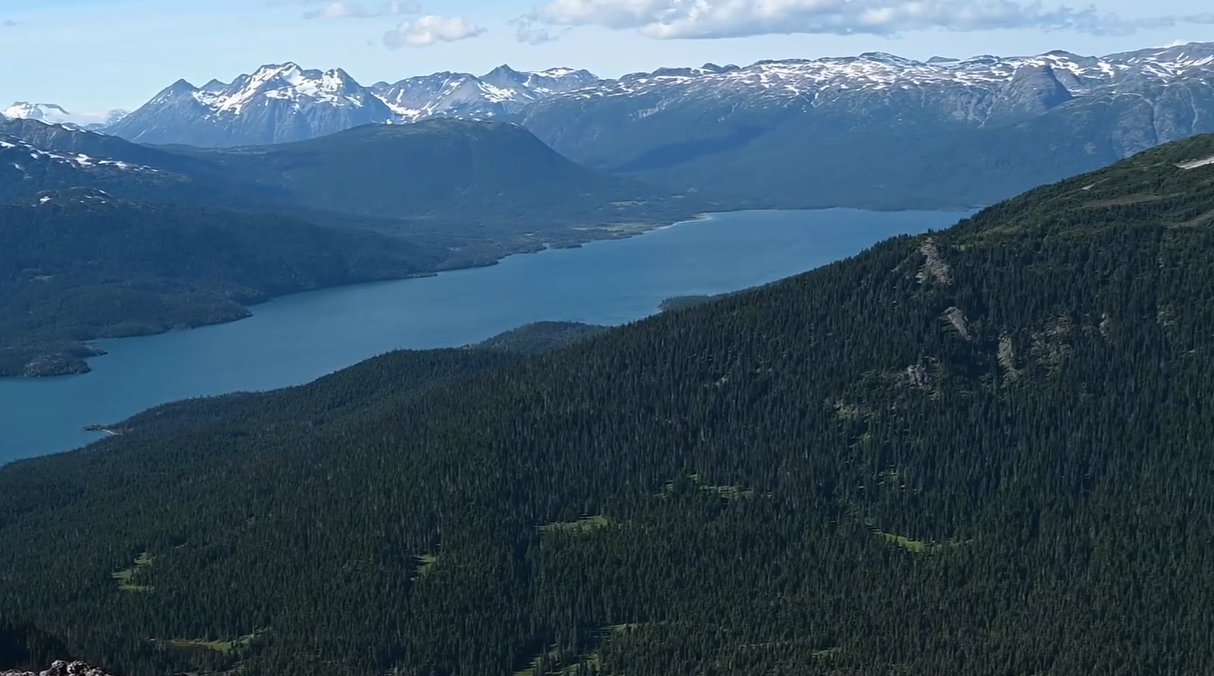
Video still: Nanika Lake.
Vancouver-based Surge Copper Corp. is planning to construct the Berg Copper Project, an open-pit copper mine, beside Nanika Lake situated at the headwaters of Wedzin Kwa on Wet’suwet’en territory near Houston, British Columbia. Fisheries biologist Michael Price tells The Narwhal that Nanika Lake’s downstream river system is the “single most important salmon spawning river in the territory”.
The Narwhal also notes that the copper deposits that would be mined are valued for their “superconductive properties which make it essential in expanding electric systems” and further notes that “molybdenum’s strengthening properties are used in everything from fighter jets to chemical processing”.
That article also highlights that the territory of Sleydo’ Molly Wickham, a wing chief in the Cas Yikh house of the Gidimt’en Clan of the Wet’suwet’en nation, “sits adjacent” to the proposed mine site.
She tells The Narwhal: “It feels like a bigger threat to our way of life than the Coastal GasLink [fracked gas pipeline].”
Sleydo’ has previously commented: “Our identity as Indigenous peoples is tied to the land, to our water, to the fact that we harvest salmon every year. …If we don’t have that our people will die. And that’s the genocide.”
The US Department of War uses 750,000 tons of minerals each year, according to the National Mining Association.
Both copper and molybdenum are listed as “materials of interest” by the Defense Logistics Agency, a combat support agency in the United States Department of War, that “manages the end-to-end global defense supply chain – from raw materials to end user disposition – for the five military services”.
Surge Copper CEO Leif Nilsson says: “Molybdenum is a strategic metal with a lot of important uses that people should care about right now.”
Timeline
Surge Copper submitted its “Initial Project Description” to the British Columbia Environmental Assessment Office on September 9, 2026.
MyBulkleyLakesNow reports: “Nilsson estimated the environmental assessment process will take about three to five years to complete with further steps needed before construction can start. …Construction is expected to take about three years with an estimated 28-year operation phase.”
We continue to follow this.
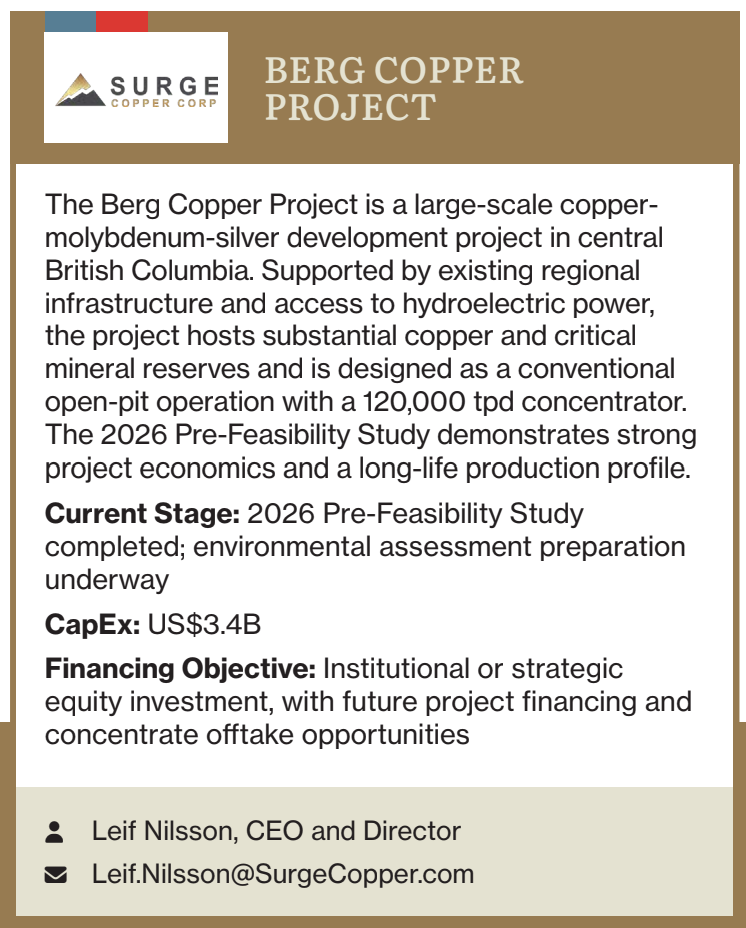
Image from Canada Investment Summit Prospectus (September 2026)
Research note
The US Department of War has invested USD $78.4 million in critical mineral mines and production facilities in Canada over a two-year period (2024-25). These include (in descending order of investment):
-Electra Battery Materials (Toronto, Ontario) – Temiskaming Shores cobalt sulfate production, Ontario (USD $20 million – August 2024)
-Fireweed Metals (Vancouver, British Columbia) – Mactung tungsten mine, Yukon (USD $15.8 million – December 2024)
-Northcliff Resources (Vancouver, British Columbia) – Sisson tungsten mine, New Brunswick (USD $15 million – May 2025)
-Nano One Materials (Burnaby, British Columbia) – Candiac lithium-ion battery materials plant, Quebec (USD $12.9 million – September 2024)
-Global Battery Materials Corp./Lomiko Metals (Toronto, Ontario) – La Loutre graphite mine, Quebec (USD $8.3 million – May 2024)
-Fortune Minerals (London, Ontario) – NICO cobalt-gold-bismuth project, Northwest Territories and Alberta (USD $6.4 million – May 2024).
The US Department of War has also invested USD $47.4 million in Canadian mining companies operating in the United States (with mining operations that have applications in the production of weapons), including:
-Trilogy Metals (Vancouver, British Columbia) – copper, cobalt, germanium production, Alaska (USD $35.6 million – August 2025)
-Lithium Americas Corp. (Vancouver, British Columbia) – Thacker Pass lithium mine, Nevada (USD $11.8 million – August 2024).
Further reading: Elbows up? Canada is letting Pentagon take ‘unprecedented’ stakes in Canadian mines (Shiri Pasternak and Nessie Nankivell, The Breach, May 22, 2026).

