


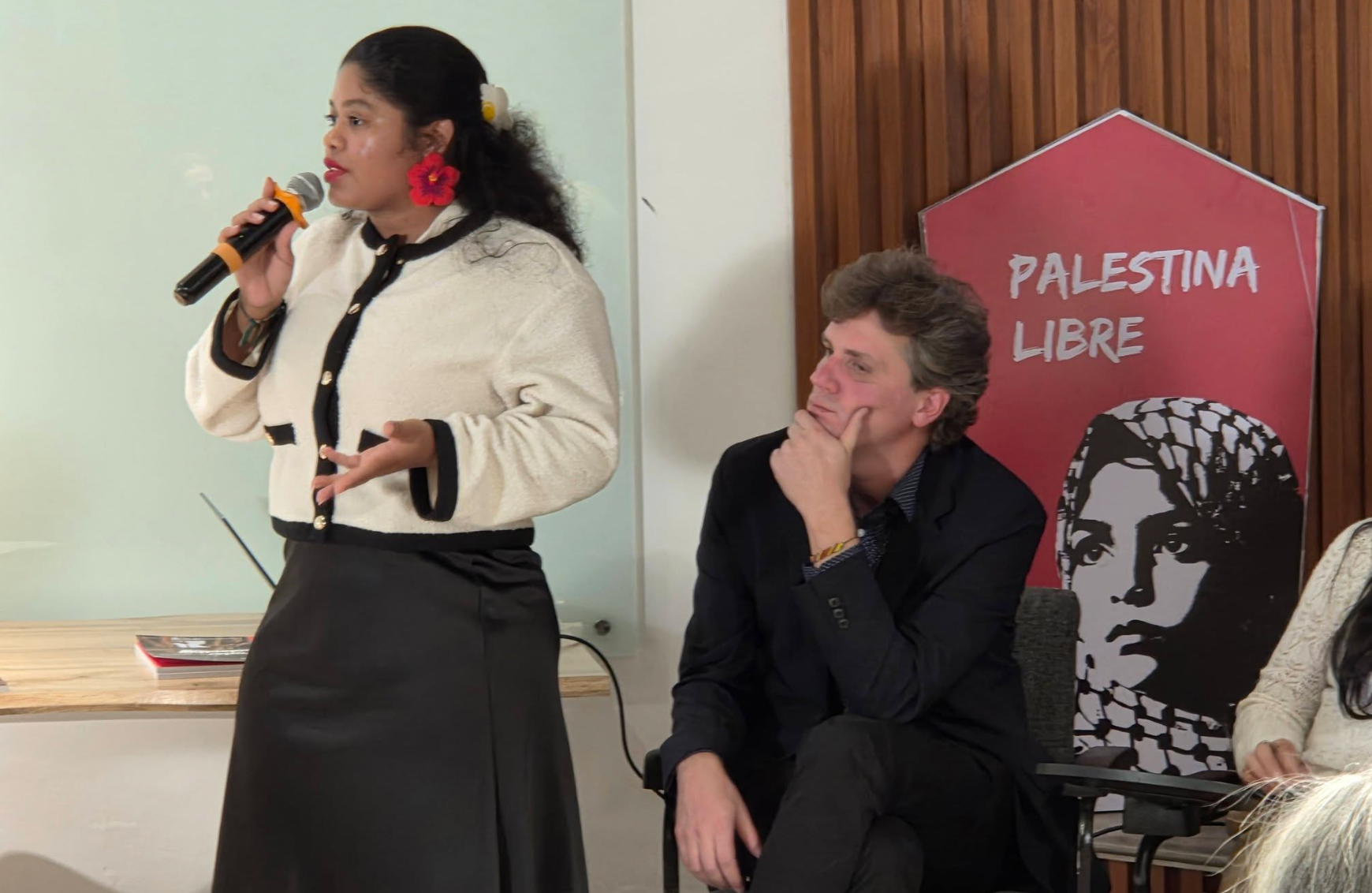
Photo: Yuvelis Morales (Colombia Free of Fracking Alliance) and Javier Garate (Global Witness), Bogota, Colombia, November 4, 2026.
On November 4, 2026, Peace Brigades International-Canada attended the launch of the Global Witness report “Collective Power” in Bogota, Colombia.
Promotion for the event noted that Yuvelis Morales, leader of the “Colombia Free of Fracking Alliance”, would be speaking. Morales is a 25-year-old Afro-Colombian environmental defender from Puerto Wilches.
Morales has participated in two previous PBI-Canada organized webinars (on April 29, 2021, and then on May 8, 2022, while in exile in France).
In her remarks at the event in Bogota, Morales explained: “This alliance focuses on specific, targeted issues. We speak out against fracking, of course, but we also speak up for life, for human rights, for the rights of nature, for the rights of ecosystems—and even for the well-being of the Magdalena River, a river that is recognized as a rights-bearing entity and has been acknowledged as a victim of the conflict.”
“Over the past ten years, we have dedicated ourselves to research, mapping, publishing, and visiting communities where fracking has actually taken place. We sought to compare that reality with our own, as there is a narrative that fracking is a highly successful experiment—one that should be replicated in Colombia, just as it was in Argentina and Mexico, and because it supposedly generates so much wealth—but one has to ask: who will actually see those benefits?”
“When we began talking to people in places where fracking has occurred, the reality we encountered was overwhelming. What we had been told about the economic benefits of fracking—and everything it was promised to bring—turned out to be a lie. The reality on the ground was defined by violence, state abandonment, pollution, tragedy, and profound inequality. It involved pressure on human rights, land dispossession, forced displacement, and conflict—in our case, armed conflict.”
“Our colleagues face murder, intimidation, stigmatization, and public targeting. They receive death threats—because that, too, is what one exposes oneself to when participating in a public decision-making arena in this country. There is a terrible violation of human rights—a targeting of people—amidst everything that is happening to us, and continues to happen to us, even today.”
“Fighting against fracking is incredibly difficult and painful; it involves violations and violence, and it can bring you to tears in so many ways. You might face threats that force you to leave your own territory—a scenario that is, unfortunately, not just an isolated possibility, but a real danger.”
“The struggle continues because we remain alive, and in that vitality, we find a sense of defiance—a spirit of rebellion. Defending water, life, and our territories in this country—the nation with the highest number of human rights defender assassinations in the world—is, without a doubt, a bold undertaking; above all, it is an act of rebellion.”
Morales concluded her remarks by stating: “I invite you all—let’s not get lost in daydreams, and I won’t romanticize anything (though, truth be told, it’s quite nice to romanticize things every now and then)—to join this struggle for life, to join this fight against fracking. Be rebels alongside us: paint, put up stickers, join our marches, and when we call for caravans, show up—come to the Magdalena Medio, to the Cesar region, or to the Cesar-Ranchería basin. Let’s work together to ensure that, even if this bill [Bill 011 of 2026] doesn’t pass, Colombia remains a country free from fracking.”
Accompaniment
Peace Brigades International-Canada continues to follow the work of Yuvelis Morales and the Colombia Free of Fracking Alliance whose more than 120 social, environmental, union, community and academic organization member groups include the oil workers union UNO, the Federation of Artisanal Fishers and Environmentalists of Santander (Fedepesan), the Regional Corporation for the Defence of Human Rights (Credhos), and the José Alvear Restrepo Lawyers’ Collective (CAJAR).
Further reading
–As communities prepare to oppose extractive projects, Canada reaffirms the ‘strengthening’ of the mining-energy sector in Colombia (PBI-Canada, October 21, 2026)
–Public Statement: We Reject the Threats Against Yuli Velásquez (Colombia Free of Fracking Alliance, October 20, 2026)
–PBI-Canada congratulates Yuvelis Morales Blanco on winning the 2026 Goldman Environmental Prize (PBI-Canada, April 20, 2026).

