


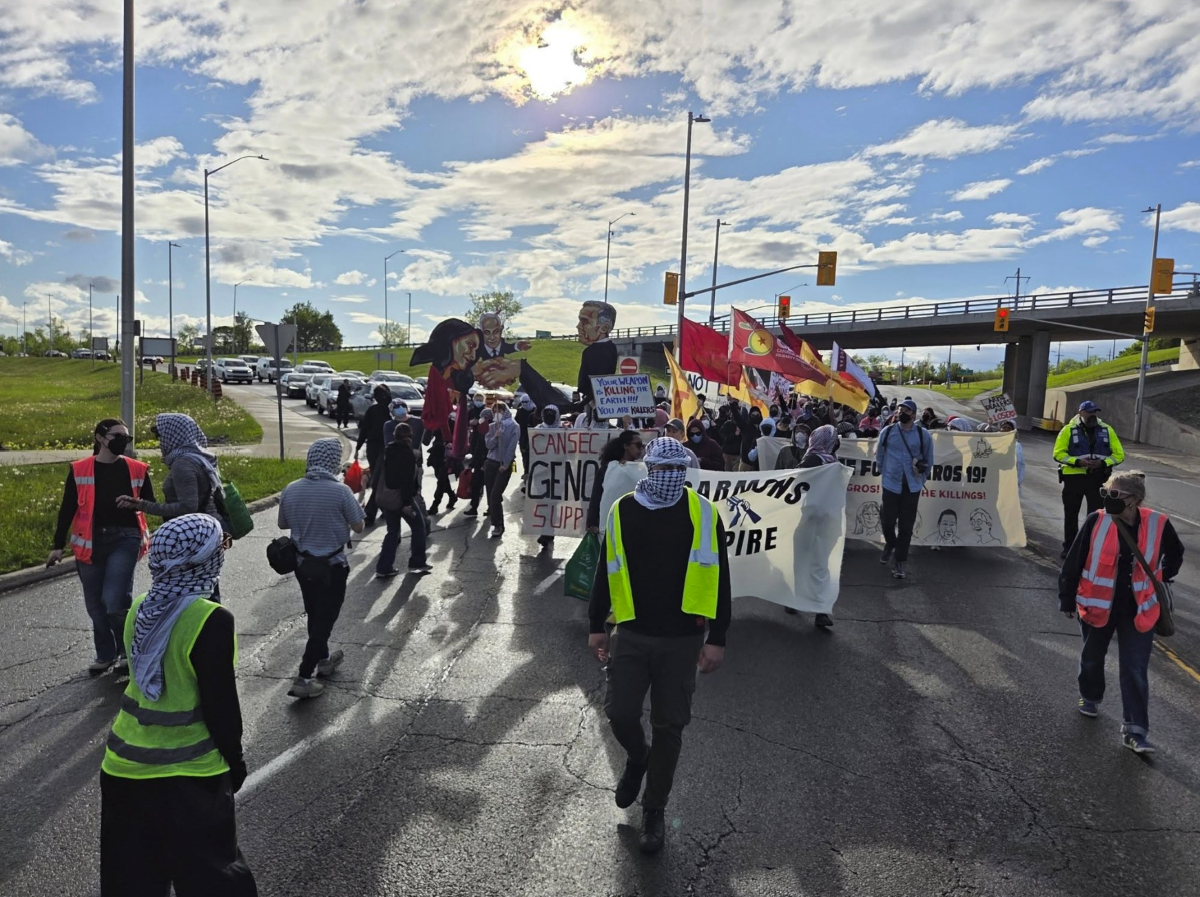
Photo: The May 2026 protest against CANSEC where companies involved in autonomous weapons systems exhibit in Ottawa.
Earlier this year, Human Rights Watch posted a short video and text noting: “Autonomous weapons systems are a hazard to human rights.”
United Nations Secretary-General Antonio Guterres has also highlighted the risks associated Lethal Autonomous Weapons Systems (LAWS) and artificial intelligence (AI) in the context of compliance with international humanitarian law.
His report in July 2024 warned of the need to “support and facilitate existing and potential new processes to address emerging challenges before they can pose a danger to peace and security, human rights, humanitarian norms and principles.”
Bonnie Docherty at the Harvard Law School International Human Rights Clinic is quoted in an article titled “Killer Robots’ Threaten Human Rights During War, Peace commenting: “Human beings, whether soldiers or police officers, often egregiously violate human rights, but it would be worse to replace them with machines. While people have the ability to uphold human rights, machines do not have the capacity to comply or to understand the consequences of their actions.”
And more than 10 years ago, Amnesty International cautioned: “AWS [autonomous weapon systems] could even be used to facilitate violations of the right to freedom of expression and right to freedom of peaceful assembly.”
What are autonomous weapon systems?
The Geneva, Switzerland-based International Committee of the Red Cross (ICRC) has explained: “Autonomous weapon systems, as the ICRC understands them, are any weapons that select and apply force to targets without human intervention. …An autonomous weapon is triggered by sensors and software, which match what the sensors detect in the environment against a ‘target profile’.”
The Brennan Center for Justice at New York University School of Law has also noted a slightly different framing: “The [United States] military is investing heavily in the development of autonomous weapons, which can select targets and take lethal action with varying degrees of human involvement. …The Pentagon requested $13.4 billion for these types of systems for 2026 alone.”
What is a battlespace?
A “battlespace” has been defined as “the area of air, sea, and land that is directly involved in war, often taken to include any technological, environmental, infrastructural, or temporal factors which may be relevant to the success of a mission.”
In this context, US Army Major Michael J. Brodka wrote this summer: “On a distant battlefield in the near future, machine signals govern action where human voices once commanded. Swarms of autonomous, unmanned systems patrol the battlespace, linked through distributed AI and mesh networks.”
The Autonomous Battlespace Conference in Ottawa
It is with this background that we look at the Autonomous Battlespace Conference taking place in Ottawa this coming November 23.
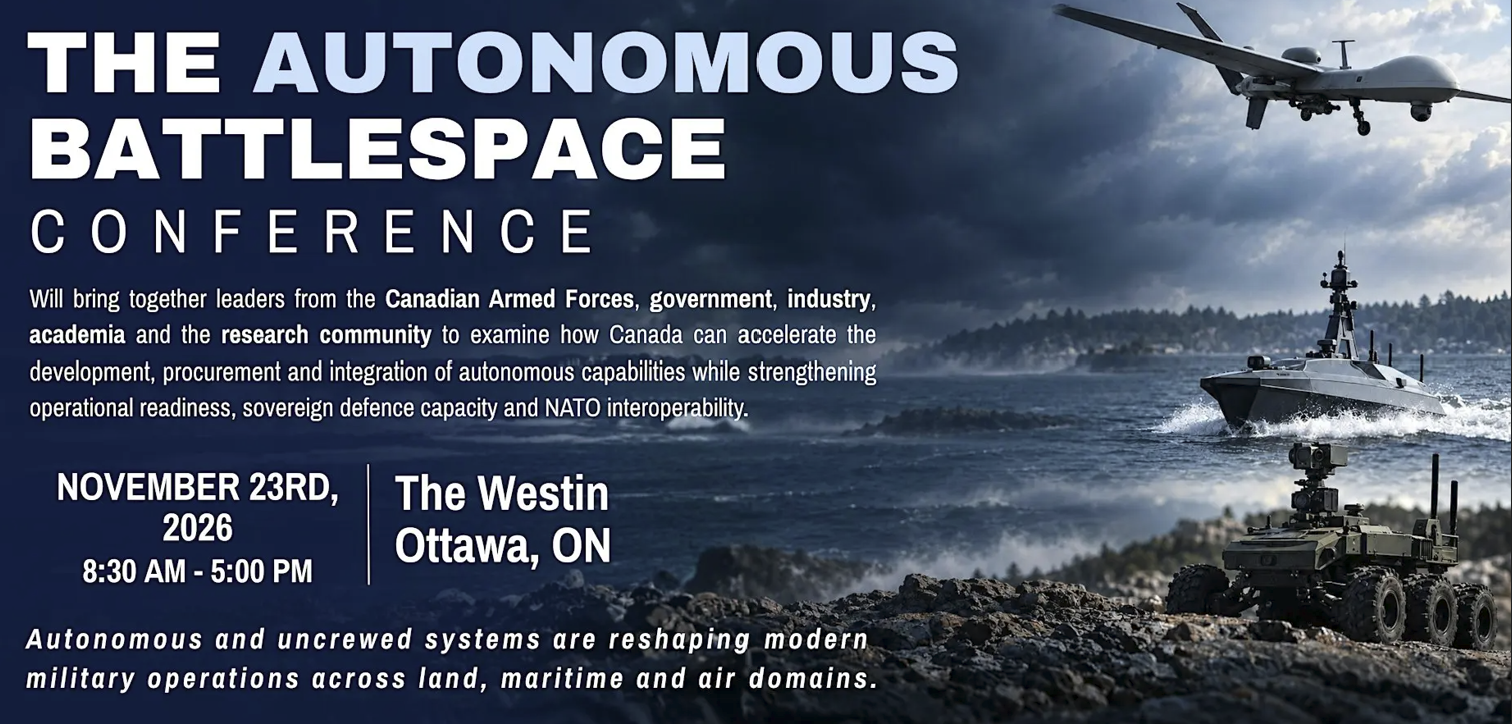
The event overview notes: “This is a full-day conference bringing together leaders from the Canadian Armed Forces, Government of Canada and defence industry to examine autonomous and uncrewed capabilities across the air, maritime and land domains, as well as the C5ISR(T) and joint integration required to connect these capabilities across the future force.”
Calian, an Ottawa-based company that has shipped its GPS antennas to Elbit Systems, defines C5ISR(T) as “command, control, communications, computers, cyber, intelligence, surveillance, reconnaissance and targeting”.
The opening “Fireside Chat” at the Autonomous Battlespace Conference will be: “A moderated discussion examining how autonomous and uncrewed systems are transforming modern warfare, the lessons emerging from contemporary conflicts, and what these changes mean for joint operations, force development, integration and the future of the Canadian Armed Forces.”
The conference also includes four panels with Canadian military personnel and yet-to-be announced industry representatives.
What corporations make LAWS?
The transnational corporations that produce lethal autonomous weapons systems (LAWS) include Elbit Systems, Israel Aerospace Industries, RTX/Raytheon, BAE Systems, Northrop Grumman, and Helsing.
The Helsing website notes: “We design new types of AI-defined autonomous systems across all domains. And we partner with governments and industry to connect their existing hardware into these new networks.”
Last month, Victor Fedeli, the Minister of Economic Development, Job Creation and Trade for the Ontario government posted on Facebook: “Helsing is a prominent German AI-driven defence technology company who recently established their Canadian headquarters in Ottawa. As defence innovation becomes increasingly focused on advanced technology and modernization, we emphasized how Ontario’s world-class AI ecosystem will be beneficial to their future endeavours.”
Palantir and AI technology for targeting
The Brennan Center for Justice explains: “The Pentagon is reportedly using AI to generate hundreds of recommendations for targets in Iran, pinpoint their location, prioritize their importance, and even evaluate whether the targeting is legal. One of the AI systems it is using, the Maven Smart System [MSS], is the culmination of a decade of collaboration between the Defense Department and the tech industry to enhance intelligence analysis, surveillance, and targeting. The system enables the military to comb through massive amounts of information from satellites, data brokers, the military’s own drones and sensors, and social media to pick out people and objects of interest.”
The Center for Strategic & International Studies (CSIS) notes: “Palantir is the prime software integrator for MSS and stated in unpublished documentation reviewed by CSIS that MSS is powered by the Palantir Platform’.”
The call for an international treaty
The Red Cross is calling on States to support negotiations toward “a legally binding international instrument” that prohibits autonomous weapons systems that are “unpredictable in their effects” and “designed to target humans directly”. Overall, they want “restrictions on all other autonomous weapons”.
The ICRC adds: “When there are violations of international humanitarian law, holding perpetrators to account is crucial to bring justice for victims and to deter future violations. …There are many questions about whether alleged perpetrators of war crimes could be held responsible under existing legal regimes.”
The Stop Killer Robots campaign is also calling for “the adoption of a new international treaty to prohibit and regulate autonomous weapons systems.” The organizations that are a part of this coalition include Amnesty International, Human Rights Watch, and Human Security in Latin America and the Caribbean (SEHLAC).
And just ten days ago, multiple organizations called on UN member states to “move urgently to legal negotiations on autonomous weapons systems”.
The signatories supporting the call for negotiations on autonomous weapons systems include the Colombian Campaign Against Landmines (CCCM), EPCAT Guatemala, and the Centre for Ecumenical Studies in Mexico.
We continue to follow this.

