


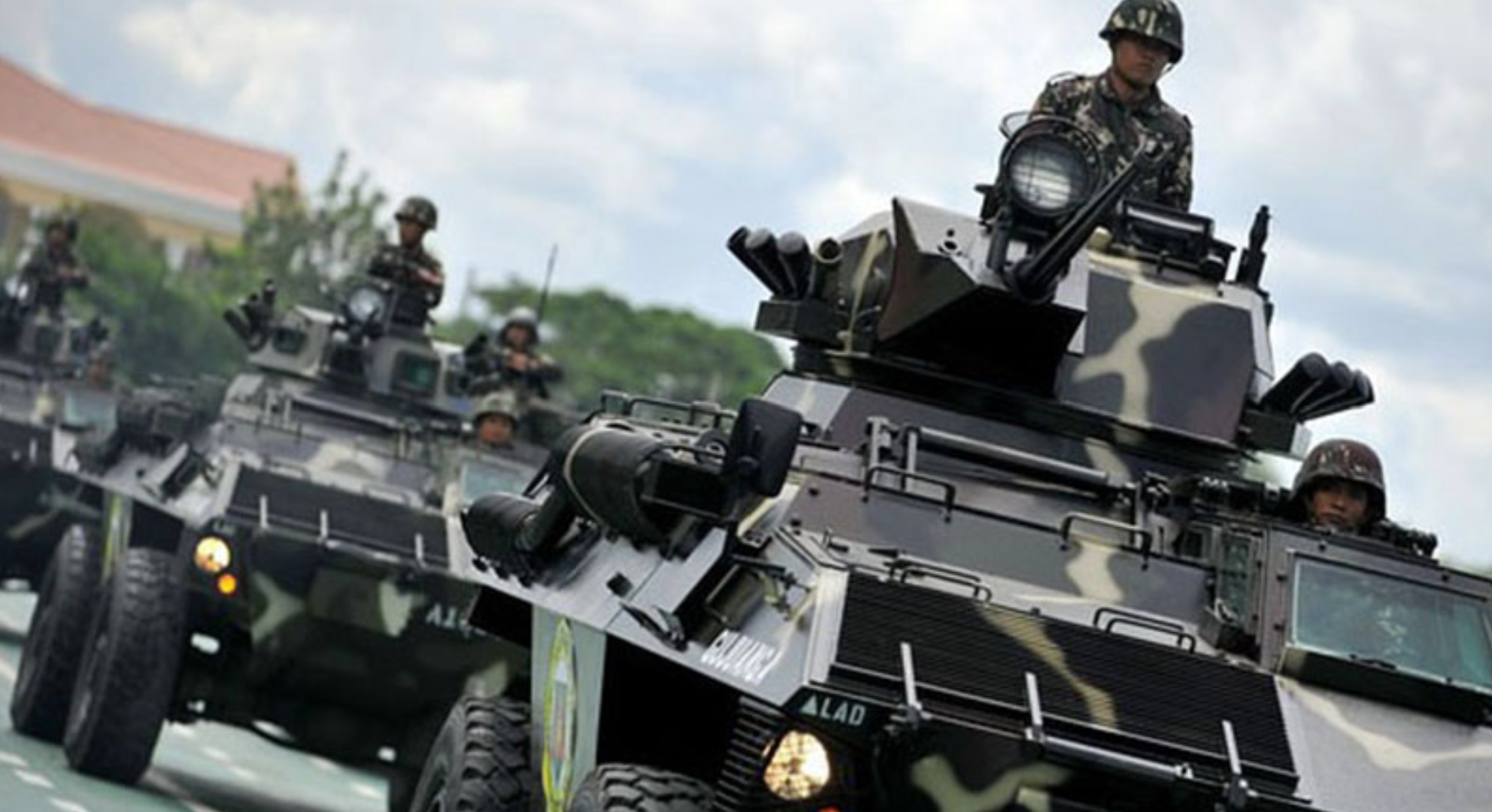
Photo by the AFP.
Global Witness has documented that between 2012 and 2024, at least 306 land and environmental defenders have been killed in the Philippines. Twelve more defenders were killed in 2025 bringing this total to 318 dead.
Global Witness has previously noted: “The military is the single biggest perpetrator of defender killings in the Philippines, especially of Indigenous Peoples.” Their report adds: “It was responsible for 64 out of 117 killings of Indigenous defenders Global Witness has documented between 2012-23.”
The independent magazine In These Times also analyzed the killing of environmental defenders in the Philippines from 2014 to 2024 and reports: “A very conservative assessment suggests evidence of state involvement in 109 of 210 such killings in the Philippines in the past decade — more than half.”
In June 2026, a report by the Observatory for the Protection of Human Rights Defenders also found that “counter-terrorism laws and counter-insurgency policies have been used to attack and criminalize land and environmental rights defenders, human rights lawyers, journalists, trade unionists, and women human rights defenders, including those from Indigenous Peoples’ communities”
That report by the Observatory states: “Perpetrators of attacks against defenders included: national and local authorities; the Armed Forces of the Philippines (AFP); the Philippine National Police (PNP); private security firms working for extractive companies; and conservative religious groups.”
What countries arm the Philippines?
In June 2025, Modern Diplomacy reported: “The Philippines is one of the world’s largest importer of arms. In a gross misallocation of resources, Manila is boosting its arms imports faster than any other major ASEAN arms importer.”
That article continues: “Manila imports more than 80% of its arms from just three countries: South Korea (33%), Israel (27%) and the US (20%).”
Notably, Canadian businesses have a relationship with all three countries.
South Korea
For example, the Trade Commissioner Service of Canada has noted: “Partnerships already exist between leading Korean defence firms and Canadian suppliers. The new Canada-Republic of Korea Security and Defence Cooperation Partnership, announced in October 2025, further strengthens the foundation for Canadian small and medium-sized enterprises (SMEs) to explore opportunities in Korea’s defence sector.”
In 2025, Canada exported $49,688,478.82 in military goods to Korea.
Israel
In July 2025, CBC News reported: “Canada is mostly a provider of components to Israel, rather than finished weapons systems or vehicles. Currently valid permits include printed circuit boards for land vehicles and materials ‘related to surveillance systems’ or ‘for repairs and maintenance of surveillance systems’.”
In 2025, Canada exported $14,671,705.14 in military goods to Israel.
United States
Canada is also a significant supplier of components to the United States military.
The annual report produced by Global Affairs Canada does not include the export of military goods to the United States. However, in September 2025, the Waterloo, Ontario-based Project Ploughshares estimated that Canada exports more than $1 billion annually in “weapons transfers” to the United States.
Canadian components in US weapons
In April 2021, the Washington, DC-based Cato Institute noted: “Since 2002, the United States has sold the Philippines nearly $900 million in weapons and provided over $1.3 billion in security assistance. In February 2021, the Philippines said it would move ahead on a purchase of 15 Black Hawk helicopters.”
The UK-based Campaign Against Arms Trade (CAAT) has also documented that the United States sold US $483 million worth of arms (Foreign Military Sales) to the Philippines between 2020 and 2024.
This included fifteen Lockheed Martin Black Hawk attack helicopters, as well as F-35 and F-16 combat aircraft. CAAT adds: “The Philippines armed forces have also received substantial quantities of small arms from the US.”
Canadian components could be related to those military exports to the Philippines. For example, Mississauga-based Magellan Aerospace now produces components for Black Hawk helicopters through the U.S. Defense Logistics Agency. Ottawa-based Gastops manufactures engine sensors for F-35 aircraft.
Direct exports to the Philippines
The direct export of Canadian “military goods” to the Philippines are relatively modest but could soon dramatically increase.
In the five-year period of 2012 to 2016, Canada exported about $12.9 million in military goods to the Philippines: $3,268,594 in 2012; $1,226,392 in 2013; $2,195,581 in 2014; $192,490 in 2015; and $6,050,640.67 in 2016.
In the nine-year period that followed (2017 to 2025), this totaled about $1.3 million: $3,219.78 in 2017; $175,497.00 in 2018; $458.00 in 2019; $18,100.00 in 2020; $399.95 in 2021; $385,000.00 in 2022; $514,604.48 in 2023; $22,929.81 in 2024; and $207,173.19 in 2025.
The relatively low latter figure is likely because a deal signed in December 2017 by Canada and the Philippines to sell 16 combat utility helicopters worth $233.36 million was cancelled by February 2018 after human rights concerns were raised.
On April 30, 2018, the National Post reported: “Just months after a contract to sell military helicopters to the Philippines was cancelled, a Canadian firm is hoping it can revive the controversial deal. … Bell says it is now back in discussions with the Philippines as a potential client for the same helicopters.”
The Canadian agenda to increase exports
This past February 2026, Prime Minister Mark Carney announced Canada’s Defence Industrial Strategy that pledges to “increase our defence exports by 50%” and “ramp up Canada’s presence at major global defence and aerospace trade shows”.
In August 2026, a Senior Public Affairs Officer, Indo-Pacific, with the Department of National Defence in Ottawa highlighted that Canada and the Philippines are taking “defence cooperation to new heights”.
ADAS and CANSEC 2027
The Asian Defense & Security (ADAS) exhibition is held biennially in Metro Manila. This is where transnational corporations, including Elbit Systems and Lockheed Martin, exhibit to secure contracts with the Armed Forces of the Philippines. The next ADAS on June 28-30, 2027, will include a “Canada Partnership Pavilion”.
Just a few weeks earlier, the Philippines is likely to be among the 100+ international delegations at the CANSEC arms show on June 2-3, 2027, at Cohere Centre in Ottawa. CANSEC is described by its organizers as “Canada’s largest defence, security & emerging tech tradeshow where $1B+ in business deals happen every year.”
We continue to follow this.

