

Peace Brigades International-Spanish State has posted on Instagram:
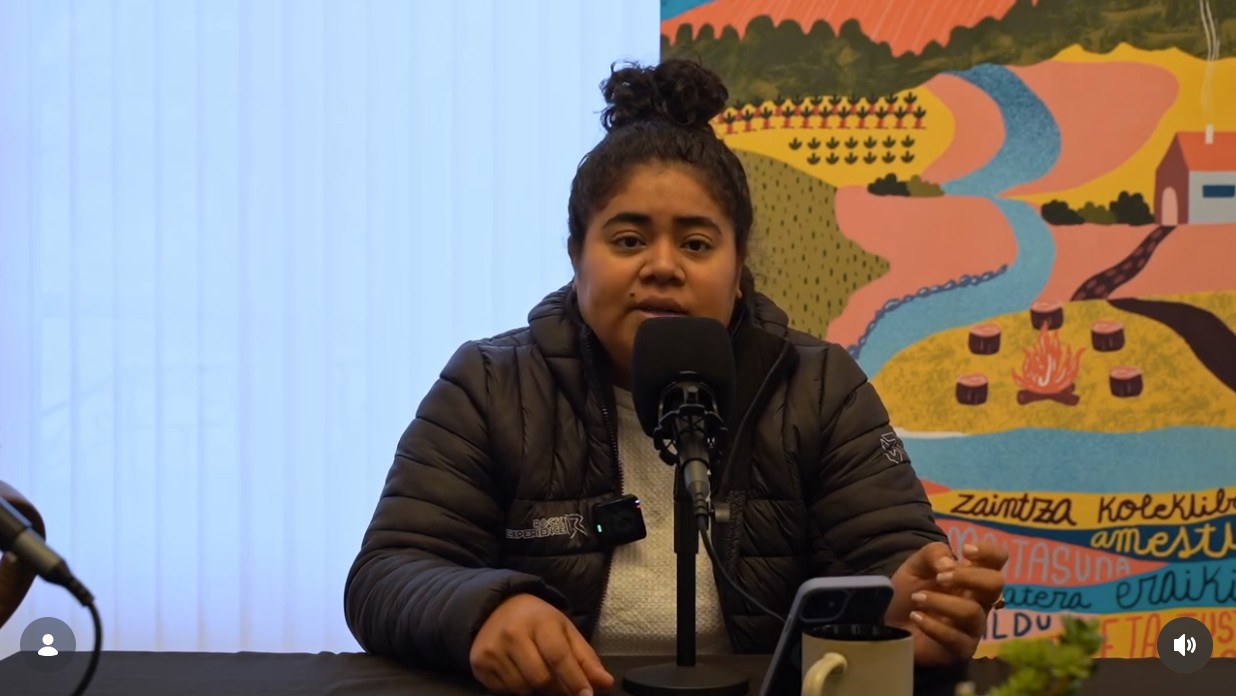
’Water and land are ours, let’s defend them.’ Gabriela Sorto, from the Coordinating Committee of Popular Organizations of the Aguán (COPA) and the Municipal Committee in Defence of Common and Public Goods (Honduras).
#WomenDefenders #CommunicationForProtection #defenders #ProtectionCommunication
Here’s the full podcast: ‘Local Waves for the Protection of Territory, Nature, and Human Rights.’ ‘Local waves to protect land, nature and human rights. Defenders of land and life.’ https://pbi-ee.org/es/recursos/audiovisual

As noted on the PBI-Spanish State website: “Recorded at El Palacio de Aiete in Donostia [a city located in the Basque Autonomous Community in Spain], which hosts the House of Peace and Human Rights, a public space focused on coexistence, historical memory and education in peace values, by journalist Olga Grande and her Radio Nómada studio.”

In this podcast, Sorto says:
“In Honduras there are some very difficult situations. For instance, there are the struggles of farmers defending their lands, the environmental struggle, the struggle against mining, open-pit mining, and, well, there’s also a struggle as social communicators, in which we are made invisible, in a way, because, well, we work for community radio stations, which don’t have the same visibility as, let’s say, the big radio stations, the ones that are supported by large corporations in Honduras.
In Honduras, since 2015, there has been a very strong struggle to defend the Carlos Escaleras mountain, which is a national park that should never have been touched by a mining company, but in this case it was.
And, well, the communities, feeling that our river, which is the source of water for the communities, and the mountain were being destroyed, we began a fight to defend the mountain, to defend the river, to defend the communities.
And we started to, let’s say, investigate, and we saw that there’s a gap in a road leading up to the mountain, where an open-pit mine is going to be located. There’s also an iron pelletizing plant, the largest in Central America, on the banks of the Guapinol River, where I live in my community. This plant was already being installed, and that leads us to say that the communities haven’t been informed that this was going to happen.
There hasn’t been a prior, free, and informed consultation. So, we started investigating and we realized that these companies use, for example, local community meetings. They use them to make it seem like the communities are in favor of these projects, where people don’t know they’re signing an attendance list, for example, to favor a mining company. And we realized this over time through the investigations, that what they were doing was validating this mining project.
And well, I think people realize they’ve been deceived, and that’s where the most outrage comes from, because they arrive through of lies, of deceptions, offering things that, well, are not their responsibility, and shouldn’t it be the State of Honduras that should provide schools, kindergartens, health centers in the communities, and that through this they are offering these things to the communities so that they can be accepted, but we know that, what good is a bridge to me, for example, if they’re going to dry up the river?
The inhabitants of the communities reacted to that, and well, there has been criminalization, dispossession, and well, imprisonment, and also murders. We had comrades imprisoned for more than, well, 914 days, among them was my father. One of them was criminalized, and because of that criminalization, there was also a diversion because we focused on trying to secure their release, and we let the mining company, for example, go about its business peacefully during all those 914 days, and was able to advance in a way that destroyed the mountain.
I say it’s like a cake, like pieces of cake, destroyed. And well, there was also exploitation in the upper part, and there is already serious damage to the rivers, the Guapinol River, the San Pedro River.
And well, we know that these mining companies, in order to extract gold, use cyanide, and cyanide has already been found in the river waters, so the rivers are no longer viable for consumption.
So, well, we pray for the release of our comrades, and the struggles of the communities continue; they continue demanding that the company stop by 2024. As a result of all this struggle and continued demands, the coordinator of the Municipal Committee was murdered more than a year ago, and so far only the perpetrators have been apprehended. We continue to demand justice in order to reach the intellectual authors, but so far we have not been able to achieve that.
Our strength comes from seeing that river, seeing that river flowing, its water still clear despite everything, seeing those mountains regaining their natural color, their green color, where there were no trees left, seeing the reconstruction that’s underway. Because in our communities, the task we’ve taken on is planting trees along the riverbank, taking care of the river, and I think that helps us keep drawing strength.
And despite the threats, I think there’s a conviction to fight, and we know that, well, we’re the ones who have lived in these communities since we were born, and I think the fight is just, and that’s why we’re doing it, because we also know that, as our comrade Berta Cáceres said, they have the bullets, but we have the words, and I think that’s what’s important: speaking the truth and telling what we’re doing from our territories, saying what’s happening.
I dream big. I dream of a future, as they say, with free-flowing rivers, free-flowing mountains, and, well, defenders standing up for their rights without fear of losing their lives.”
The full interview can be heard in Spanish here.


