


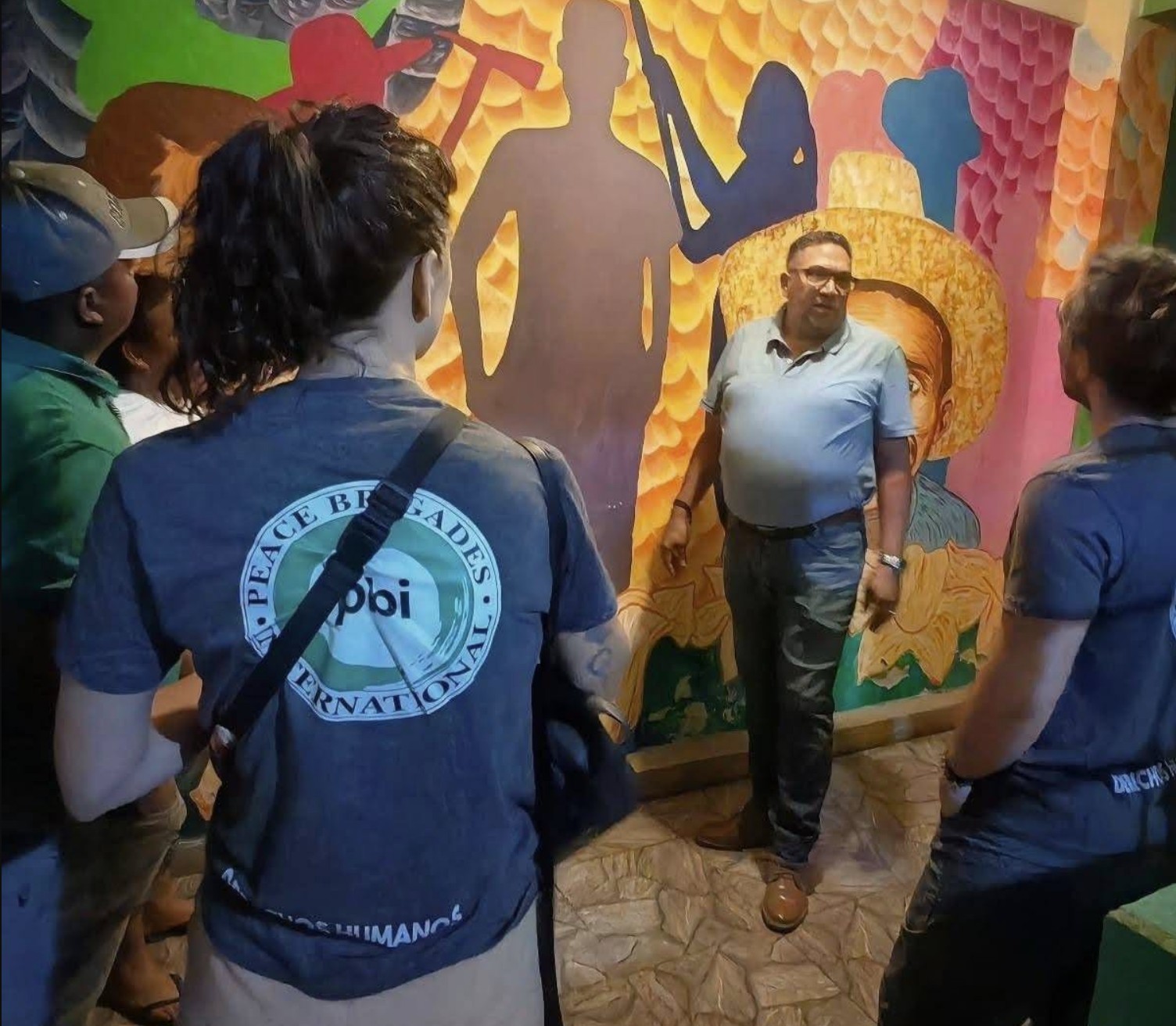
The Peace Brigades International-Honduras Project has posted on social media:
“’We are vigilant and trying to unite and become stronger, not only under our own banner, but also with all the other organizations working toward the same goals,’ says the @cntctegucigalpa [National Union of Rural Workers], regarding the constitutional challenge filed against the Agro-industrial Law.
During PBI’s visit to their offices, the CNTC highlighted the serious situation of criminalization of peasant leaders. Despite this, they say progress is being made, with more than 1,000 new land titles granted to peasant families and increasing international support.
‘We are trying to raise awareness among our grassroots members in the territories, especially those most vulnerable to extractive and tourism projects, so that they don’t stop working on their land titling processes.’”

The Agro-Industrial Law
The Center for the Study of Democracy (CESPAD) noted: “On February 10, 2026, a draft law aimed at granting preferential legal and administrative protection to the agro-industrial sector was presented in the National Congress. The proposal stands out for measures such as the streamlining of licenses, the declaration of non-affectability of lands and the immediate intervention of security forces in conflict scenarios.”
Infobae commented: “The approval [in June 2026] of the Law for the Strengthening and Protection of the Agroindustrial Sector by the National Congress has opened a broad debate among productive sectors, peasant organizations, human rights defenders and international organizations on the scope and possible consequences of the new regulations. …The implementation of the regulations and their effects in the coming months will be decisive in assessing their impact on one of the most sensitive issues in the Honduran reality: agrarian conflict and the coexistence between economic development, productive investment and the rights of rural communities.”
After the passage of the Agro-industrial Law, El Heraldo noted: “The forces of public order will be obliged to intervene immediately in cases of strikes, demonstrations or protests on public roads. In such crisis scenarios, the National Police and road authorities must enable safe logistics corridors and clear accesses, ports and routes without delay.”
Then on June 10, Criterio.hn reported: “In a clear violation of parliamentary regulations, the National Congress of Honduras expanded the scope of the Law … to include the energy and tourism areas.”
And on June 15, Criterio.hn further reported: “Not satisfied with the legislative shield granted to sectors such as agribusiness, energy and tourism, the liberal deputy for Puerto Cortés, Alex Berrios Lamothe, promoted the initiative called the Safe House Law. Presented as a response to crime, the initiative deepens the protection of private property by expanding the cases of legitimate defense, even in situations where the protected legal asset is not life but property.”
The constitutional challenge
On June 24, 2026, Telesurtv.net reported: “A massive front made up of more than 217 peasant, indigenous, Garifuna, feminist and social movements organizations appeared before the Constitutional Chamber of the Supreme Court of Justice of Honduras to file a preventive habeas corpus. The legal action seeks to stop the application of the recently approved Law for the Strengthening, Protection of the Agroindustrial Sector and Energy Projects, under the argument that it puts at serious risk the communities settled in disputed territories and areas of high productive interest.”
Avispa Midia also reported: “[Lawyer Edy Tábora, the director of the law firm Justicia para los Pueblos / Justice for the Peoples] explained that the legal appeal is directed against authorities of the three branches of government, including Nasry Asfura, who assumed the presidency recently in January of this year.”
That article highlighted: “It is also aimed at the heads of the National Police, Armed Forces, the National Congress, the Public Prosecutor’s Office and the Supreme Court of Justice, ‘for their direct or indirect responsibility in the eventual implementation of measures that could lead to arbitrary detentions, forced evictions and serious violations of fundamental rights,’ the organizations maintain in a public statement.”
Accompaniment
On March 3, 2026, PBI-Honduras, PBI-Canada coordinator Brent Patterson met with Franklin Almendares, General Secretary, and Rosa Santamaría, member of the National Board of Directors, of the CNTC at their office in Tegucigalpa.


Peace Brigades International has accompanied the CNTC since May 2018.


