

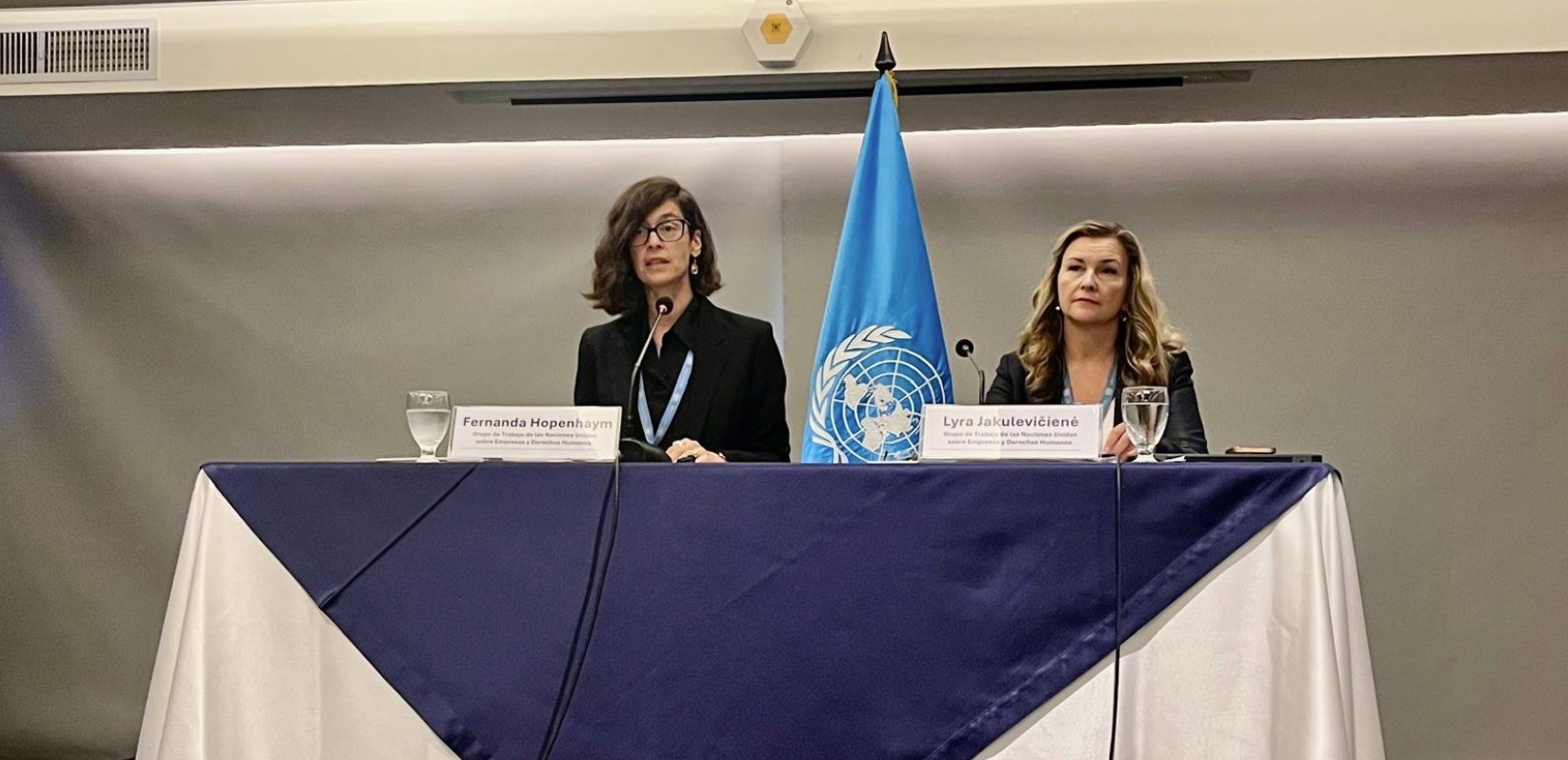
Photo: Fernanda Hopenhaym and Lyra Jakulevičienė presente their preliminary report in Guatemala City, August 28, 2026.
El Pais reports: “The United Nations (UN) Working Group on Business and Human Rights concluded its 10-day visit to Guatemala on Friday [August 28] with a report on the treatment of those who oppose extractive, energy and agro-industrial projects in the country. In their closing statement, the experts stated that the widespread criminalization of human rights defenders is ‘alarming and must cease immediately’.”
The Working Group was in Guatemala from August 18 to August 28.
The Associated Press adds: “The group led by experts Fernanda Hopenhaym and Lyra Jakulevičienė held meetings with employers, local authorities, workers, trade unions and President Bernardo Arévalo.”
El Pais further notes: “In the labour field, the statement includes testimonies about fatal accidents due to non-compliance with safety regulations, extended hours without adequate rest, child labor on agricultural plantations and cases of workers who had social security contributions withheld that were never transferred to the authorities. The most targeted sectors were oil palm, bananas, sugar cane and mining.”
Labour rights
The Working Group’s “end of mission statement” says: “The Working Group received first-hand testimonies concerning violations of labour rights in the agricultural sector, particularly in palm oil, banana and plantain, and sugar cane plantations, as well as in the mining sector. These reports included allegations of workplace injuries – including fatalities – resulting from failures to comply with basic occupational health and safety standards. We received reports of employers systematically failing to provide adequate protective equipment, particularly for workers handling hazardous chemicals.”
It further notes: “The Working Group noted that many workers, particularly in monoculture fields, are required to work excessively long hours with few, if any, rest breaks, for the minimum wage. Some are reportedly forced to resort to consuming mixtures of energy drinks and painkillers to endure these conditions, causing serious health problems. We are also deeply concerned by reports of child labour in agricultural plantations.”
Human rights defenders
The Working Group also highlighted in their preliminary report: “Throughout the visit, the Working Group repeatedly noted allegations of the criminalisation of human rights defenders, including members of Indigenous communities, representatives of non-governmental organizations, lawyers and journalists, in connection with their legitimate efforts to expose and denounce harmful business activities. Defenders have reportedly faced charges such as terrorism, illegal association, attacks against private property, aggravated usurpation and extortion. The weaponizing of the justice system to target human rights defenders and silence dissent is a matter of deep concern.”
Protection mechanism
This preliminary report also highlights: “Guatemala has a constitutional framework that protects human rights and has ratified key international instruments, including ILO Convention 169. We welcome recent efforts by the Government to address business-related human rights impacts, including the adoption of the Public Policy for the Protection of Human Rights Defenders (2025-2035), measures to combat forced labour and trafficking, progress toward protection mechanisms for journalists, and national plans on gender and climate change. The Working Group calls on the Government to expedite the operationalization of the new policy on defenders and to ensure that the associated protection mechanism is provided with adequate resources, technical capacity, and institutional support.”
To read the full report: End of Mission Statement, Country Visit to Guatemala, 18 – 28 August 2026 (United Nations Working Group on Business and Human Rights, August 28, 2026, Guatemala City).

