


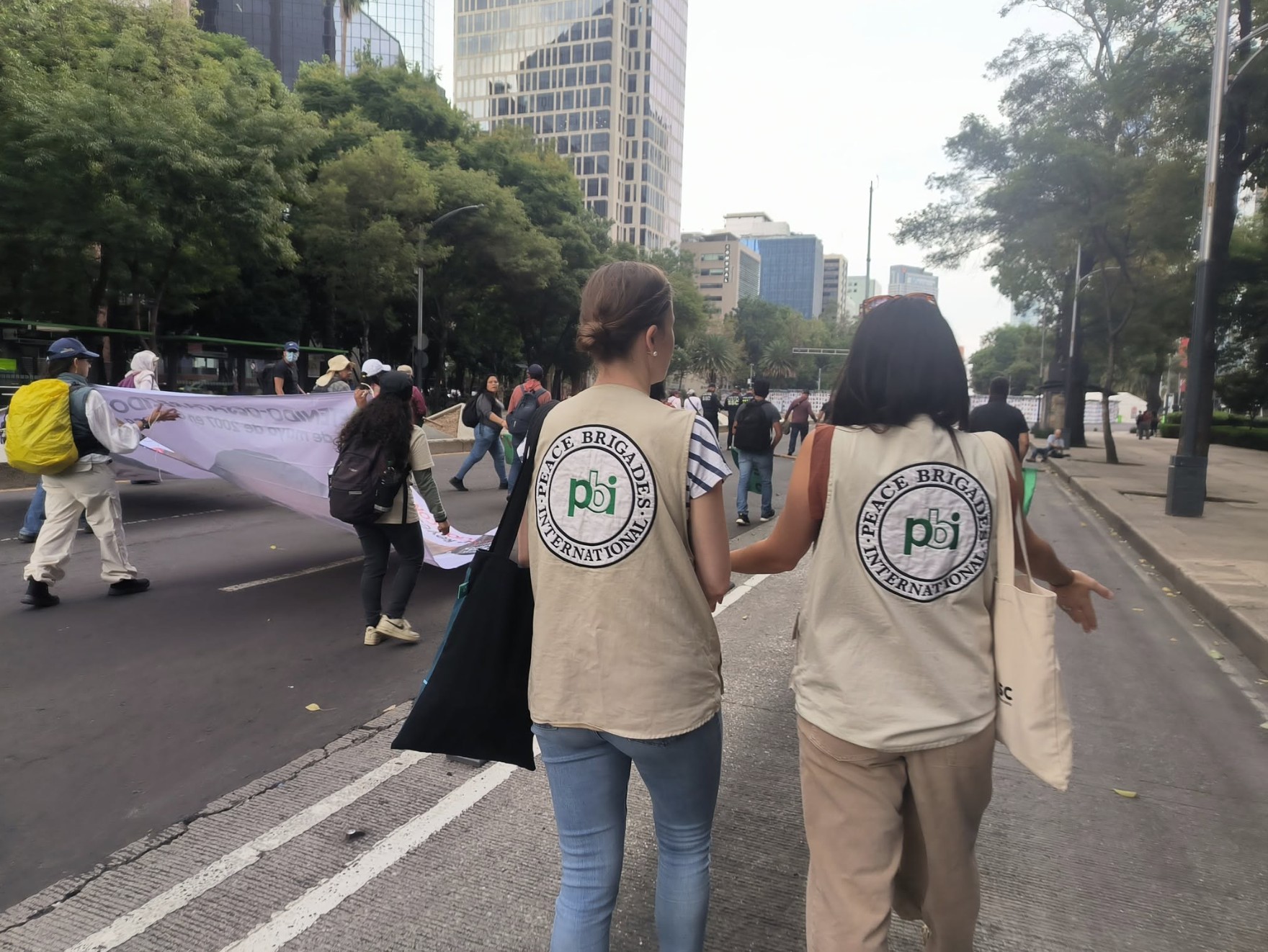
Photo by Comité Cerezo México.
The Cerezo Committee has posted on Facebook about the “16th March for Truth, Justice and Remembrance”in Mexico City that took place on the International Day of the Victims of Enforced Disappearances (August 30).
The march organized by the National Campaign against Enforced Disappearances began at the Angel of Independence in downtown Mexico City and proceeded about four kilometres to the Zócalo (officially named the Plaza de la Constitución), a massive main public square where the National Palace, the official seat of the federal executive branch and the presidential residence, is located.

Then Milenio reported: “Collectives, searching mothers and activists took over Paseo de la Reforma Avenue on Sunday, August 30, in the framework of the International Day of the Victims of Enforced Disappearances, to demand the location of the more than 132,800 people who, according to the National Search Commission, remain unlocated in the country. …The day culminated with the departure of the ‘16th March for Truth, Justice and Memory’ at 3:00 p.m., convened by the National Campaign against Forced Disappearance. Hundreds of people and human rights organizations finally gathered in the Zócalo square to reiterate the demand for search actions before the authorities.”
Publimetro further noted: “The National Registry of Missing and Unlocated Persons counted 132,844 people in that condition as of August 29, according to official data cited this Sunday by Amnesty International. The organization also warns of a forensic crisis: more than 72,000 bodies remain unidentified in morgues in the country.”
That article also highlighted: “The day occurs just two days after the Ministry of the Interior presented 10 actions to strengthen the National Search Strategy. The package includes completing the data from the National Registry, ensuring that each report has an investigation folder, reinforcing searches in hospitals and detention centers, implementing a human identification plan with the FGR [the federal Attorney General’s Office in Mexico] and expanding the capacities of the National Search Commission. For families, however, the parameter remains different: that the records, alerts and files produce concrete results.”
PBI statement
Peace Brigades International also highlighted in this social media post:
“On this International Day of the Victims of Enforced Disappearances, we express our deep concern over the rise in these cases and extend our most heartfelt solidarity to the searchers.
We call upon the authorities to effectively and promptly activate investigation and search protocols.
Furthermore, we urge the implementation of clear safeguards to protect the physical integrity of those who search at all times, ensuring that their legitimate right to find their loved ones is exercised in an environment of protection, care, and absolute respect for their lives and dignity.”

Ten years ago, The Guardian commented: “On 10 December 2006, the newly inaugurated president, Felipe Calderón, launched Mexico’s war on drugs by sending 6,500 troops into his home state of Michoacán, where rival cartels were engaged in tit-for-tat massacres as they battled over lucrative territory. …Since 2007, almost 200,000 people have been murdered and more than 28,000 reported as disappeared.”
That article further notes: “Since [2006-2007] the US has donated at least $1.5bn [to Mexico’s war on drugs] – but the biggest costs have been human. …Human rights groups have detailed a vast rise in human rights abuses by security forces who are under pressure to make arrests, obtain confessions and justify the war. Reports of torture by security forces increased by 600% between 2003 and 2013… Mexico’s decade-long war on drugs would never have been possible without the huge injection of American cash and military cooperation under the Merida Initiative. The funds have continued to flow despite growing evidence of serious human rights violations.”
On February 22, 2026, CNN reported: “Violence erupted in several states in Mexico after security forces from multiple federal branches of Mexico’s military carried out the operation [in which Nemesio ‘El Mencho’ Oseguera Cervantes, the head of the Jalisco New Generation Cartel, was killed] in the western state of Jalisco. …Mexico’s Secretariat of National Defense said that US authorities provided ‘complementary information’ that supported the operation. A US defense official confirmed that an interagency US task force ‘played a role’ in the operation.”
We continue to follow this.

