


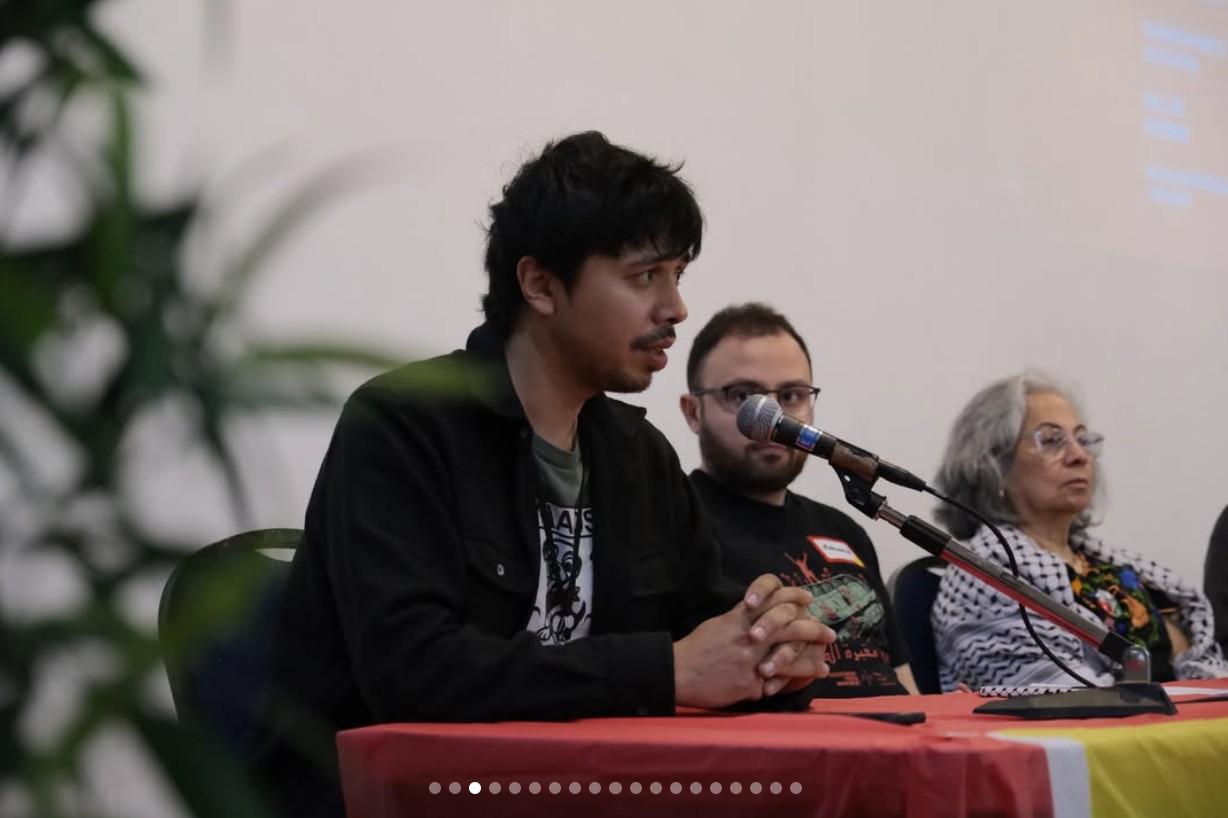
Photo: Gitxsan land defender Kolin Sutherland-Wilson speaks at ILPS conference in Ottawa; May 26, 2026. Photo by Radyo Migrante TO.
The Canadian Association of Defence and Security Industries (CADSI) has posted on LinkedIn: “CADSI’s VP of Communications & Government Relations, Nicolas Todd attended the Critical Minerals for Defence this week in Toronto. We shared insight into how Canada’s critical mineral industry plays a role within this new defence ecosystem, notably its effect on industrial capacity and supply chains.”
Speakers at that June 9-19, 2026, conference also included representatives from the Marten Falls First Nation, Lockheed Martin, Natural Resources Canada, Export Development Canada, the Department of National Defence, the United States Air Force, UK Export Finance, the European Union Delegation to the United States, the Government of Ontario, the Canada Infrastructure Bank, and Lomiko Metals.
Gitxsan land defender Kolin Sutherland-Wilson has highlighted the connection between corporate mining on Indigenous lands in Canada and weapons production. At a Palestine solidarity rally in Victoria, British Columbia in February 2026, Sutherland-Wilson expressed his opposition to “mines to fuel their need for the rare earth elements and critical minerals to build their weapons that they employ against peoples all around the world.” He concluded with “Free Palestine!”
The Tyee has reported that Vancouver-based Defense Metals is proposing the Wicheeda project, located 80 kilometres north of Prince George, that contains neodymium and praseodymium, rare earth elements that can be used in the manufacturing of military equipment. The Tyee notes: “In 2020, [Defense Metals] brought in two strategic advisers [one from Lockheed Martin, the other who had been with the CIA] to help with business development and securing purchase agreements.”
Last month, Shiri Pasternak and Nessie Nankivell wrote: “Even as Prime Minister Mark Carney touts his plans to protect Canada’s economic sovereignty, the country’s critical minerals are making their way into U.S. weapons.”
The article explains: “Nickel, copper, graphite, cobalt, tungsten, chromium, and rare earth elements are not just inputs for batteries and wind turbines. They are also needed to build fighter jets, drones, missiles, radar systems, submarines, armour, and ammunition. …Starting in 2022, the U.S. Department of War began pouring millions of dollars into Canadian mining companies extracting critical minerals. …Over just two years in 2024 and 2025, the Pentagon invested over $78 million USD in companies operating mining projects in Canada: Fortune Minerals, Lomiko Metals, Fireweed Metals, Northcliff Resources, Nano One Materials, and Electra Battery Materials.”
Pasternak and Nankivell cite the example of the Lomiko Metals La Loutre graphite mine near Duhamel, Quebec, about 120 kilometres north of Ottawa. They note: “It secured an $8.4 million USD grant from the Pentagon, matched by a further $4.9 million CAD grant from Natural Resources Canada. …Canada’s environmental assessment processes do not ask where minerals will ultimately go once they leave the mine site. They do not ask whether extracted materials will power batteries or weapons.”
They add: “The La Loutre graphite mine has faced strong opposition from the Kitigan Zibi Anishinabeg First Nation.”
And Pasternak and Nankivell have also noted: “In New Brunswick, the proposed Sisson tungsten project, owned by Northcliff Resources, received $15 million USD in Pentagon funding. Tungsten carbide, an exceptionally hard metal, is used in armour-piercing ammunition. Wolastoqey leaders have opposed the project for years.”
The NB Media Co-op has further reported: “[Elder Alma Brooks has] pointed to Israel’s prolonged and devastating U.S.-backed assault on the Gaza Strip, ‘a genocide that’s happening right under the nose of the world’”.
That article further notes: “[Wolastoq Grand Chief Ron] Tremblay said the Wolastoq Grand Council rejects activities contributing to war and what he called the ‘continuum of genocide’ in places such as the Gaza Strip and the West Bank.”
The risk of attacks against defenders
In their Global Analysis 2025/26 report issued today, Front Line Defenders documents that the “most targeted areas of human rights defence” worldwide are “land, environmental and peasant communities’ rights” (23.46% of the human rights defenders killed in 2025) and “Indigenous peoples’ rights” (17.03% of those killed).
And in their September 2025 report, Global Witness noted: “Once again, mining emerged as the deadliest sector, with at least 29 related cases in 2024. Next came logging with eight cases and agribusiness with four. Road-building and infrastructure projects, poaching and hydropower have also driven deadly attacks in 2024.”
We continue to follow this with concern.
Additional reading: ‘Our minerals could be used to annex us’: why Canada doesn’t want US mining (Sara Hashemi, The Guardian, January 5, 2026); Elbows up? Canada is letting Pentagon take ‘unprecedented’ stakes in Canadian mines (Shiri Pasternak and Nessie Nankivell, The Breach, May 22, 2026); Wolastoqey land defenders reject the proposed Sisson open-pit tungsten mine and weapons production (PBI-Canada article, December 2, 2025) and Why Is the US War Department Buying into a BC Mining Company? (Amanda Follett Hosgood, The Tyee, October 16, 2025).

