


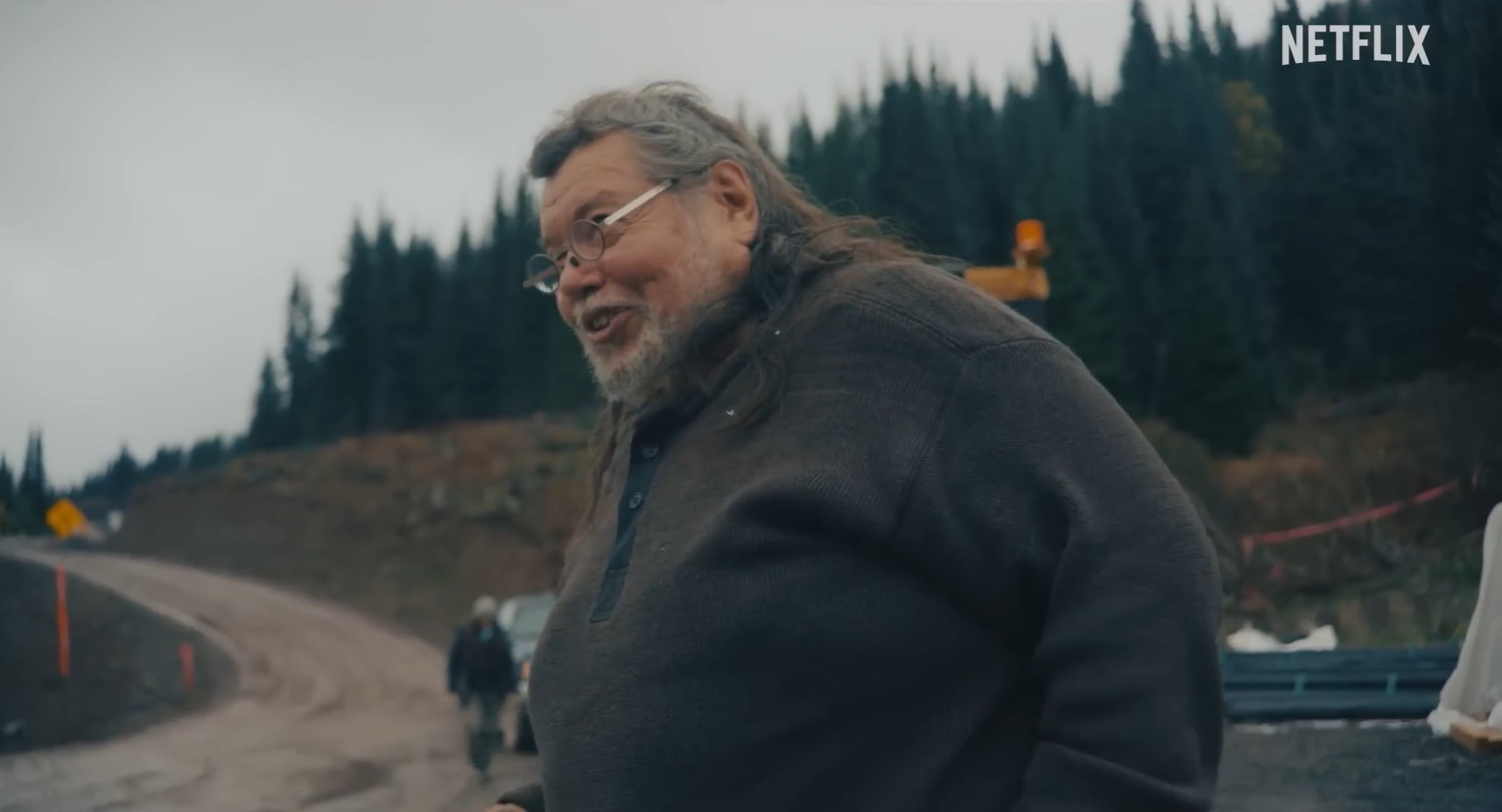
Video still: Chief Dsta’hyl in the trailer for the documentary “Yintah”.
Dsta’hyl, also known as Adam Gagnon, is the Wet’suwet’en Hereditary Wing Chief of the Likhts’amisyu Clan and a human rights defender.
JURIST News reports: “The Court of Appeal for British Columbia unanimously upheld the criminal contempt conviction against Chief Dsta’hyl (Adam Gagnon) on Tuesday [April 28]. He was found in breach of a court injunction by protesting against a pipeline project in the territories of the Wet’suwet’en First Nation.”
PBI-Canada laments this decision and is concerned that the continued use of injunctions and marginalization of Indigenous laws further puts at risk the safety and security of Indigenous land and environmental defenders protecting their lands and waters from extractive megaprojects.
The use of injunctions against Indigenous rights
The JURIST News article continues: “At issue in the appeal was whether Chief Dsta’hyl could make a defense on the ground that he was acting in accordance with a co-existing Indigenous legal order.”
The article further explains: “In 2019, the British Columbia Supreme Court issued an injunction banning protests in the construction area of the Coastal GasLink pipeline project. Defying the injunction, Chief Dsta’hyl organized a blockade in an attempt to halt the construction in 2021.”
But University of Ottawa associate law professor Aimée Craft – an expert on Indigenous laws, treaties and water – says: “What the injunction hasn’t addressed … is the conflict of laws issue between Indigenous legal orders and … Western legal systems.”
Further commenting on the use of injunctions, professors Shiri Pasternak and Irina Ceric have written: “It is now increasingly clear that the injunction is a legal tool of political expediency. It has an almost arbitrary authority to empower law enforcement to contain and criminalize people by securing vague geographical boundaries and broad powers of removal, often indefinitely. In the hands of industry and governments alike, the injunction, still billed as an extraordinary legal remedy, has emerged as the all-too-ordinary response to Indigenous assertions of jurisdiction and solidarity.”
After examining 100 cases across Canada, the Yellowhead Institute found that 76 per cent of injunctions filed against First Nations were granted, while 81 per cent filed by First Nations against corporations were denied.
The Yellowhead Institute report comments: “When First Nations contest the authority of the province or the regulatory processes, like environmental assessment, that fail to acknowledge their lack of consent, companies take advantage of a legal system built to protect the interests of property. Injunctions have worked as a blunt instrument in opposition to Indigenous law.”
Chief Dsta’hyl designated a prisoner of conscience
The actions by Chief Dsta’hyl in violation of an interlocutory injunction prohibiting anyone from physically impeding construction of the TC Energy Coastal GasLink fracked gas pipeline took place between October 17 and 26, 2021. He was convicted on February 20, 2024. The Crown had sought 60 to 90 days in jail for him. He was sentenced on July 3, 2024, to two months of house arrest.
On July 31, 2024, Amnesty International stated that it had “made the unprecedented decision to designate Likhts’amisyu Clan Wing Chief Dsta’hyl of the Wet’suwet’en Nation as the first-ever designated Amnesty International prisoner of conscience in Canada.” At that time, Ana Piquer, Americas Director at Amnesty International, commented: “The Canadian state has unjustly criminalized and confined Chief Dsta’hyl for defending the land and rights of the Wet’suwet’en people.”
Land defenders oppose PRGT
We continue to follow this notably in the context of the Government of Canada’s proposed fast-tracking of megaprojects including the construction of the Prince Rupert Gas Transmission (PRGT) fracked gas pipeline opposed by the Gitxsan and Gitanyow nations in northern British Columbia.
If that pipeline receives fast-tracked approval from the Government of Canada-established Major Projects Office (MPO), and if it receives a final investment decision (FID) enabling it to move forward, Gitanyow land and environmental defenders have vowed to establish a blockade to stop its construction.
PBI-Canada is concerned that a repeat scenario could unfold in which an injunction is imposed that marginalizes Indigenous rights and the Royal Canadian Mounted Police (RCMP) deploy their Critical Response Unit-British Columbia (CRU-BC) in a militarized enforcement action that uses violence to repress Indigenous land defenders upholding their laws and rights on their territories.


