

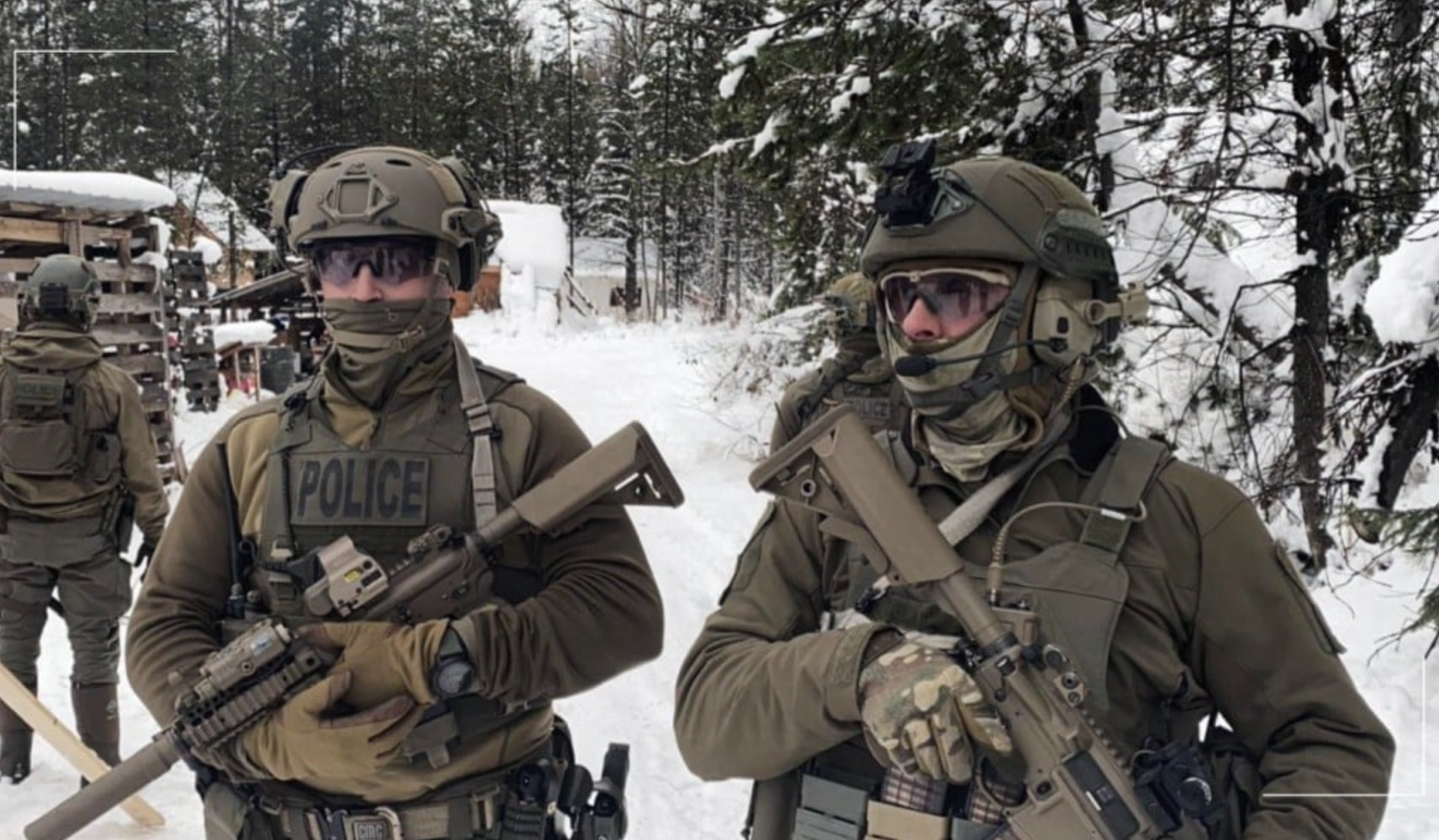
Photo: Royal Canadian Mounted Police (RCMP) C-IRG officers during the November 2021 raid on Wet’suwet’en territory. Photo by Michael Toledano.
Peace Brigades International-Canada continues to be concerned about impunity and the potential for continued violence and human rights violations by the Royal Canadian Mounted Police (RCMP) against Indigenous land and environmental defenders opposing megaprojects on their territories within Canada.
This week, Sleydo’ Molly Wickham, Wing Chief of Cas Yikh, a house group of the Gidimt’en Clan of the Wet’suwet’en nation in British Columbia, told APTN News: “The police would just terrorize and come in at all hours of the night, two o’clock in the morning, drag everybody out of bed, shining lights, hiding in the bushes, just really trying to enforce the fact that they were there and that they had full control over our lives. Most of the people that have lived through this experience on the Yintah [territory] have experienced extreme PTSD [Post-Traumatic Stress Disorder].”
Now, the Civilian Review and Complaints Commission for the RCMP (the CRCC) has posted an “Investigation Update (March 2026)” on its “systemic investigation” of the RCMP Community-Industry Response Group (C-IRG).
When it was launched more than three years ago, that “systemic investigation” into the RCMP C-IRG was intended, in part, to “examine whether relevant policies, procedures, guidelines and training … are consistent with applicable jurisprudence/case law and the Canadian Charter of Rights and Freedoms”, “assess whether or to what extent the activities and operations of the C-IRG are carried out in accordance with legal standards”, and “identify the extent to which C–IRG’s operations and actions meet, reflect, consider or are consistent with the standards and expectations set by … the United Nations Declaration on the Rights of Indigenous Peoples (UNDRIP)…”
The CRCC Update, posted on March 18, 2026, notes: “A report outlining the CRCC’s investigative findings is now complete. However, the CRCC’s systemic investigation cannot be finalized in the absence of a decision-maker. The CRCC Chairperson position has been vacant since January 2025.”
The CRCC has also now posted: “Update on the status of C-IRG-related public complaints and reviews (as of March 1, 2026)”.
That Update notes: “Between 2019 and 2022, the CRCC received 572 public complaints related to the RCMP’s enforcement of civil injunctions in British Columbia associated with: Coastal GasLink pipeline project on Wet’suwet’en Traditional Territory; Teal Cedar Products Limited logging operation in the Fairy Creek Watershed; Cooper Creek Cedar Limited logging operation in Argenta-Johnson’s Landing.”
That Update also notes the “top five allegation categories for complaints related to the RCMP’s enforcement at the three sites, in descending order” include Neglect of Duty, Oppressive Conduct, Improper Attitude, Improper Use of Force/ Irregularity in Procedure, Mishandling of Property, and Improper Arrest.
Again, that Update highlights: “The authority to issue Satisfied, Interim and Final Reports rests with the Chairperson. In the absence of any other CRCC members, reports cannot be issued due to the lack of a decision-maker.”
Three-year systemic investigation
The CRCC launched its “systemic Investigation of the RCMP “E” Division Community-Industry Response Group (C-IRG)” on March 9, 2023.
On June 7, 2023, the CRCC told PBI-Canada via e-mail: “The CRCC strives to complete its systemic investigations within 12-18 months; however, the timely provision of requested information and access to RCMP personnel will largely determine when the CRCC’s report will be available.”
From the Update posted on March 18, 2026, it appears that the investigation took approximately 36 months rather than 12-18 months.
Long-standing concerns
APTN has reported that almost a year before the systemic investigation: “An APTN News investigation of C-IRG in June of 2022 uncovered allegations against the unit that includes ‘intimidation, torture, brutality, harassment, racism, theft, destruction of property, arbitrary detention, inhumanity, lying and deceit.’ The investigation obtained evidence of vast spying — including casual surveillance of law-abiding groups engaged in the democratic process — collusion with private security, collaboration with industry lawyers and wilful violations of RCMP policy.”
And the CBC reported in January 2023: “More than 100 grievances accepted for investigation [by the CRCC] contain allegations of excessive force, illegal tactics, unprofessional behaviour, racism, discrimination and charter violations by the force’s Community-Industry Response Group (C-IRG).”
The call to suspend the C-IRG
Shortly after the systemic investigation was launched on March 9, 2023, the Abolish C-IRG coalition stated: “Given the nature of the complaints and substantial evidence supporting them, we argue for the suspension of all C-IRG deployment in BC pending investigation and resolution of all complaints currently before the CRCC. The CRCC reviews can take years to complete, and it is irresponsible to have this unit continue operations during that time, enabling the continuation of unlawful use of force, arrests, detentions, and assaults that have sparked such an investigation.”
At that time, The Kimberly Bulletin also reported: “Noah Ross, a lawyer who represents [Last Stand West Kootenay], told the Nelson Star that he thinks the CIRG should be disbanded, or at least its operations should be stopped, while the investigation is underway, because the unit committed a number of human rights violations while making its Argenta arrests.”
Photo: On March 22, 2023, PBI-Canada hand-delivered to the CRCC office in Ottawa this letter from the Abolish C-IRG coalition calling for the suspension of the C-IRG during the CRCC systemic investigation.

Rebranding and expanding the C-IRG
Instead of abolition or suspension, the C-IRG has been well-funded, rebranded and seen an expansion of its mandate.
On March 10, 2023, just a day after the systemic investigation was launched, The Tyee reported that the British Columbia government had allocated $36 million to the RCMP C-IRG as of April 1, 2023.
Then on January 1, 2024, the RCMP announced that the C-IRG was “renamed as the Critical Response Unit – British Columbia (CRU-BC) to better reflect the scope of work and service that its members are called to.”
In February 2024, The Tyee reported: “C-IRG’s approach to public disorder has been adopted as a ‘national best practice,’ according to senior media relations officer Staff Sgt. Kris Clark, and a rebrand is underway to reflect its expanded role in B.C.”
In early March 2026, The Breach reported: “Just a few months before encampments had sprung up for Gaza, C-IRG had rebranded and expanded its role to include ‘civil and public order incidents.’ Now operating as the Critical Response Unit (CRU), the unit showed up across B.C. university campuses, including UBC’s campuses in Vancouver (UBC) and Okanagan (UBCO), the University of Victoria (UVic), and Vancouver Island University (VIU).”
That article adds: “Not only was the CRU showing up, they were also advising universities on how to respond to them. Documents obtained by The Breach from the universities and the provincial Ministry of Public Safety reveal the significant role that the CRU played in shaping the institutions’ response to a nationwide wave of student activism not seen in decades. These same records show that the CRU was surveilling student protesters, sharing intel with local police and the provincial government, preparing to clear encampments, and advising universities on how they might punish protesters with consequences ranging from expulsion to criminal charges.”
It then highlights: “Together, these activities form a picture of how the CRU’s role is expanding, as it positions itself as the go-to militarized force to respond to every protest deemed a ‘public order incident.’”
And just this week, The Maple reported that RCMP and Canadian Armed Forces (CAF) personnel participated in a seminar organized by the Israeli military in November 2025. The Maple highlights: “The seminar, titled ‘Lessons Learned From the Frontline,’ was held two months after the United Nations declared that Israel had committed genocide against Palestinians in Gaza.”
Lack of oversight, but more funding for the RCMP
On October 30, 2025, CBC News journalist Catharine Tunney reported: “The watchdog body meant to investigate Mounties’ conduct has been without a chairperson for months [since January 2025], stalling investigations and weakening transparency about how the country’s police force interacts with Canadians across the country.”
That article further noted: “While teams of investigators and lawyers are still working, a spokesperson for the CRCC said the review body is unable to issue any decisions in the absence of a chair or other senior decision-makers.”
It might be further noted that the Canadian Press has previously reported: “The [Carney government] budget [tabled on Tuesday November 4, 2025] does not say whether Ottawa will fill vacant positions such as the climate change ambassador, the envoy for women, peace and security, and the ombudsperson responsible for investigating reports of forced labour abroad [CORE].” This might suggest that there is a pattern of other key positions that have been left vacant.
And while that Budget did not address those vacant oversight positions, it did allocate funds for an additional 1,000 RCMP personnel.
Fast-tracking major projects
It is particularly worrisome that the systemic investigation of the RCMP C-IRG remains unpublished and unaddressed in the context of the fast-tracking of major projects that could see the deployment of the CRU-BC against land and environmental defenders on Indigenous lands in northern British Columbia.
In August 2025, Prime Minister Mark Carney’s government established a Major Projects Office (MPO) “to move major projects forward faster, responsibly, and sustainably.” The 15 projects that have been “deemed to be of national importance and significance” include LNG Canada Phase 2 (that would involve the construction of compressor stations on Wet’suwet’en territory) and Ksi Lisims LNG (that would be fed by the Prince Rupert Gas Transmission pipeline on Gitxsan and Gitanyow territories).
In August 2025, Toronto Metropolitan University professor Shiri Pasternak and University of New Brunswick professor Tia Dafnos also wrote in The Breach: “A RCMP unit criticized for violent and unlawful conduct will be involved in enforcing new laws in British Columbia that will fast-track resource and infrastructure projects… Newly obtained documents show the RCMP’s Community-Industry Resource Group (C-IRG) will work with secretive provincial committees that monitor and respond to opposition to major projects…”
Pasternak and Dafnos further noted: “One of the key roles of the unit on these two committees is intelligence coordination. The unit now has dedicated resources to monitor opposition to proposed and active infrastructure projects. Weekly reports from the RCMP to the BC government, obtained by The Breach, show that in 2024 CRU-BC was keeping tabs on opposition to the controversial LNG and gas projects across the province. This monitoring allows the unit’s liaison team to approach communities to gather information and attempt to counter potential disruptions, while maintaining ties to industry proponents and sharing intelligence with corporate and contracted private security personnel.”
The CRCC may also be concerned about this.
In September 2024, CBC News reported: “In a scathing report completed last month, the commission found the Mounties wrongfully arrested [Brian] Smallshaw while he was hiking [near Fairy Creek] three years ago when he wouldn’t submit to a search he considered unconstitutional. ‘The commission is concerned about similarly broad and intrusive strategies being implemented during future protests, leading to similarly unreasonable searches and arrests,’ says the report.”
We continue to follow this.

