


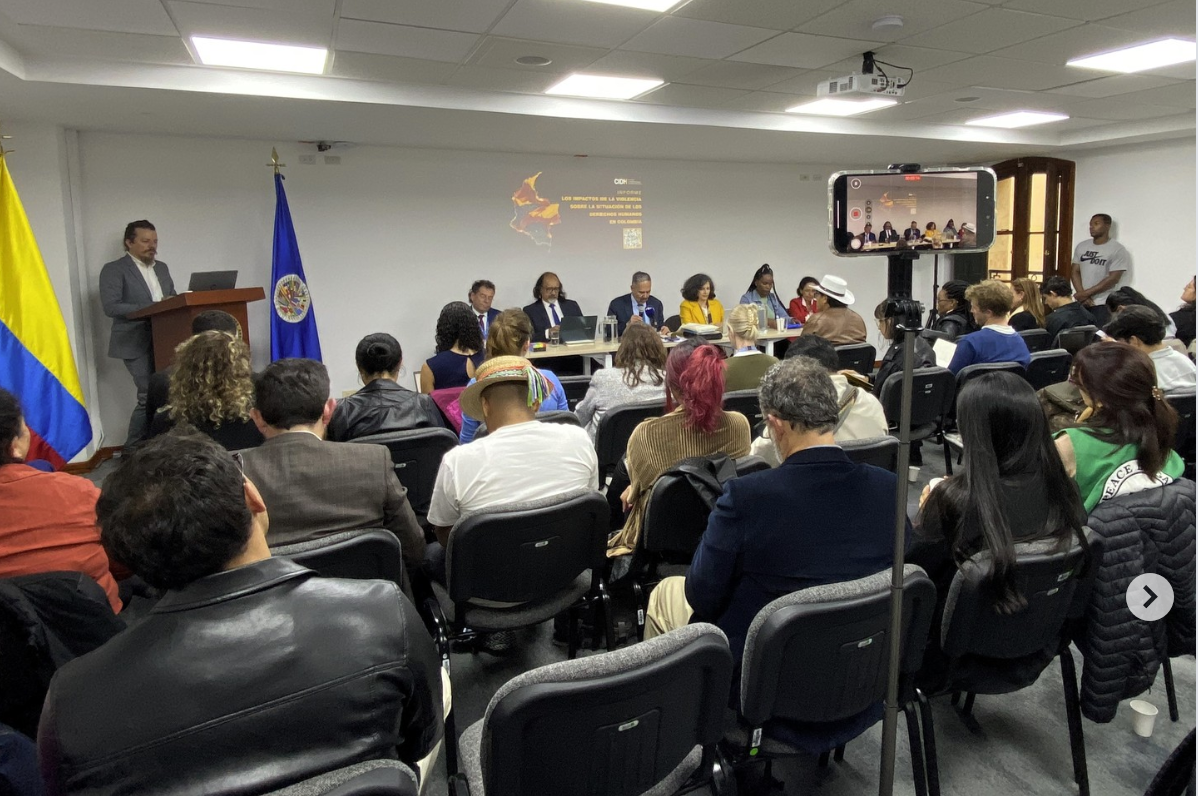
The Peace Brigades International-Colombia Project has posted on social media: “We attend the presentation of the CIDH [Inter-American Commission on Human Rights] report on the impact of human rights violations.”

Caracol Radio reports: “The Inter-American Commission on Human Rights (IACHR) presented a report on the situation of violence in Colombia and the impact it has on human rights. It concludes that, despite the progress and efforts to build peace, there are still structural factors such as inequality, discrimination and the absence of the State in large areas of the territory.”
That article adds: “The report makes 57 recommendations to the Colombian State, including the creation of a broad space for national dialogue as a central axis to move towards peace with justice.”
Infobae further reports: “Referring to the 57 recommendations of the IACHR, [Commission president José Luis Caballero Ochoa] said: ‘The central axes are in the first recommendations to continue with the peace process and dialogue with armed actors; The first, in fact, is committed to a national dialogue. It is very timely that the Commission opens the report like this because this can help Colombian society to build agreements and eliminate polarization.’”
And BluRadio highlights: “On the murder of social leaders, which in the last year exceeded 180 cases, the president of the IACHR was emphatic: ‘You have to protect defenders, you have to protect social leaders. We have expressed this a lot to the Colombian State; it is an obligation that they have to attend to with greater prestige.’ In addition, he pointed out that ‘we are also with protection measures, precautionary measures for defenders and social leaders. This is an issue that the Commission is very concerned about and I believe that the State has to be at the forefront with that protection.’”
The full report with its 57 recommendations can be read here. We draw particular attention to recommendations 27 to 32:

Human rights defenders, social and community leaders, and journalists
- Create a national registry of attacks against human rights defenders and social and community leaders, as well as journalists, which, among other things, contains:
Detailed and georeferenced information on each of the acts of violence against this population, as well as the status of ongoing investigations;
Variables that enable the disaggregation of information based on ethnicity, race, gender, and intersectionality;
Information that enables the development of strategies for prevention, protection, and state accountability;
- Include in the Single Victims Registry human rights defenders and social and community leaders as victims of the armed conflict due to their role in defending and promoting human rights.
- Issue the Comprehensive Public Policy on Guarantees, agreed upon with civil society, including concrete actions, an action plan, a budget, and inter-institutional coordination for its implementation.
To this end, among other measures, the following is recommended:
This policy should articulate policies, programs, and plans for the protection of human rights defenders and social and community leaders, guaranteeing a response by the State to threats against defenders and leaders, its consistency with ruling SU-546/23, the Early Warning System of the Ombudsman’s Office, consultation with protected persons, and an ethnic-racial, gender, territorial, and institutional co-responsibility approach.
- Adopt effective and comprehensive measures for the protection of human rights defenders with social and community leadership, as well as journalists and media workers, through differentiated risk assessment protocols, the implementation of preventive measures, the institutional strengthening of technical risk assessment capacities, and the diligent and thorough investigation of attacks, in compliance with the obligations to prevent, protect, and guarantee human rights.
- Design, implement, and evaluate a work plan for the protection of journalists from community media and peace radio stations, within a reasonable time frame. To this end, its sustainability must be guaranteed and institutional support promoted with a territorial, participatory, and differential approach, recognizing its role in peacebuilding and local democracy.
- Design, implement, and evaluate actions aimed at strengthening the National Protection Unit in material and professional terms within a reasonable timeframe. To this end, it should focus on the implementation of measures for defenders and leaders from indigenous, Afro-descendant, and peasant communities, as well as journalists, ensuring the participation of protected persons and taking into account ethnic-racial and gender perspectives.

We continue to follow this.

