

The Peace Brigades International-Honduras Project has posted on social media:
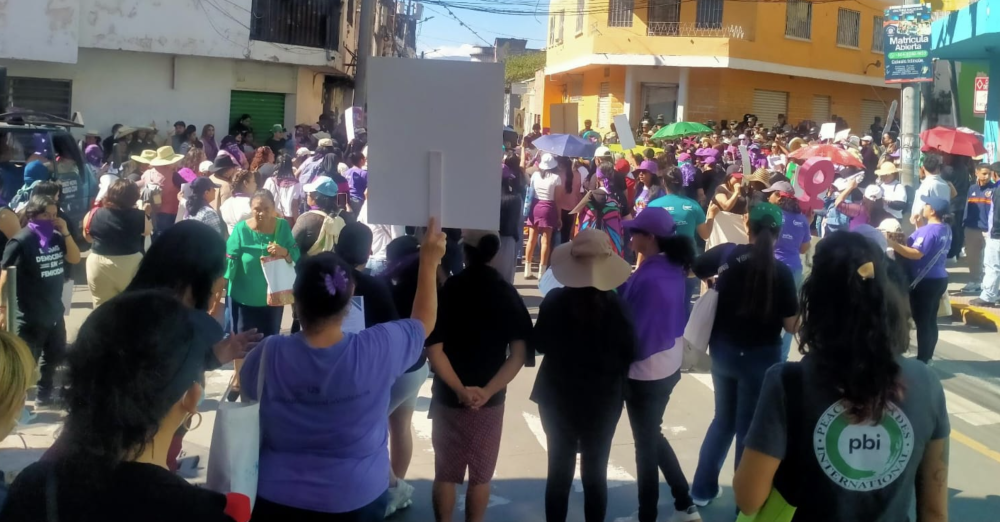
“On January 25, Honduran Women’s Day, we observed a peaceful march by feminist organizations in downtown Tegucigalpa. During the demonstration, we saw a contingent of the Armed Forces fire tear gas at the women defenders. We express our concern about this violence perpetrated by state forces against women in Honduras. We recall that in the Universal Periodic Review of November 2025, a total of 33 countries urged Honduras to take measures to combat violence against women.”

Infobae reports: “Violence that especially affects women and girls is once again at the forefront in Honduras. According to data reported by the Violence Observatory of the National Autonomous University of Honduras (UNAH), at least 200 murders of women were recorded by the end of 2025.”
That article further notes: “In the first days of 2026 alone, specialized organizations have already documented more than 15 female deaths – most of them classified as femicides – which leads feminist groups and human rights organizations to demand that the State take immediate measures of protection, improve institutional responses, and actions to ensure justice for victims.”
The Spanish news agency EFE adds: “Feminist groups in Honduras on Sunday expressed their fear that the next conservative government of President-elect Nasry Asfura will eliminate or weaken state entities dedicated to the defense of women’s rights, in a context marked by high rates of femicides.”
Mobilization met with tear gas
Criterio.hn has explained: “On January 25 of each year, Honduras commemorates Honduran Women’s Day, a date that went down in history after the right to vote and political participation of women was won in 1955.”
Contracorriente reports: “This Sunday, January 25, 2026, while carrying out a symbolic act in commemoration of Honduran Women’s Day in Tegucigalpa, a group of women demonstrators was repressed with pepper spray and beatings by the Military Police. … [The mobilization started] from Morazán Boulevard to Tegucigalpa’s Central Park. The route was marked by the closure of several streets due to checkpoints installed by the Armed Forces and the National Police, which prevented the mobilization from reaching its final destination [the Central Plaza].”
Nubia Casco of the November 25 Platform tells EFE of her concerns about the Asfura government (that was sworn into office a few days after this mobilization): “Now we are entering a far-right government, with the threat of the disappearance of women’s institutions and others of citizen participation and civil society. For us it is a fear … a very dark future is looming.”
We continue to follow this.
Intervention by Canada at the UPR for Honduras (November 7, 2025)
Thank you, Mister President.
Canada thanks Honduras for its participation in the Universal Periodic Review. We welcome the positive steps taken by Honduras toward eliminating violence against women and girls, supporting survivors of intimate partner violence, promoting safe and dignified human mobility, and the reintegration of returnees.
Canada recommends that Honduras:
Fully implement the National Protection Mechanism by establishing robust accountability measures for state authorities who fail to provide adequate protection to human rights defenders, including Indigenous rights defenders, environmental rights defenders, and journalists.
Strengthen enforcement of Article 118-A of the Penal Code, which defines and penalizes femicide, by improving prevention, investigation, and prosecution of gender-based violence.
Enhance the independence and integrity of the justice system by establishing a transparent judicial appointment process in line with the UN Basic Principles on the Independence of the Judiciary.
Advance questions
What concrete measures is Honduras implementing to demilitarize its prison system and broader public security structures, in accordance with international human rights standards and recommendations from treaty bodies, including the UN Subcommittee on Prevention of Torture?
Could Honduras elaborate on efforts to strengthen the National Protection Mechanism for Human Rights Defenders, particularly regarding its independence, effectiveness, and accessibility for those working in high-risk areas such as land, environmental, and Indigenous rights?

