

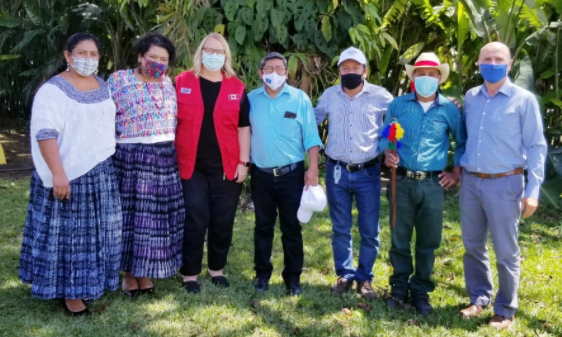
On March 12, the Canadian Ambassador to Guatemala met with Maya Q’eqchi’ defender and CCDA coordinator Lesbia Artola.
Ambassador Rita Rudaitis-Renaud tweeted: “The work of women human rights defenders such as Lesbia Artola, @CCDA_Guatemala with whom I had the pleasure of meeting today, is vital in the construction of a peaceful and inclusive society.”
The Canadian Embassy also tweeted: “We appreciate the work of human rights defenders like Lesbia Artola of the CCDA in #Coban, sometimes putting themselves or their loved ones at risk. This work is essential for building an inclusive and peaceful society.”
The CCDA challenges dispossession and megaprojects
PBI-Guatemala has explained: “The CCDA accompanies more than 150 Maya Q’eqchi’ communities who have been repressed and stripped of their land or are immersed in conflicts regarding land tenure. Due to their work many of their members have faced threats, criminalization processes, kidnappings, and murders.”
The Guardian has reported: “A peace agreement in 1996 should have led to land redistribution, but a handful of powerful families still dominates the economy, and Guatemala remains one of the world’s least equal and most violent countries, with the largest 2.5% of farms occupying more than 65% of the land.”
That article highlights that foreign-backed mining, dams and other extractive industries have meant the continued evictions of Indigenous peoples.
While campesinos are branded as land invaders, Artola says the invaders are the large land-owning families and corporations occupying Indigenous territories.
Attacks against CCDA members
In 2018, five CCDA members were killed in the Verapaz region. PBI-Guatemala has accompanied the organization since July 2018.
For the past four months, PBI-Guatemala has noted in their monthly information packages that Artola and CCDA colleague Imelda Teyul have faced ongoing security incidents.
Prior to that, PBI-Guatemala also noted: “Lesbia and Imelda have confirmed that there are three criminalization processes against them. The Indigenous Peoples Law Firm (BPI) is providing them with legal accompaniment. PBI is very concerned about the physical, psychological and emotional wellbeing of both human rights defenders.”
Voices at Risk, Escazu Agreement
The Voices at Risk guidelines for Canadian embassies notes: “Through engagement with affected Indigenous individuals and communities, where appropriate, missions should encourage prompt investigations into alleged acts of intimidation, threats, violence and other abuses against Indigenous HRDs.”
Earlier this month, Canada’s Ambassador to the UN Leslie E. Norton also stated: “Some states have established specific protection mechanisms to prevent risks and attacks against HRDs and to intervene when need be. Canada wants to stress these important milestones such as the Escazu Regional Agreement in Latin America and the Caribbean.”
While Guatemala has signed this Agreement, it has not ratified it.
PBI-Guatemala continues to closely monitor the security situation of the CCDA through regular telephone contact and in-person visits.

