

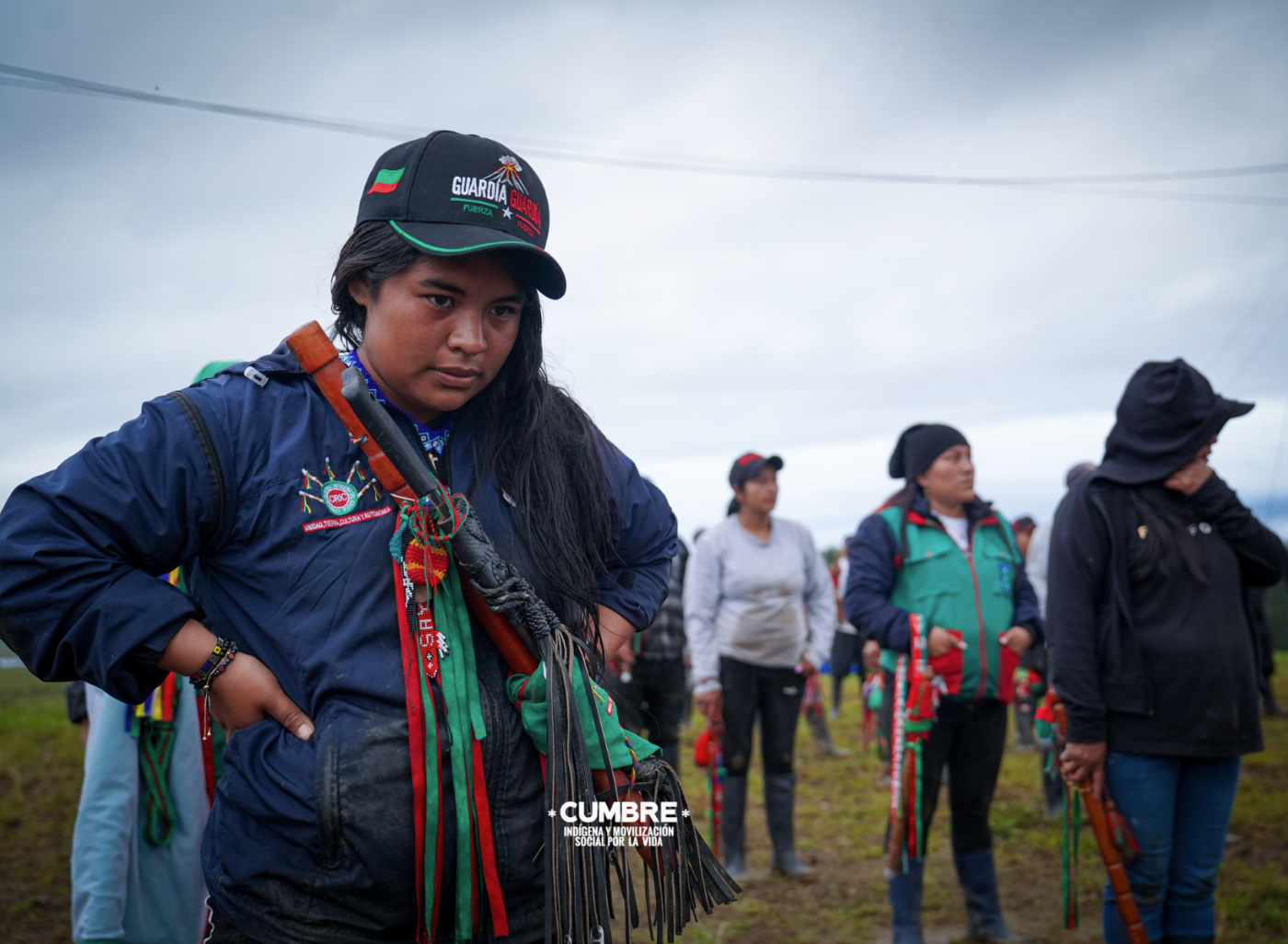
Photo: The Indigenous Summit and Social Mobilization for Life.
The Peace Brigades International accompanied Association for Social Research and Action (Nomadesc) has posted on social media:
“The Indigenous Summit for Life concludes with a massive mobilization and gathering in Santander de Quilichao, where lawyer Delaespriella has been summoned for a direct dialogue on November 14. The Summit declares to the nation and the international community that its resolutions include demanding that the current government annul the decree regarding social protest and withdraw the Ministry of the Interior’s draft proposal—which endangers the lives, safety, and freedom of the Indigenous Guard—as well as rejecting modifications to the prior consultation process and the advancement of extractive projects in ancestral territories. Santander de Quilichao, October 14, 2026. #Cauca #October14 #SocialProtest”
The video with the social media post says:
“We indigenous people and the social sectors are facing the necessity to generate our voice of resistance, our voice of protest. This government intends to dismantle our rights, it intends to expel us from our territories, The indigenous peoples say to society, to the world, we are the caretakers of oxygen and water for all, for humanity, and we say to this president that we are going to defend our territories.
The summit said that in one month we had to get to the place where the president of the republic was to wait, and we made it clear that we were not pressuring him. It follows a route of open dialogue, we are not violating the constitution, but on the contrary, if we reject the social decree and protest, we will not accept that as social organisations and indigenous peoples.”
The Indigenous Guard
Intercontinental Cry has explained: “Indigenous guards are elected by their communities and mandated to protect Indigenous lives and territory without the use of arms. Throughout both the civil war and the undeclared battle for territory and resources that has followed it–and carrying only the staffs that serve as their mandate of office.”
The Sur International Journal on Human Rights has also noted: “The Indigenous Guard is a collective and voluntary effort to defend life through the administration of their own law,2 peaceful resistance, the use of indigenous legislation, the defence of human rights and the promotion of peace in territories marked by violence.”
De la Espriella decree
On October 1, Prensa Latina reported: “The Regional Indigenous Council of Cauca (CRIC) today rejected a draft decree [that reforms Decree 1066 of 2015] of the National Government of Colombia whose purpose would be the dismantling of the Indigenous Guard, according to that organization. …[CRIC] pointed out that the existence of this mechanism does not derive from the recognition, authorization or regulation of the State, but from the mandate of the communities and traditional authorities, as part of their organizational processes and self-government.”
Quatroges also explains: “For the CRIC, a national information system administered from Bogotá could change the relationship between communities and public institutions. The organization warns that the data collected could facilitate mechanisms for monitoring, stigmatization, and prosecution of people engaged in territorial defense, particularly in regions where illegal armed organizations persist.”
Accompaniment
Peace Brigades International has accompanied Nomadesc since 2011 and its president Berenice Celeita since 1999.

