

The Peace Brigades International-Nicaragua Project has posted on social media:
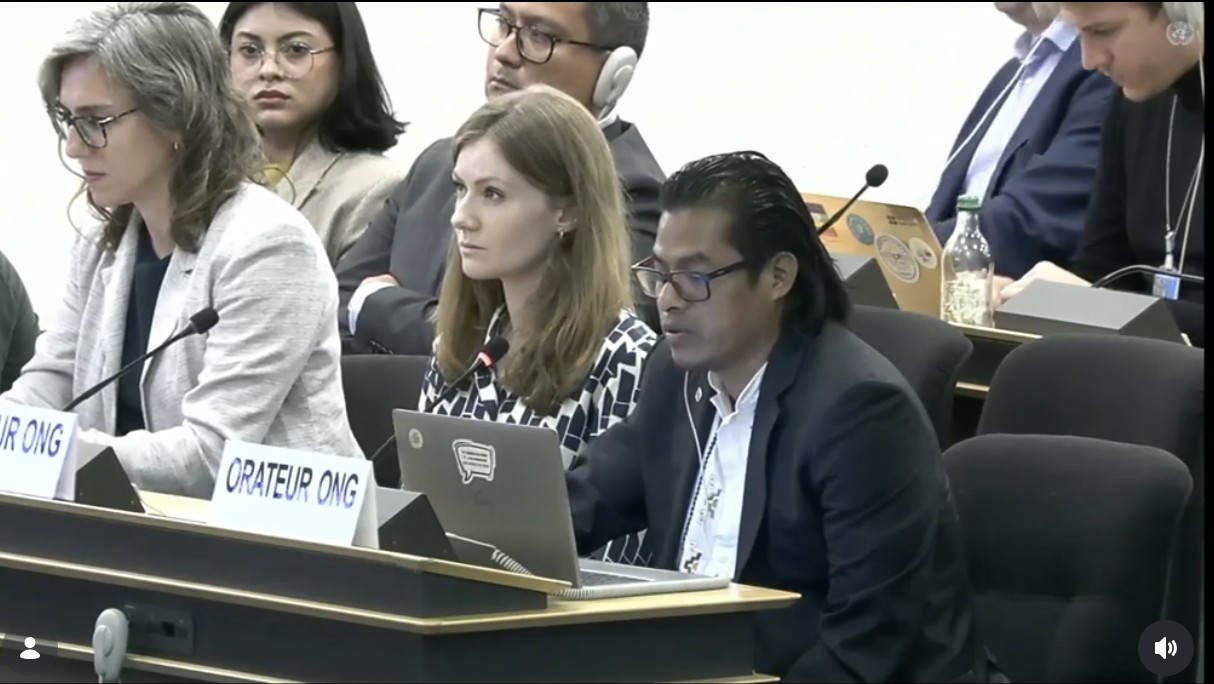
“During the 63rd session of the [United Nations] Human Rights Council [in Geneva, Switzerland] this week, Indigenous defender Lusben Taylor presented a statement regarding the situation facing the Mayangna people in Nicaragua and called for urgent attention from the international community.
‘From Mayangna territories, we call upon this Council not to allow our tragedy to be normalized, nor for our territories to be turned into sacrifice zones.’
Lusben is a leader of the Mayangna Association for Social Development (AMDES) and was accompanied during his participation in the Council by Fundación del Río and Peace Brigades International.”

EFE also reports: “With the support of the organizations Peace Brigades International (PBI) and the Nicaraguan Fundación del Río, Taylor exposed, during the session held in Geneva, the displacements, violence, arbitrary detentions, the murder of community leaders and the advance of extractivist activities faced by indigenous peoples.”
Taylor stated:
“President and Council Members, I am Lusben Taylor, an indigenous Mayanga leader, and I am here to denounce the very serious situation facing the Mayanga people in Nicaragua and to ask for the international community’s urgent attention.
Our ancestral land is not just the geographic space, it is our home, our collective memory, our identity, and the multidimensional crisis that is threatening our physical, cultural, and political and territorial survival. We have been forcibly displaced due to the occupation of our land, violence, and the killing of community leaders.
Eight Mayanga forest guards and four indigenous leaders remain arbitrarily detained. The Wiru and Kitanga community remains under siege, and this is just one example of the violence endured and the lack of protection from the state. To this, you have the expansion of mining licences and extractive activities in indigenous land without consultation or free prior informed consent.
There are currently 63 mining sites that are located on indigenous land and land of people of African descent. The Mayanga territories call on this Council to not allow that our tragedy become normal, nor that our territories be converted into sacrifice areas. Thank you.”
His full presentation can be seen here (starting at 1:49:53).
Vancouver-based Equinox Gold on Mayanga territory
Natural Resources Canada notes that there are three Canadian mining companies operating in Nicaragua.
In January 2025, Mongabay reported: “International sanctions against the industry have done little to slow it down, with companies from China, Canada, the U.K. and Colombia setting up operations in ecologically sensitive areas — often near national parks and on Indigenous territory.”
That article adds: “Since 2022, seven concessions covering nearly 170,000 hectares (420,000 acres) were granted within titled Indigenous territory in the Caribbean coast autonomous regions, which have belonged to Indigenous peoples since the 1980s. Canadian company Calibre Mining has 151,921 hectares (375,405 acres) in the Autonomous Region of the North Caribbean Coast, while a collection of Chinese companies have 212,727 hectares (525,660 acres) between them, according to Land Matrix.”
The Mayangna peoples of Nicaragua mainly live in villages along the rivers of the North Caribbean Coast Autonomous Region (RACN).
In November 2024, the digital newspaper El Faro also reported: “In recent years, gold has become Nicaragua’s top export commodity, surpassing coffee and beef in 2020 thanks to lax government regulations, substantial tax incentives, and what the former CEO of Canada’s Calibre Mining —the largest mining company operating in Nicaragua, with concessions covering nine percent of the country’s total land mass— described as the ‘rule of law and order.’”
That article further notes: “Canada’s Calibre Mining is the greatest beneficiary by far, with nearly 1,130,000 hectares under concession, record production every year (Calibre’s annual gold output has more than doubled since 2020), and expected exponential growth thanks in part to the recent purchase of the Eastern Borosi open-pit complex, located in the heart of the North Caribbean Autonomous Region.”
In June 2025, Vancouver-based Equinox Gold completed its acquisition of Calibre Mining “with an implied transaction value of approximately $2.56 billion”.
In March 2026, Equinox Gold Chief Operating Officer David Chester Schummer met with Nicaraguan government authorities “to review the status of its operations in the country and discuss plans for expansion and new investment”. The meeting was led by Laureano Ortega, son of co-presidents Daniel Ortega and Rosario Murillo.
We continue to follow this.

