

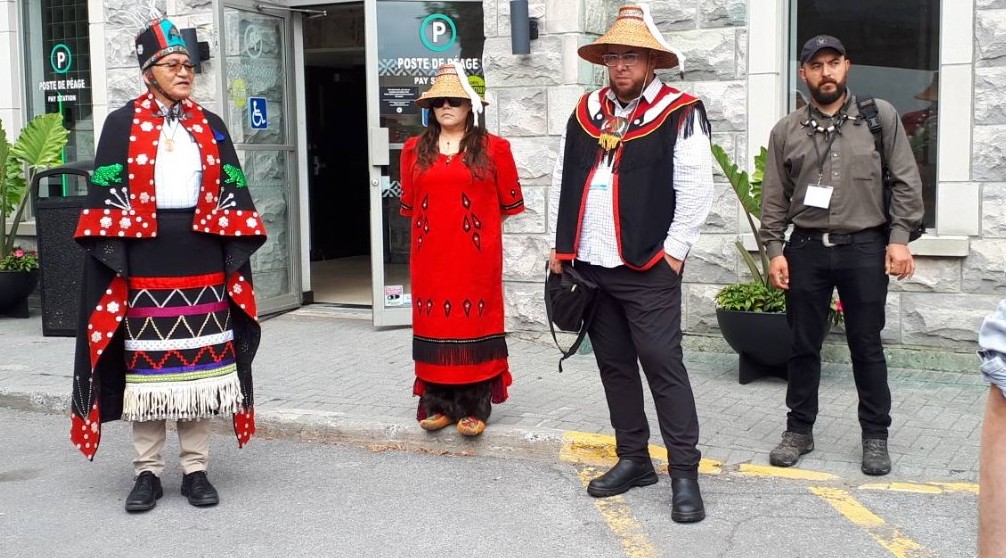
Photo: Wet’suwet’en Hereditary Chief Na’Moks, Wet’suwet’en land defender Gaylene Morris, Gitxsan hereditary leader Gwii Lok’im Gibuu, and Dogwood Northern B.C. coordinator Kai Nagata in Gatineau, Quebec, July 17, 2025.
On August 29, Canadian prime minister Mark Carney announced the launch of the new Major Projects Office (MPO) “to get nation-building projects built faster”.
His media release highlights that these projects include “ports, railways, energy corridors, critical mineral developments, and clean energy initiatives.”
More specifically, these projects could include, as the prime minister recently noted: ” reinforcing and building on the Port Of Montreal, Contrecoeur; a new port, effectively, in Churchill, Manitoba, which would open up enormous LNG [liquified natural gas] plus other opportunities; and other East Coast ports for those critical metals and minerals.”
This past June, CBC News reported: “Carney said last week he supports ‘nation-building projects,’ including a possible decarbonized oil pipeline — if he can find consensus among the premiers.” The following month, the Western Standard reported: “Prime Minister Mark Carney on Sunday [July 6] said the Prince Rupert Gas Transmission (PRGT) pipeline that would transport natural gas from northeastern BC to a proposed LNG facility on Pearse Island near Prince Rupert, BC, is ‘highly, highly likely’.”
The Wet’suwet’en and Gitxsan respond
In response to the establishment of the Major Projects Office, Wet’suwet’en Hereditary Chief Na’Moks comments: “When a supposedly democratic country like Canada sets up an office of cherry-picked individuals whose purpose is to generate profits, not protections, it is not only immoral, it fails to uphold Canada’s constitutional duty to consult, and other constitutional protections owed to Indigenous peoples. All Canadians, and all Indigenous Nations, must stand together to oppose this office and refuse to support it.”
Deputy Chief of the Hagwilget Village Council Gwii Lok’im Gibuu (Jesse Stoeppler) further comments: “By rushing projects through a fast-track office built for industry, the government is eroding its duty to consult, weakening environmental protections, and silencing the very communities who will bear the consequences.”
And Gidimt’en Checkpoint representative Eve Saint says: “Our Nations will not stand for this. Time and again, these companies cause total destruction to our lands and waters, with no cleanup and no accountability.”
Concerns about “violent and unlawful conduct” by police against land defenders opposed to major projects
It is in the context of the launch of the MPO that we also highlight a recent article titled Controversial B.C. RCMP unit to police opposition to fast-tracked resource projects by Shiri Pasternak and Tia Dafnos (The Breach, August 21, 2025).
Pasternak and Dafnos write: “A RCMP [Royal Canadian Mounted Police] unit criticized for violent and unlawful conduct will be involved in enforcing new laws in British Columbia that will fast-track resource and infrastructure projects…”
They explain: “Newly obtained documents show the RCMP’s Community-Industry Resource Group (C-IRG) will work with secretive provincial committees that monitor and respond to opposition to major projects…”
They also caution: “With its policing of pipeline and logging demonstrations having been deemed a ‘national best practice’ by the RCMP, there is potential that this model—and its criminalization of Indigenous and climate protest—could be replicated in other provinces, as resistance heats up against a wave of environmental deregulation being pushed by Prime Minister Mark Carney and several premiers.”
Previous expressions of concern by the United Nations
The United Nations Committee on the Elimination of Racial Discrimination sent three letters to Canada (on December 13, 2019, November 24, 2020, and April 29, 2022) expressing concern about three major projects (the Coastal GasLink pipeline on Wet’suwet’en territory, the Trans Mountain pipeline on Secwepec territory, and the Site C hydroelectric dam).
With respect to the December 2019 letter, CBC News reported: “[The committee] said it’s disturbed by law enforcement’s ‘forced removal, disproportionate use of force, harassment and intimidation’ and ‘escalating threat of violence’ against Indigenous people.”
APTN News has also noted that the November 2020 letter stated: “According to the information before the Committee, the Governments of Canada and of the Province of British Columbia have escalated their use of force, surveillance, and criminalization of land defenders and peaceful protesters to intimidate, remove and forcibly evict Secwepemc and Wet’suwet’en Nations from their traditional lands, in particular by the Royal Canadian Mounted Police (RCMP), the Community-Industry Response Group (CIRG), and private security firms.”
And in 2022, Global News reported: “The April 29 letter [the third letter from the United Nations committee] alleges escalated use of force, surveillance, and ‘criminalization of land defenders’ have been used to ‘intimidate, remove and forcible evict’ Wet’suwet’en and Secwepemc peoples from their land’.”
This UN committee that monitors a convention to end racial discrimination, ratified by Canada on October 14, 1970, directly called for the suspension of the Trans Mountain pipeline expansion project.
The August 29, 2025, statement from the Prime Minister’s Office says that Dawn Farrell, the new Chief Executive Officer of the MPO, “brings four decades of experience in Canada’s energy sector, including as President, CEO, and Board Chair of Trans Mountain Corporation…” In its biography of Farrell, Trans Mountain notes: “Most recently, she led the completion of the Trans Mountain Expansion Project.”
We continue to follow this.
Further reading: Canada: International law obligations to suspend construction of pipeline and stop use of force against Wet’suwet’en | Legal Brief (Lawyers Rights Watch Canada, March 17, 2020).

