


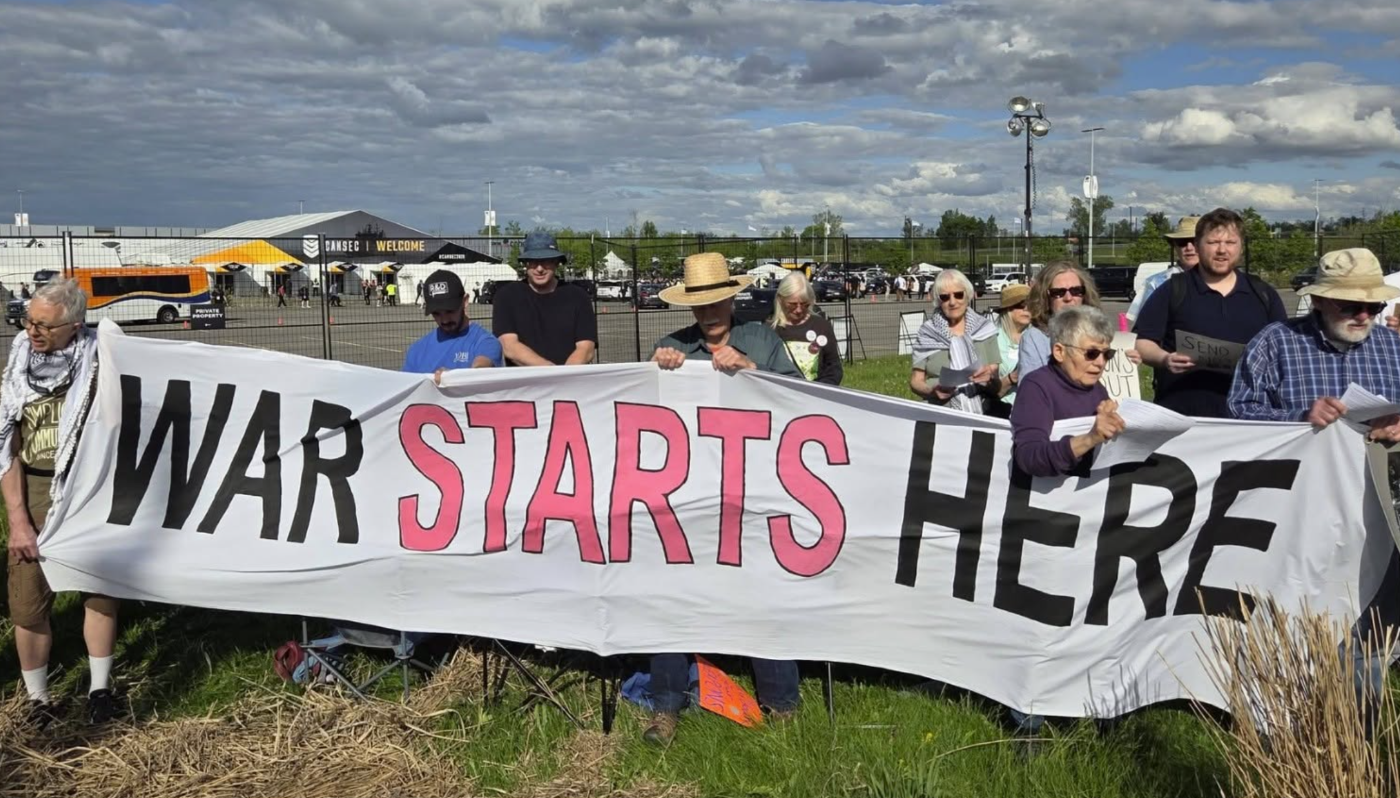
Photo: Companies building autonomous weapons and AI-enabled targeting systems exhibit at the annual CANSEC arms show in Ottawa.
Earlier this month, on the International Day to End Impunity for Crimes against Journalists, the Director-General’s Report on the Safety of Journalists and the Danger of Impunity (UNESCO) identified “a disturbing new threat: the growing use of unmanned aerial vehicles (UAVs), or drones to kill journalists. During the 2024-2025 biennium, 50 journalists, 40% of the total killed in conflict zones, were killed by drone strikes.”
Then this past weekend, The Guardian reported on the collapse of international talks at the Review Conference on Conventional Weapons at the United Nations in Geneva, Switzerland that were seeking a negotiating mandate for a legally binding international treaty to control on the use of autonomous weapons.
And today, Monday November 23, 2026, an “Autonomous Battlespace Conference” organized by the North Atlantic Treaty Organization (NATO) Association of Canada is taking place at The Westin Ottawa.
Autonomous and semi-autonomous weapon systems can be understood as any weapon that selects and applies force against “targets” with the use of technology, sensors and software, with minimal or no human intervention.
Autonomous Battlespace Conference

The conference overview notes: “This is a full-day conference bringing together leaders from the Canadian Armed Forces, Government of Canada and defence industry to examine autonomous and uncrewed capabilities across the air, maritime and land domains, as well as the C5ISR(T) [command, control, communications, computers, cyber, intelligence, surveillance, reconnaissance and targeting] and joint integration required to connect these capabilities across the future force.”
General Dynamics, Rheinmetall at Ottawa conference
Social media promotion for the “Autonomous Battlespace Conference” highlights that the “defence industry” speakers will include the Technical Director-Autonomous Systems at General Dynamics Mission Systems-International; the Vice-President Business Development at Davie; the Co-Founder & Chief Executive Officer of AVSS; and an Industry Representative from Rheinmetall Canada.
Rheinmetall has noted: “Rheinmetall is a specialist in autonomous systems in the air and space domains. These include, among other things, unmanned aerial vehicle systems, drones, and air-supported reconnaissance systems.”
Their website on “loitering munition systems” also promotes: “Potential targets can be observed autonomously or remotely over extended periods of time and engaged with precision at the decisive moment.”
AI-enabled targeting puts journalists at further risk
Targeting (the “T” noted in the conference description), specifically AI-enabled targeting, is an increasing concern for human rights, international law and specifically State attacks against frontline journalists.
In his July 2024 report on “technological developments of relevance to weapons, means or methods of warfare” United Nations Secretary-General Antonio Guterres warned of the need to “support and facilitate existing and potential new processes to address emerging challenges before they can pose a danger to peace and security, human rights, humanitarian norms and principles.”
This past week Radio-Canada reported: “Some experts say the use of AI to determine where and when to strike in the first place is an even more pressing concern than [autonomous] weapons themselves. …In one of the most prominent examples of AI-assisted targeting, Israeli intelligence officers described to Israeli-Palestinian publication +972 Magazine and the Hebrew-language outlet Local Call how the military’s Lavender AI system allegedly identified 37,000 targets in Gaza, with one saying soldiers had about 20 seconds to review each target before they carried out a strike.”
Thirty-nine journalists killed in drone attacks in 2025
Earlier this year, similar to the findings in the UNESCO Director-General report, the Committee to Protect Journalists (CPJ) documented: “One clear warning sign in the 2025 numbers is the rising number of journalists killed by drones: unmanned aircraft or small flying devices controlled remotely and with the ability to visually identify targets. Suspected and documented killings of press members spiked from just two in 2023 — the first year CPJ documented such press killings — to 39 in 2025.”
The CPJ adds: “Military drones were confirmed or thought to be behind 33 of those killings. Israel was responsible for nearly 75% of the journalists and media workers killed by drones from 2023 to 2025. Turkey’s attacks in Iraq and Syria account for another 10%.”
Impunity for war crimes
Helen Clark, the former head of the UN Development Programme, has commented in The Guardian: “Militaries around the world are increasingly relying on artificial intelligence to find, track and annihilate targets. …A strike that might have taken half an hour and required significant human consideration only a few years ago can now take minutes, or even seconds… When an autonomous weapons system assists in committing a war crime, accountability becomes difficult to establish.”
The UNESCO ‘Safety of Journalists’ report notes: “The global impunity rate for killings of journalists around the world is 86%. …The Arab States continue to be the region with the highest rate of impunity for killings of journalists at 98%.”
Collapse of talks for a binding treaty
This past weekend, The Guardian Reported “an overwhelming majority of states at the Review Conference [wanted] to agree a negotiating mandate leading to a legally binding treaty”. It further reports that “a bloc of seven countries – Austria, Belgium, Brazil, Ireland, Mexico, New Zealand and Panama – had led the push for a binding treaty to be negotiated within one year” but that “the US was reluctant to agree a binding treaty” and that “South Korea, Japan, Turkey, the UK, France and Germany were among the defence tech powers exploring AI-enabled weapons who also expressed resistance to being bound by a new law, instead advocating for a nonbinding agreement”.
Deutsche Presse-Agentur has also reported: “Other countries [along with the US and Russia] with large or growing arms industries also opposed negotiations on a legally binding agreement, including Israel, Belarus and Britain.”
Canada’s position
The Waterloo, Ontario-based Centre for International Governance Innovation has noted: “Canada has maintained an understandable posture of ambiguity on lethal autonomous weapons systems (LAWS), particularly within the Convention on Certain Conventional Weapons (CCW) process.”
A “Policy Brief” published by the University of Waterloo in 2023 further states: “Canada is lacking a policy on the development and use of AI for military use” and needs to develop a policy to guide “the use of AI-based weapon systems not only for its armed forces but also dictate its position in use of such weapons internationally”.
This past week CBC News reported that an AI summit in Spain in February 2026 “Canada, agreed to a declaration on how to govern use of the technology in warfare”, which does not appear to be the same as supporting a binding treaty.
We continue to follow this.
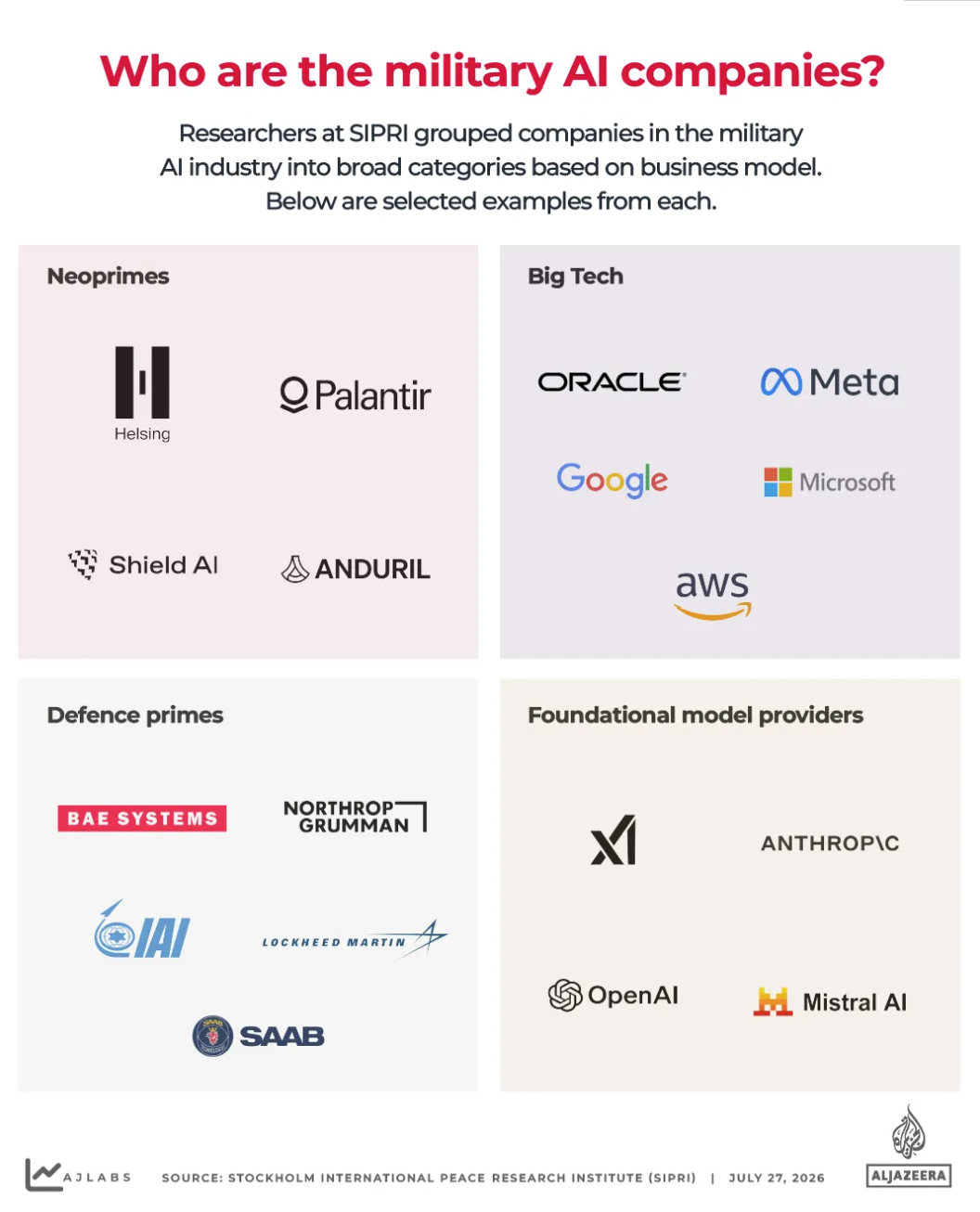
Image from The AI military complex: Which are the main companies in it? (Aljazeera, July 27, 2026).
Further reading: Autonomous Weapon Systems pose emerging dangers for human rights defenders, risk weakening accountability for war crimes (PBI-Canada, October 26, 2026).

