

The Peace Brigades International-Honduras team has posted on social media:
“’We, who fight for what is just, have even had to confront the very justice system that ought to be protecting us’, state spokespersons for the Dignified Encampment René Alemán and Pedrina Melgar, who are campaigning against mining activities affecting eight watersheds in the Medina area.
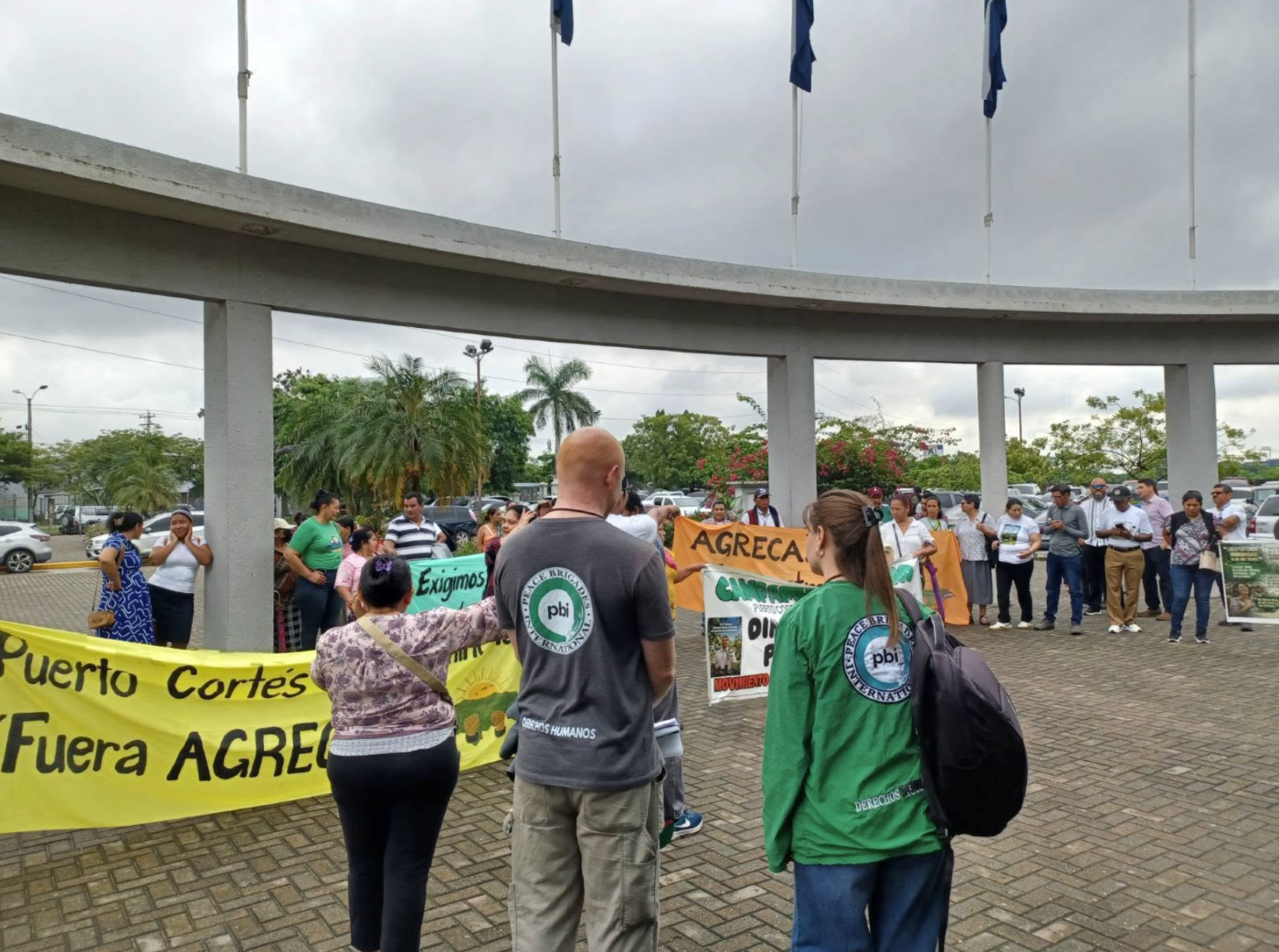
Currently, 12 defenders from the encampment are facing criminalization proceedings in the San Pedro Sula Criminal Court, following accusations of land usurpation brought by the company AGRECASA.
PBI, which provides accompaniment to the encampment, was present to observe the proceedings, alongside members of the international community. In this context, we underscore the importance of protecting the right to social protest, the right to life, and the right to a dignified life.”
On November 19, Movimiento Amplio explained on social media:
“Yesterday, the initial hearing was held for the defenders of the Medina area, members of the Dignified Camp René Alemán and Pedrina Melgar. Documented evidence was presented during the hearing that their actions are in response to the legitimate exercise of rights and the defense of water, health, life, and territory.
We demand that the Judiciary issue a resolution that guarantees their rights and does not criminalize territorial defense.
The resolution will be issued on December 4th.
We call on social and human rights organizations to remain attentive and support this process.
Defending the territory is not a crime!”
And on November 17, 2026, Mongabay reported:
“This story dates back to 2004, when AGRECASA arrived in the area to exploit stony materials on Sapadril hill.
More than two decades later, residents of at least 10 communities, including Brisas de Tramadre (where the quarry is located), Sector Medina, Baracoa, Campana, Las Delicias, and Sapadril face the consequences of this mining activity: dust invades them, their homes are cracked — due to detonations made for the exploitation of the stony materials — and they are dealing with concerns that the water of the Sapadril and Medina rivers, as well as the Brisas del Mar stream, may be contaminated.
The community leader states that people filed complaints, photos, and videos with various state agencies, without receiving effective responses.
The inhabitants of the communities affected by the Sapadril Quarry operations mention data found in reports from government agencies themselves: the mining company AGRECASA, they claim, uses around 60,000 gallons of water per hour in its stone washing processes, and then that water is discharged into the Medina River, so there are also impacts on the Alvarado lagoon and the beaches of Puerto Cortés.
Seeing that nothing was happening in judicial matters, on April 22, 2025, International Mother Earth Day, residents of Sector Medina set up a camp in front of the AGRECASA facilities. They decided to name it after two key figures in the defense of the territory in the area: René Alemán, a teacher murdered in 2013, and Pedrina Melgar, who died in June 2025.
[The] confrontation with the mining company has led to 13 people — 12 men and one woman — facing legal proceedings for the alleged crime of usurpation.
According to the Center for Democracy Studies (Cespad), the company produces more than four million tons annually, and 25% of that material is exported to the United States.
Lawyer Lisbeth Rodríguez, from the Broad Movement for Dignity and Justice and representative of the communities … highlights that, while residents’ complaints do not progress, there are 13 people from the affected communities facing legal proceedings as a consequence of their defense of the territory.
Twelve men and one woman, members of the camp, are facing criminal proceedings for the crime of usurpation against AGRECASA, since the company reported them for trespassing on its property. The communities point out that the camp is located on a public road. According to members of the movement, the process constitutes retaliation for their work in defense of water and Sapadril hill.
For those who remain in the camp, the wait goes beyond an administrative procedure: it is linked to access to water, the living conditions of families, and the possibility of continuing to inhabit their territory. That is why, more than a year after settling in front of the quarry, they maintain their demand that the State respond to the complaints and determine the future of extractive operations in their territory.”
We continue to follow this.
Additional reading
–PBI-Honduras visits with the defenders of the Medina Sector resisting the Agrecasa Cantera Sapadril mine (PBI-Canada, February 24, 2026)
–PBI-Honduras issues ALERT on threat against the René Alemán Pedrina González Dignified Camp (PBI-Canada, October 14, 2026)
–PBI-Research Unit initial study of the “Cantera Sapadril” open-pit non-metallic mine in Honduras (PBI-Canada, October 7, 2026).

