


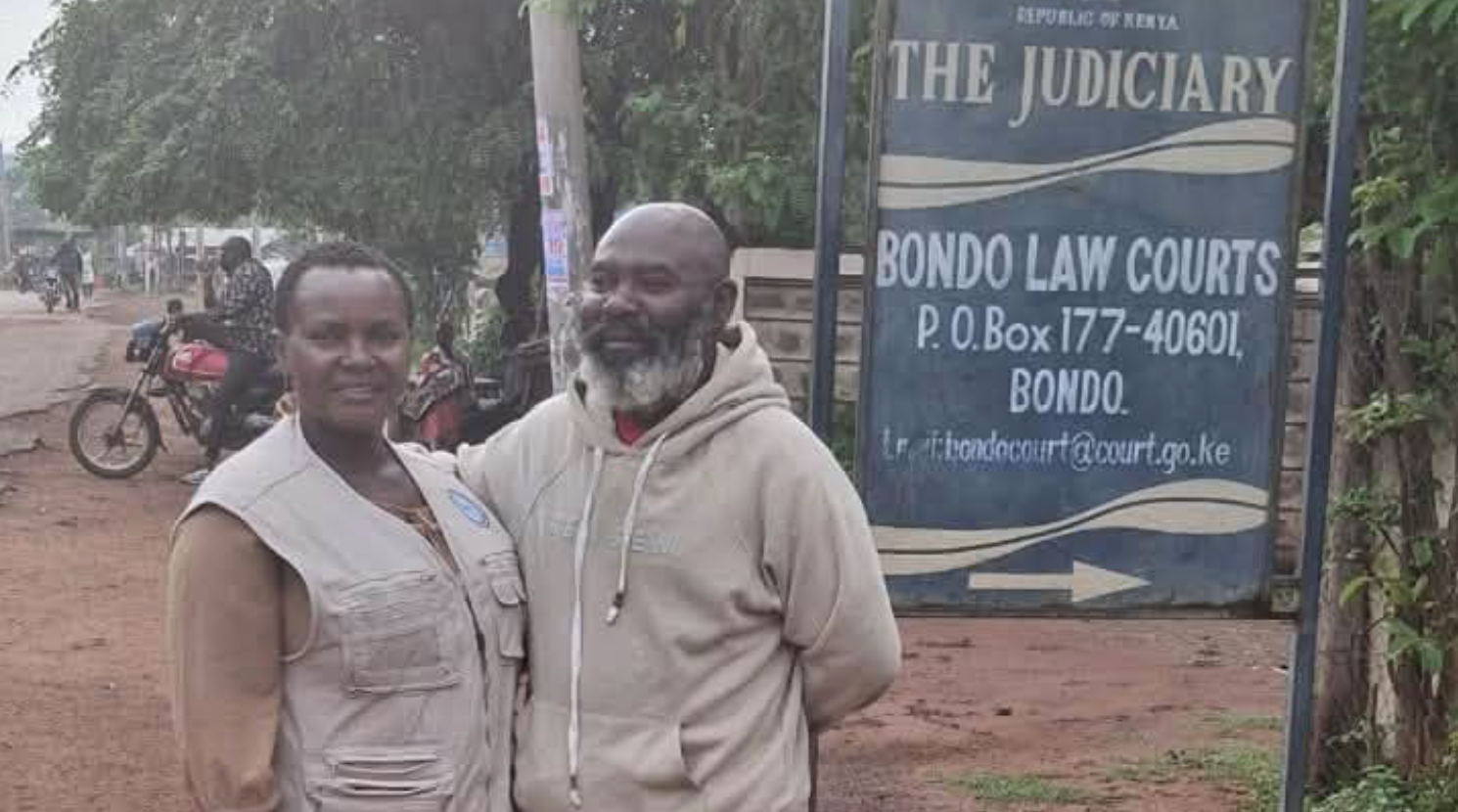
The Peace Brigades International-Kenya team has posted on social media:
“PBI Kenya provided physical accompaniment to Ombok Otieno, a land and environmental rights defender, during his appearance at Bondo Law Courts, standing in solidarity with his work to protect community land and the environment.
Through physical accompaniment, we offer a visible international presence to help deter threats, reduce the risks defenders face and support them to continue their human rights work. We walk alongside defenders, respecting their autonomy and decisions.”

In May 2026, Mongabay reported: “About a year ago, Kenya announced plans for its first nuclear power plant to be built in Siaya County, on the shores of Lake Victoria. …[Residents living near the proposed nuclear power project have] voiced concerns about potential nuclear contamination and ecological risks to Africa’s largest fresh-water lake. Many locals depend on the lake for food and their livelihoods.”
The article also explains: “The project was initially earmarked for Kilifi County, on Kenya’s coast, but after Kilifi residents rejected the plan, the government shifted to the new site in Siaya County.”
By August 2026, Greenpeace noted: “James Lawi Guya, a community organiser, … is now one of eighteen people arrested over peaceful opposition to the project. At least one is a child. …The arrests did not begin with James, and the violence did not begin overnight. On 21 May 2026, Sakwa residents marched carrying banners that read, simply, ‘We Reject’, and were met with police rather than dialogue. The confrontation sharpened in late July. On Friday 24 July, a government sensitisation meeting at Ka’John Trading Centre, attended by NuPEA, KenGen and the Bondo MP, collapsed into chaos, and David Otieno Mboya, an artisanal miner from Lenya, was shot in the leg.”
On September 1, 2026, PBI-Kenya posted on social media: “Today, we receive concerning news about the arrest of human rights defender Otieno Ombok, community representative who has been at the forefront of campaigning for Access to Information about the proposed nuclear plant in Siaya County. According to the Friends of Siaya Anti-Nuclear Plant Interim Coordinating Committee, he was arrested on Tuesday morning while making a solidarity court appearance.”
That same day, human rights defender Boniface Ogutu Akach posted on social media: “Ombok has been vocal in opposing the establishment of the proposed nuclear plant in Siaya without comprehensive and meaningful public participation. As a nonviolent champion, he has courageously organised his community to demand that local voices be heard and respected. Through protests, community conversations, and the drafting and submission of memoranda, Ombok has consistently advocated for the rights of communities affected by the proposed project.”
And deCOALonize has cautioned: “Environmental rights defender Otieno Ombok was abducted by DCI [Directorate of Criminal Investigations] officers from the Bondo Law Courts yesterday, seized while standing in solidarity with 19 young Kenyans unlawfully arrested for opposing the Sakwa Bondo Nuclear Power Plant. This is not an isolated incident. It follows the shooting of a protester in Lwenya and the arrest of dozens of youth for opposing the nuclear project. Civic space in Siaya is under siege.”
Connections with Canada
In March 2026, Siaya Today reported: “Cabinet Secretary of Energy and Petroleum Opiyo Wandayi held high level bilateral talks with a distinguished Canadian delegation, led by His Excellency Joshua Tabah, High Commissioner to Kenya, and the Honourable Randeep Sarai, Minister for Energy.”
The article continues: “The deliberations centered on strengthening the strategic partnership between Kenya and Canada, placing particular emphasis on fostering mutual growth within the energy sector. …The focus on mutual growth in the energy sector highlights how bilateral talks like these can drive progress for both partners. Kenya seeks to advance its energy infrastructure and diversification efforts, while Canada brings expertise in sustainable energy practices and resource management.”
On June 25, 2026, The Kenyan Wall Street reported: “Kenya has stepped up preparations for its first nuclear power plant after officials from the state-owned electricity producer KenGen spent a week studying Canada’s nuclear industry.”
The Kenyan Wall Street article quotes Sophie Price, the Head of Cooperation at the High Commission of Canada to Kenya, who says: “Building a nuclear program is not only about technology; it is also about people, institutions and long-term capability. For every engineer in nuclear energy, for example, many more diverse professionals are needed across operations, safety, regulation and community engagement, and that is why partnerships like this matter to us.”
The article notes that the visit of the Kenyan delegation to sites in Canada, including the Bruce Nuclear Generating Station on Lake Huron, “would help shape the institutional foundations required before construction of a reactor can begin”.
Construction to start in 2027
Earlier this week, Power Shift Africa posted: “Kenya plans to begin building its first nuclear power station in 2027, yet it has no finalised policy for managing the high-level radioactive waste the plant will produce.” They then ask: “How can the building of a nuclear power station start in 2027 when there is no HLW [high-level radioactive waste] management policy in place?”
We continue to follow this.
Further reading: Otieno Ombok on the Global Sumud Flotilla

In this 10-minute video posted by PBI-Kenya, Otieno Ombok talks about his experience with the Global Sumud Flotilla earlier this year.
“Flotilla is a non-violent action by people in Europe, citizens, who decided to take food to Palestine, like humanitarian assistance, by community citizens, raising the food from individuals, either in cash or in kind, and then taking small boats with the human rights defenders, and citizens simply wanting to contribute to the situation of human suffering that comes as a result of the war in Palestine.
They come from Europe, they come from South Africa, they come from America, Canada, all over the world, Australia. We had people from Australia and Latin America being part of Flotilla for this time. And the numbers were bigger, especially after October 7, because the aggression by Israel was even bigger. Bombardment that is unprecedented. And this, my goal was to tell Africans, Kenyans, that we need to be part of this struggle. Not because it is political, but it is humanitarian.
You get attacks from evangelical extremists, Christian Zionists within the country who are supporting Israel. I’ve been shunned by fellow academicians who say, now you cannot teach in our university because of not supporting Israel, and many other things that come with that.
Flotilla has contributed to non-violence, and as a non-violent practitioner in Kenya, this was the right opportunity.”


