


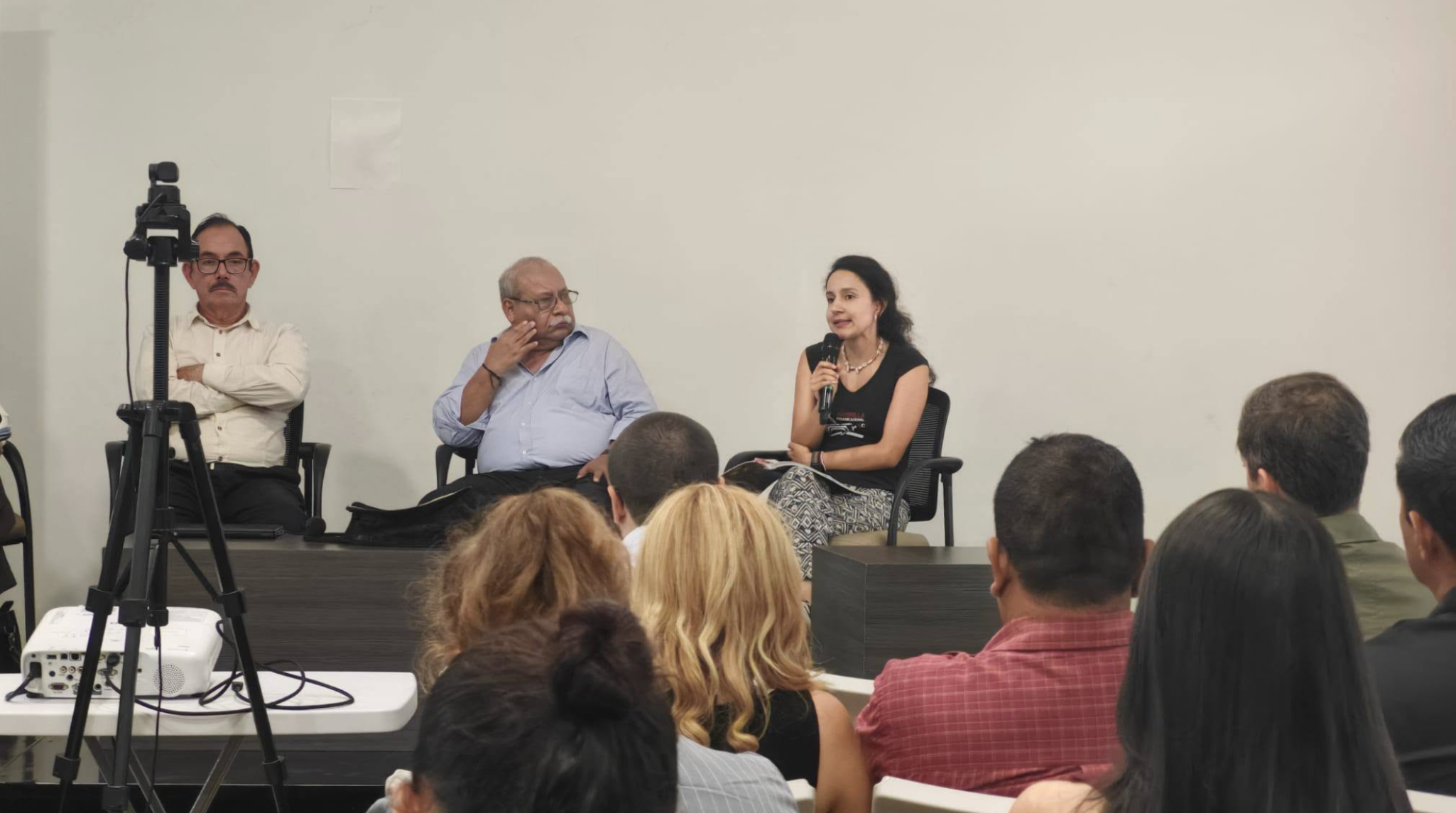
The Peace Brigades International-Honduras team has posted on social media:
“Honduras lives on! It lives on within Indigenous and Afro-descendant communities, among the women who sustain life-affirming processes, and among the youth who refuse to be resigned,” stated Ismael “Padre Melo” Moreno during a session focused on monitoring the Honduran State’s compliance with rulings from the Inter-American Court of Human Rights (IACHR).
The event, which examined the prevailing context of corruption and institutional democratic weakness, highlighted several key cases—including those of Vicky Hernández, the Escaleras Mejía family, and the Garifuna communities of Punta Piedra and Triunfo de la Cruz, among others.
“Society must be mindful of the need to demand its rights at all times,” urges Bertha Zúniga, General Coordinator of COPINH Honduras [the Civic Council of Popular and Indigenous Organizations of Honduras].

The Spanish news agency EFE provides the context that these views were expressed at the ‘Honduras Facing Its International Obligations: Context and Challenges in Human Rights’ public forum held in Tegucigalpa on November 17.
The Centre for Justice and International Law (CEJIL) also explained in their promotion in the lead-up to the event “This meeting is organized by the Sentences Monitoring Desk of the Inter-American Court of Human Rights – Honduras, a national and international articulation dedicated to monitoring compliance with the resolutions of the [Inter-American Court of Human Rights] by the Honduran State.”
Ismael Moreno
Criterio.hn explains that Ismael Moreno, mentioned in the PBI-Honduras social media post, is the “former director of the Reflection, Research and Communication Team (ERIC) and a Jesuit priest”. Their social media post adds: “[Ismael Moreno] noted that rather than dismantling corruption, impunity, the capture of institutions, militarization and the use of the state to serve a small group in power, these remain intact and have expanded, despite attempts at a transition to democracy.”
Criterio.hn also highlighted Ismael Moreno, replying to a question at the public forum about the factors affecting the protection of human rights and the strengthening of democracy in Honduras, cited impunity, weak or captured institutions, corruption, structural inequality and violence in all its forms, the lack of protection for human rights defenders and independent journalists, the development model and its relationship with territories, and the fragility of democratic culture.
Lack of compliance with the IACHR
The EFE news report highlights: “The event recalled that, of the 20 cases for which Honduras has been condemned by the IACHR, 18 remain in the supervision phase of sentence enforcement.”
The GIEI report
With respect to Copinh, an Interdisciplinary Group of Independent Experts (GIEI) was established under the auspices of the Inter-American Commission on Human Rights (IACHR) in February 2025 with the mandate to analyze and strengthen the investigation into the murder of Copinh co-founder Berta Caceres, as well as to propose measures of reparation and guarantees of non-repetition.
On January 13, 2026, the final report of the GIEI was published, concluding that the murder of Caceres was the result of an organized crime motivated by corporate interests that was “predictable and preventable.” The report points to the responsibility of the Honduran state, corporate actors, and financial institutions.
In September 2026, Peace Brigades International signed a joint letter along with numerous other organizations requesting that the European Union and its Member States “urge the State of Honduras to implement the GIEI recommendations to ensure access to justice, guarantees of non-repetition, and reparation”.
Accompaniment
Peace Brigades International has accompanied Bertha Zúniga Cáceres, the daughter of Berta Caceres and the general coordinator of the Civic Council of Popular and Indigenous Organizations of Honduras (COPINH), since May 2016.

