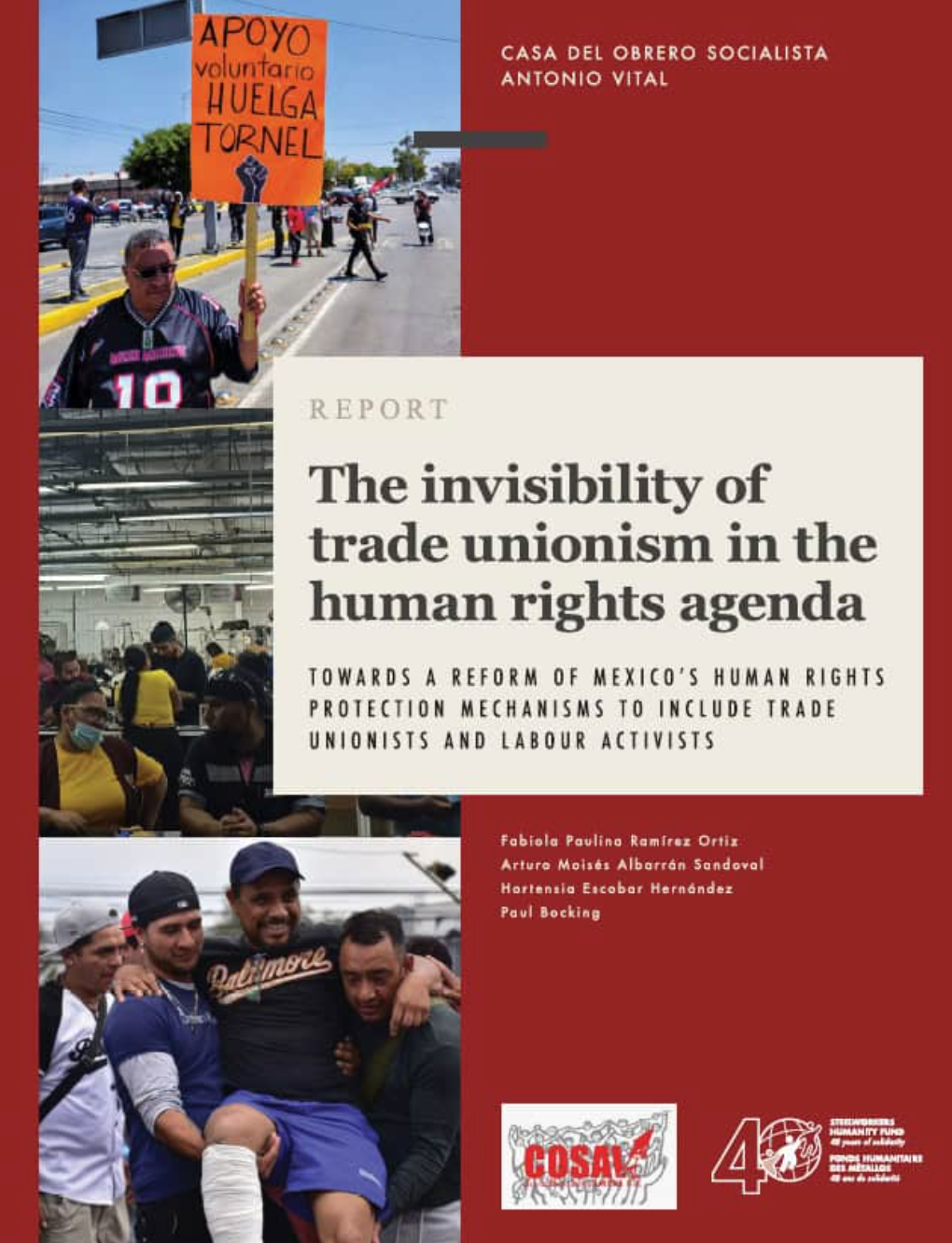

Peace Brigades International-Canada welcomes the United Steelworkers (USW) publication The invisibility of trade unionism in the human rights agenda: Towards a reform of Mexico’s human rights protection mechanisms to include trade unionists and labour activists (October 1, 2026).
The 72-page report is available in both English and Spanish here.
We highlight that the USW report proposes the creation of a National Protocol for the Protection of Trade Unionists and Labour Rights Defenders in Mexico, coordinated by an Inter-institutional Immediate Reaction Table for High-Risk Labour Disputes.
Key excerpts from our reading of the report include:
The threats faced by trade union activists
-Throughout its history, the labour movement in Mexico has faced violence and repression from the state, employers and their agents. (page 3)
-Political violence against trade unionists and labour human rights defenders responds to a persistent structural logic. (page 3)
-Mexico continues to be one of the riskiest countries for human rights defenders. According to the 2025 Annual Report of the Inter-American Commission on Human Rights (IACHR), 3,357 petitions were received in the region that year; 700 originated from Mexico, the second highest figure, only after Colombia. (page 15)
-Violence against trade unionists in Mexico is one of the most persistent expressions of political and structural violence against human rights defenders. (page 18)
Trade union activists are human rights defenders
-It is urgent that the Mexican State explicitly recognize trade unionists as human rights defenders and establish specialized mechanisms for prevention and protection. (page 19)
-This protection must include preventive measures, immediate responses to threats, diligent investigations, coordination between labour, ministerial, and security authorities, as well as effective guarantees for the exercise of union activity. (page 20)
The limitations of existing Protection Mechanism
-At the federal level, the Protection Mechanism for Human Rights Defenders and Journalists has been operating since 2012. Its creation responded to persistent aggressions against both groups and to the demands made for years by national and international organizations. (page 16)
-Although the Mexican State recognizes the defense of human rights as a legitimate activity, in practice, the Federal Protection Mechanism for Human Rights Defenders and Journalists (MFPPDDHP) usually dismisses the cases of trade unionists on the grounds that they are ‘labour conflicts’ or criminal acts. (page 4)
-Despite the formal recognition of social rights, the Mechanism’s Regulations allow the authority to analyze and qualify the “activity” of the person requesting protection. In fact, when it comes to labour rights defenders and/or trade unionists, this analysis translates into the denial of admission. (page 17)
-We demand that the corresponding authorities expressly include in the Law for the Protection of Human Rights Defenders and Journalists, that trade unionists and labour human rights defenders are eligible as direct beneficiaries of the Mechanism. (page 52)
-There is no legal impediment to expressly incorporating labour defenders and trade unionists into the Protection Mechanism; what has been lacking is the political will to respond to widely documented violence. Modifying the Mechanism is no longer a recommendation, but an obligation of the Mexican State. (page 57)
A comparison with the Protection Mechanism in Colombia
-The Colombian experience is particularly relevant to this analysis. In the face of decades of anti-union violence and sustained pressure from national and international organizations, the State developed one of the broadest protection systems in Latin America for trade unionists and labour rights defenders. (page 44)
-The main lesson for Mexico is that a protection mechanism should not be limited to reacting when the threat has already occurred. The Colombian experience shows the need to articulate individual and collective measures, strengthen territorial prevention, ensure coordination between labour, security and law enforcement authorities, and expressly recognize trade unionists and labour rights defenders as human rights defenders. It also shows that protection cannot depend on the size of the union, its capacity to exert pressure or the possibility of resorting to international bodies. (page 50)
-In this sense, Mexico has the opportunity to learn from the advances and limits of the Colombian model. Rather than reproducing it automatically, it is necessary to build an appropriate response to the national context, capable of intervening from the first signs of harassment, addressing the risks linked to trade union organizations and preventing violence from escalating. (page 50)
The call to support this initiative
-The democratic transformation of the world of work in Mexico would not have been possible without the constant accompaniment of international organizations, global unions, cooperation agencies and multilateral mechanisms committed to the defense of labour rights. (page 56)
-We call on trade unions, organizations, defenders, academia and national and international organizations to support this initiative and contribute to the construction of a proposal to reform the Federal Mechanism for the Protection of Human Rights Defenders and Journalists, adding their cases, proposals and endorsements to the request that will be formally presented to the authorities. (page 57)
Next steps
Peace Brigades International-Canada welcomes this report by our friends at United Steelworkers and looks forward to the opportunity to discuss ways to support and contribute to the construction of this proposal.
The full 72-page report is available in both English and Spanish here.