

El Pais has reported: “The effects of the earthquake that shook Colombia on Monday, August 10, also generated concern in indigenous communities settled in the Pacific, including Chachajo, a reservation of the Wounaan people, located in the lower basin of the San Juan River, between the departments of Chocó and Valle del Cauca. …After the earthquake, photographs and videos began to be disseminated from the community in which damage to some structures can be observed.”
By late-August 2026, Agenda Propia reported: “The central community of Chachajo, established in the lower basin of the San Juan River, was 80 percent destroyed. More than 60 houses collapsed. The others are broken, uninhabitable. Most of the 585 people who live there are sleeping rough.”
That article added: “Ten days after the earthquake, they had not received help from any state entity.” And it appears that almost two months later, the State has not assisted the Indigenous community of Chachajo.
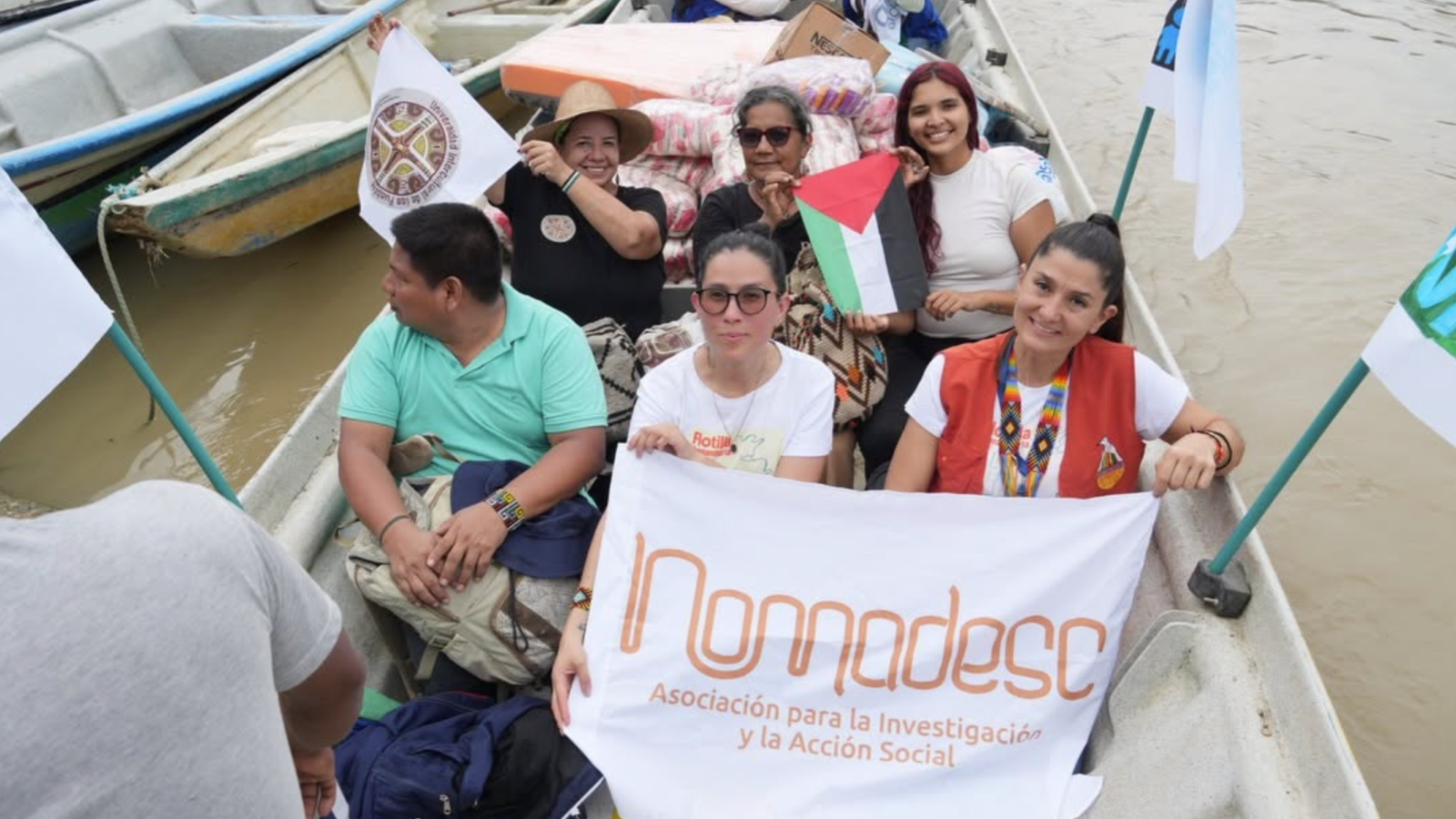
In response, the Colombia delegation of the Global Sumud Flotilla has mobilized to provide material aid. Yesterday, the Association for Social Research and Action (Nomadesc) posted on social media:
“Navigating the waters of the Calima and San Juan rivers toward the Chachajo reserve, one instantly realizes that life here is sustained through sheer, determined effort.
Amidst the water, the Chachajo timber, and the vast landscape, the true driving force of this journey is the unwavering strength of the people.
Faced with a lack of immediate institutional response, various collectives joined forces to organize a minga – a communal effort embodied by a human chain passing along roofing sheets, food supplies, water, and other essentials for survival. One of the most admirable aspects of this journey is seeing the community organize from the grassroots level, looking out for one another, and demonstrating that solidarity is not charity, but a political and ethical act.
‘That organized solidarity keeps us strong’. Many hearts came together to provide humanitarian aid—food, hygiene products, school supplies, roofing sheets, and even soccer balls—driven by the conviction that solidarity is the surest path to strengthening the dignity of our communities.”

Accompaniment
Peace Brigades International has accompanied the Association for Research and Social Action (Nomadesc) since 2011 and its president Berenice Celeita since 1999.


