

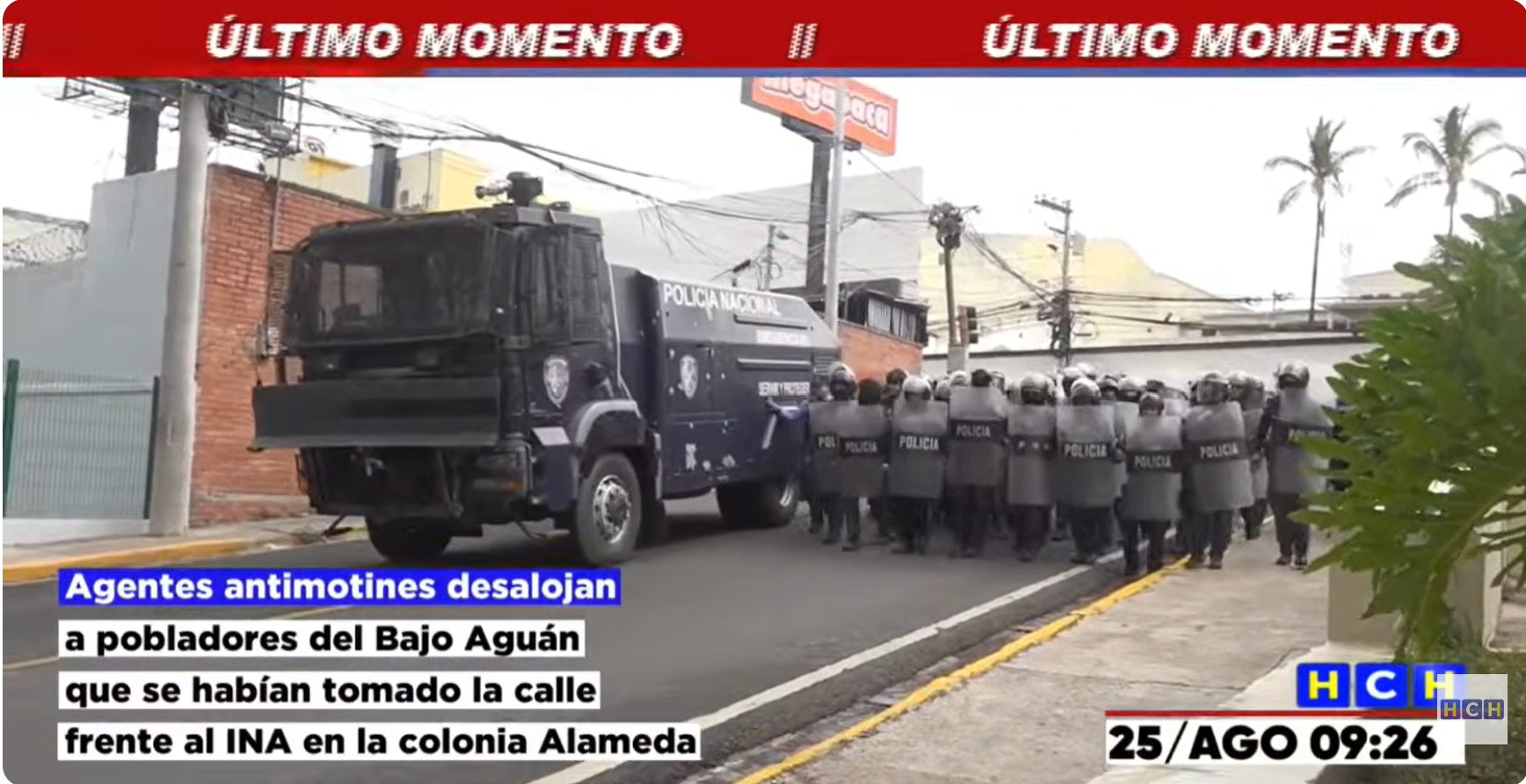
Video still: HCH Television coverage of water cannon truck.
The Peace Brigades International-Honduras Project has posted on social media:
“On 24 August, PBI was present during the organizations’ peaceful demonstration outside the INA [National Agricultural Institute] premises and witnessed the excessive use of force by the police to disperse the protest, using tear gas and a water cannon, without taking into account the presence of elderly people and those with health conditions.
We at PBI wish to express our concern regarding the infringement of the right to protest and the shrinking of civic space, as well as the arrest of one of the people taking part in the protest in defence of the right to land and territory.”
HCH Televisión also reported: “The protest of a group of peasants from Bajo Aguán in front of the facilities of the National Agrarian Institute (INA) ended with the intervention of riot police, who used a tank and tear gas to evict the demonstrators who were occupying the street in the Alameda neighborhood. The peasants had come to the place to demand answers to their claims related to the defense and respect of their lands, in addition to requesting the departure of the INA minister, Javier Talavera.”
The HCH video coverage included this image of the water cannon truck deployed to disperse the peaceful demonstration.


The website also notes: “During the year 2020, all Beit-Alfa activities were acquired by HOS.”
Beit Alpha Technologies (B.A.T) is a private Israeli company with its head office in Kibbutz Beit-Alfa, Israel. HOS Technology R&D is also an Israeli company with its head office in Kokhav Yaier, Israel.
The Database of Israeli Military and Security Export confirms that Beit Alfa’s the “armored riot control vehicle” is used in multiple countries including Honduras, Guatemala, Chile, Spain and France.
The Database website adds that the “Riot Control Vehicle with Water Restraint System … was originally designed during the first Intifada to be used to suppress Palestinian protests in less lethal means due to criticism on Israel for use of rubber coated bullets. They are in use by Israeli military forces and Israel police. Riot Control vehicles with WRS and the Skunk are used regularly in the West Bank by Israeli military and police forces against Palestinian protestor and civilians.”
Honduras imports arms and military goods
Trading Economics notes that Honduras imported $15.69 million “from Israel of Arms and ammunition, parts and accessories” in 2024.
The Observatory of Economic Complexity has posted on their website: “In 2024, Honduras imported Weapons primarily from: Brazil ($3.24M), Turkey ($2.29M), United States ($1.53M), Czechia ($1.38M), and Mexico ($1.08M). The fastest growing origins for Weapons imports in Honduras between 2023 and 2024 were: Brazil ($1.16M), Spain ($619k), and Germany ($4.39k).”
In June 2019, Stop US Arms to Mexico documented: “Colt Manufacturing, based in Hartford, Connecticut, exported machineguns to Honduras that were used by military police to fire on protesters against electoral fraud in 2017. Colt shipped 1,714 machineguns to Honduras in 2015, 350 in 2016, and 1,000 in 2017, at a value of $3,558,686. Honduran police frequently attack nonviolent protests with CS tear gas, which is manufactured by Nonlethal Technologies in Homer City, Pennsylvania.”
“Defence” exports and human rights obligations
Peace Brigades International-Canada is examining the relationship between the export of weapons, military equipment and technology and their impact on human rights, organizations, defenders and communities, specifically those accompanied by PBI.
Amnesty International has highlighted:
“Under the UN Guiding Principles on Business and Human Rights, all companies have a responsibility to respect human rights and undertake human rights due diligence to identify, prevent, mitigate and account for how they address both their potential and actual human rights impacts. In relation to the defence sector, this means companies must assess and address human rights risks and abuses arising in all aspects of their business, including how clients such as national armies and police forces use their weaponry and related services.
The primary purpose of due diligence is to avoid causing or contributing to human rights abuses. Therefore, if a company cannot prevent or adequately mitigate adverse human rights impacts, it should avoid or cease supplying the relevant arms and related services. These responsibilities exist over and above compliance with national laws and regulations – such as state licensing systems – aimed at protecting human rights.
Failure to carry out adequate human rights due diligence increases both reputational and legal risks for an industry that supplies high-risk products to dangerous environments. Legal concepts of “corporate complicity” in and the “aiding and abetting” of international crimes continue to evolve and could in the future apply to arms companies that continue supplying weapons in the knowledge that they may be used to commit or facilitate serious violations of international human rights or humanitarian law.”
We continue to follow this.
Additional reading
– High-pressure water cannon causes long-term ocular injuries and psychological impact on Cristian Espinoza, a Honduran artist and activist (Honduras case study, Lethal in Disguise, a project by Physicians for Human Rights and the International Network of Civil Liberties Organizations).
– Arms companies are ‘washing their hands of their responsibilities’ – new report (Amnesty International, September 2019).
– Israeli military exports linked to eviction of CNTC farming community, violence against human rights defenders in Honduras (PBI-Canada, April 22, 2026).

