

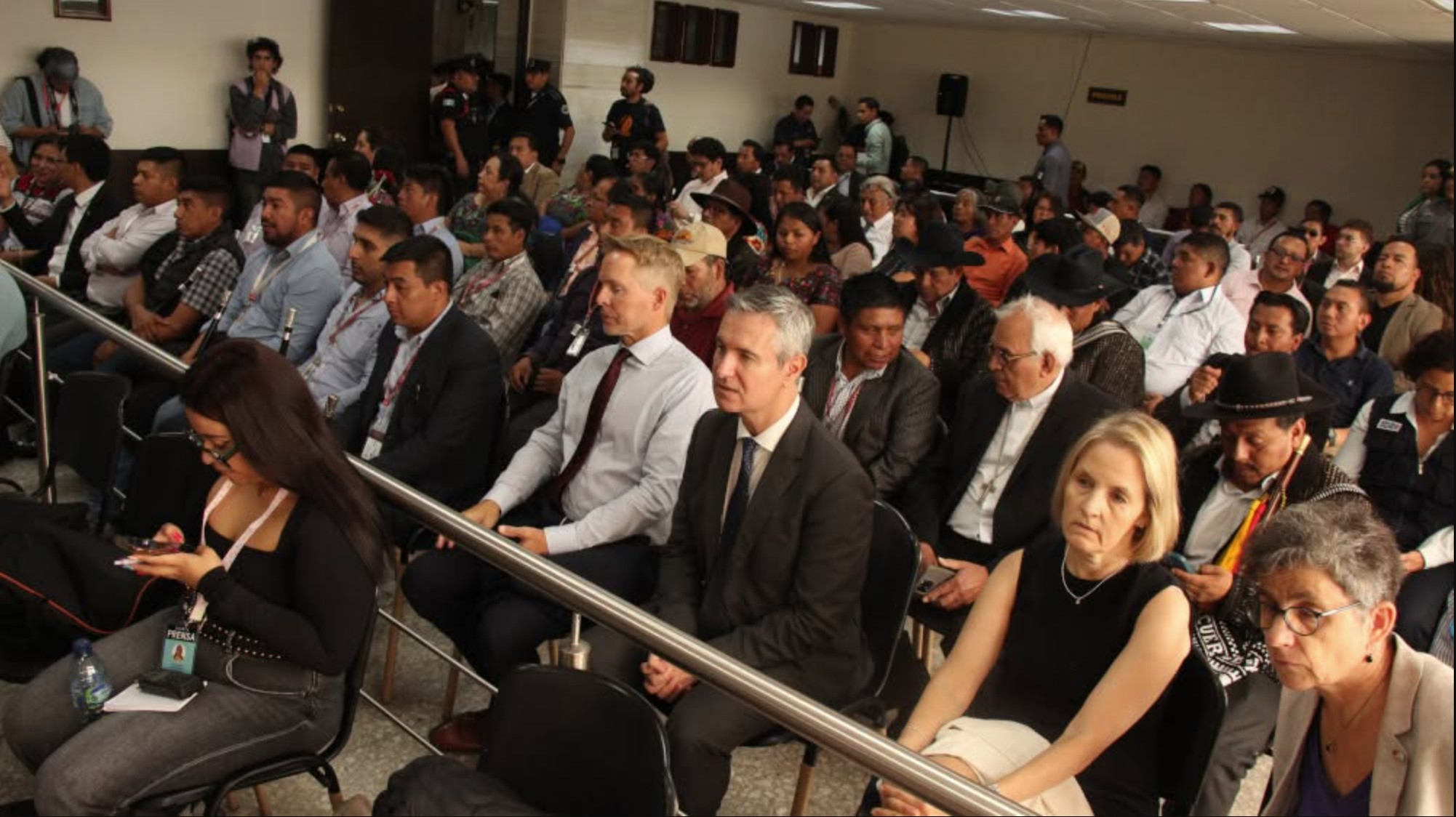
On August 4, the Peace Brigades International-Guatemala Project posted on social media:
“Today, #PBI is observing a hearing involving Luis Pacheco, Hector Chaclán and Basilio Puac. These former Indigenous leaders, who represented the 48 cantons, are facing criminal proceedings for their leadership role in the uprisings by Indigenous peoples to defend the results of the 2023 elections. They are charged with terrorism, obstruction of justice and criminal association.
Judge Mynor Moto, who was investigated four years ago for corruption and conspiracy to obstruct justice, ruled on three matters: (i) to agree to extend the investigation phase so that Pacheco and Chaclán’s defence team can prepare an expert report on the role of indigenous authorities in their communities; (ii) to reject the Anti-Terrorism Foundation as a joint claimant for failing to appear at the hearing; and (iii) to grant alternative measures, allowing Pacheco and Chaclán to be released from pre-trial detention, where they had been held for more than 16 months; Puac is already facing the proceedings on conditional release. All parties requested this change to the coercive measure.
The judge ordered house arrest at their respective residences, with the right to travel throughout the country; the obligation to report monthly to the Public Prosecutor’s Office; a ban on leaving the country without authorization; a ban on holding public office during the legal and criminal proceedings; and a financial guarantee of Q160,000 for each of them.”


Amnesty International further explains: “Luis Pacheco and Héctor Chaclán were imprisoned for peacefully exercising their human rights and for playing the leadership role entrusted to them by their communities. They remained in pretrial detention after being arrested in April 2025 on charges related to the 2023 nationwide protests.”
Amnesty highlights: “In May 2026, Amnesty International declared them prisoners of conscience, concluding that they were being persecuted for peacefully exercising their rights to freedom of expression and assembly.”
On October 6, 2023, the Associated Press reported: “Thousands of protestors have blocked roads across Guatemala in surging demonstrations to support the president-elect, Bernardo Arévalo, after the country’s highest court upheld a move by prosecutors to suspend his political party over alleged voter registration fraud. Arévalo, an anti-corruption crusader who won a landslide victory in the August election, has denounced the suspension as a ‘coup’ aimed neutralizing him before he takes office in January, and his supporters are demanding the resignation of the prosecutors responsible. Street blockades that started this week grew from 14 on Monday to 58 road and highway blockages Friday.”
And following their release from custody this month, Plaza Publica reported: “Pacheco and Héctor Chaclán, former president and treasurer of the organization 48 Cantons of Totonicapán, returned to Totonicapán on the night of Wednesday, August 5 as part of a panel that had its doors open to greet their neighbors on the road; They were escorted by a caravan of cars and motorcycles. The news of their release immediately spread through the community, at the doors of the houses and at the turns of the road neighbors came out to celebrate them with balloons and whistles.”
That article also tells us: “After spending more than 15 months isolated in a cell of the Mariscal Zavala military prison, located in Guatemala City, where they were each other’s only company, that night they were no longer alone, hundreds of neighbors and residents came out in the cold of the night of the highlands to receive them.”
Additionally, JURISTnews notes: “Pacheco and Chaclán have not been cleared of the charges of terrorism, unlawful association and obstruction of criminal proceedings. The latest order changes the conditions under which they will await further proceedings, leaving the underlying criminal case unresolved. Each must pay 160,000 quetzales in bail, remain in Guatemala and avoid contact with witnesses.”
While the court process continues, the next presidential election in Guatemala is scheduled to take place in June 2027, less than a year from now.
There is already commentary about how 2026 could shape that election.
In January 2026, the Atlantic Council noted: “This year, Guatemala will undergo the most consequential institutional reset since its return to democracy in 1986. Five bodies that determine who gets prosecuted, who gets protected, who gets elected, and, ultimately, who governs the country will be renewed within a tight five-month window. The attorney general, the Constitutional Court, the Supreme Electoral Tribunal, the comptroller general, and the rector of the University of San Carlos (USAC) all come up for selection between February and August 2026—a timing so unusual that analysts have described it as a ‘planetary alignment.’”
And Luis Javier Medina, a political scientist from the University of San Carlos of Guatemala, has commented: “Amid all this, there is a clear intention on the part of political actors to prevent the reformist faction—whether through the Movimiento Semilla party or another organization—from competing in the upcoming elections. This heightens the importance of the aforementioned processes, as those selected for second-degree offices will have the final say in many decisions concerning the 2027 elections.”
We continue to follow this.

