


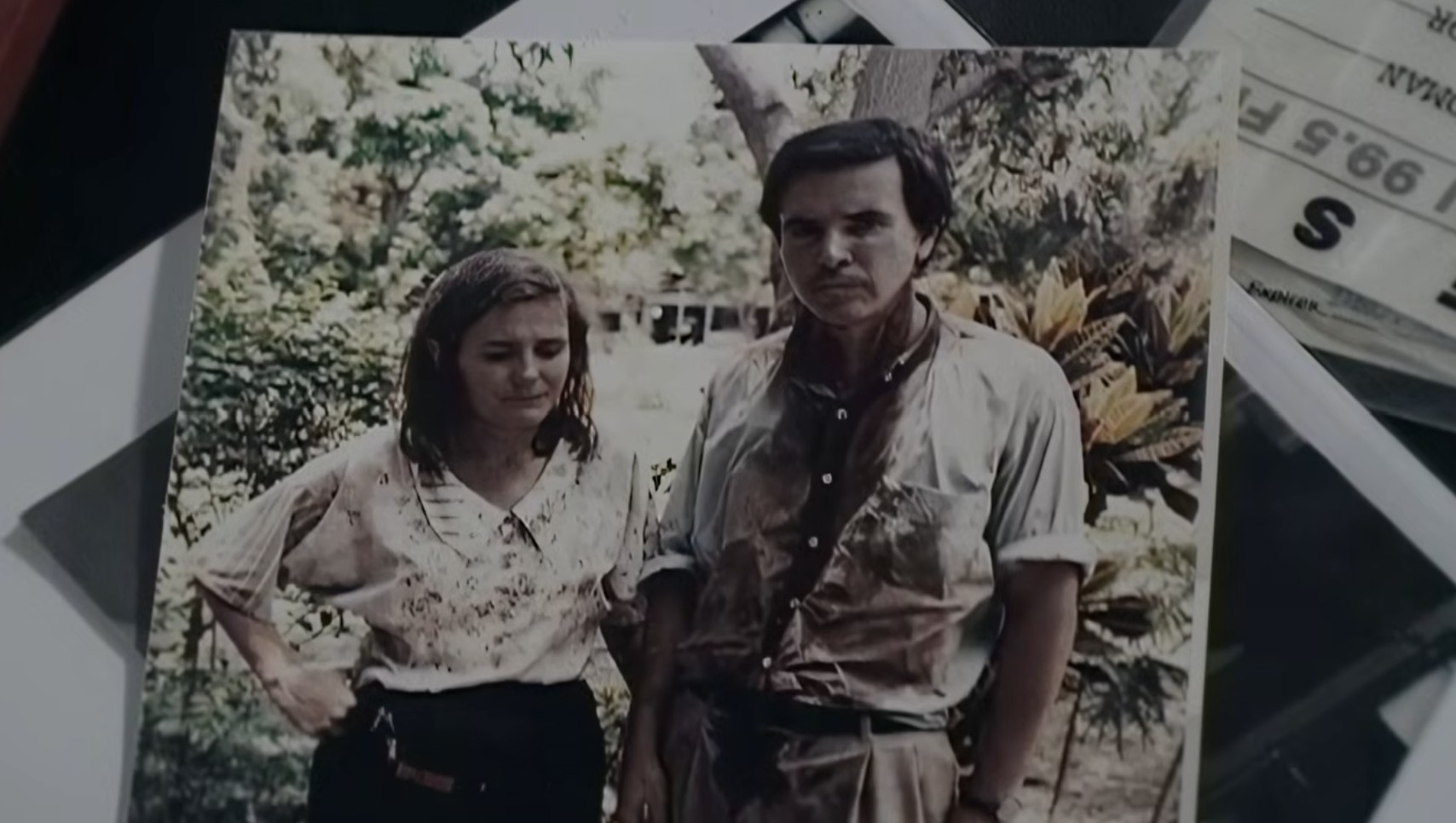
Video still: Journalists Amy Goodman and Allan Nairn after being attacked by Indonesian security forces on November 12, 1991, during the Santa Cruz massacre on East Timor. Goodman says: “Our job is to be at the target end: how does it feel when that button [on a military jet] is hit? That’s our job as journalists.”
As noted on the Peace Brigades International global website: “From 1999-2011, Peace Brigades International provided protective accompaniment and participatory peace education to human rights defenders in Papua, Aceh, Flores, West Timor and Jakarta. …After extensive dialogue with civil society organizations and other stakeholders, PBI began supporting human rights organizations in Indonesia in 2014.”
Several years before PBI’s historic presence in West Timor, which is adjacent to and on the same island as East Timor, political activist Sebastiao Rangel, aged 18 and unarmed, was killed inside a church on October 28, 1991, by Indonesian security forces.
About two weeks later, on November 12, 1991, about 100 people were killed and many more wounded by Indonesian security forces as they gathered at the Santa Cruz cemetery in Dili, East Timor for the funeral of Rangel. As many as 300 people were detained and some were reportedly tortured and killed in detention.
US and Canadian-made weapons
In The Guardian review of the documentary “Steal This Story, Please!” about Democracy Now! and host Amy Goodman, reviewer Peter Bradshaw writes: “[Goodman] had a breakthrough with her on-the-spot reports in 1991 on Indonesia’s massacre in East Timor, perpetrated mostly with US-made weapons; she was savagely beaten with M16 rifle-butts, along with the New Yorker’s Allan Nairn – who gallantly threw himself on top of her to spare her the worst of the brutality.”
It should be noted that Canada also exported weapons to Indonesia from 1975 to 1991 and only briefly paused arms exports to Indonesia after the November 1991 massacre. Arms sales resumed in November 1993. More recently, according to Government of Canada figures, during the period of 2012 to 2024 when 25 land and environmental defenders were killed in Indonesia, Canada exported almost $45 billion of so-called “military goods and technology” to that country.
Last week, Dan Sabbagh, the Guardian’s defence and security editor, also reported:
“Thirty-five years ago, Goodman travelled to East Timor in southeast Asia, then in the midst of a brutal occupation by Indonesia that had seen more than 100,000 people already killed. Despite the level of human suffering, it was not a well-covered story then, but Goodman and another American journalist, Allan Nairn, had arrived, hoping to follow a visit from a UN delegation.
It was 12 November 1991. Goodman and Nairn had gone to witness a commemoration mass for Sebastiao Rangel, killed a fortnight earlier by the Indonesian military. Several hundred swarmed into a church in the capital, Dili, then walked to a nearby cemetery, hemmed in by high walls. It had become a public act of defiance by the Timorese, but Goodman thought that while the Indonesian military had committed massacres before, they would not dare do so in front of western journalists.
“I held my microphone up like a flag, Allan put the camera above his head. I slung my tape-recorder, which I’d always hidden, over my shoulder and we walked to the front of the crowd,” Goodman recalls. Shortly after, Indonesian soldiers marched up “10 to 12 abreast” armed with US M16 assault rifles and fired on the crowd “without warning, without hesitation, without provocation”.
She cannot forget what happened next. “The first to go down was this little boy behind us who had his hands up in the V sign. ‘Viva East Timor,’ they shouted. ‘Viva independence! Viva Sebastiao!’” Goodman and Nairn were not shot but they were attacked and beaten with boots and rifle butts. Nairn threw himself on top of Goodman to protect her, and the soldiers “took their US M16s like baseball bats and slammed them against his skull until they fractured it” before finally relenting.”
Bearing witness
It was a defining moment, perhaps the ultimate justification for reporters bearing witness. Indonesian soldiers killed 271 protesters that day at the Santa Cruz cemetery. Goodman and Nairn survived because they were from the US, managing to get a flight out of the country. Though their equipment was seized, they were able to recount what happened in interviews and in a press conference in the following days, and their story was stolen by the world’s media.
“The sword and the shield”
“I mean, even just telling you right now, I can picture all of it. I can feel all of it,” she says. After the massacre, she and Nairn and dozens of Timorese piled into a Red Cross van and “drove like that as a human mass” to a hospital. There “the doctors and nurses started to cry when they saw us,” not because they were more badly hurt than the Timorese, but because, Goodman thinks, of what they represented, as westerners – both “the sword and the shield” – suppliers of arms to the Indonesians and people able to spread the truth.
The story of the Dili massacre is at the heart of the documentary and Goodman’s career. Film footage of the massacre, shot secretly by another journalist, Max Stahl, emerged subsequently, and gradually the Indonesian occupation became untenable. A referendum was held in 1999, and 78.5% of people voted for independence. Three years later, Timor-Leste became a country in its own right, and it was the first time that Goodman was able to return.”
Continued impunity
In November 2021, the 30th anniversary of the Santa Cruz massacre, the East Timor and Indonesia Action Network (ETAN) urged the international community to end impunity for the human rights crimes committed during the occupation of Timor-Leste.
ETAN stated: “Perpetrators from countries such as the United States, Britain, and Australia that actively aided in these crimes by providing weapons, training, and political support have yet to be held accountable.”
More about the work of ETAN here.
The trailer for the “Steal This Story, Please!” documentary can be seen here.
Additional reading: Country report: The export of “military goods” to Indonesia; attacks against human rights defenders (PBI-Canada, February 2, 2026).

