

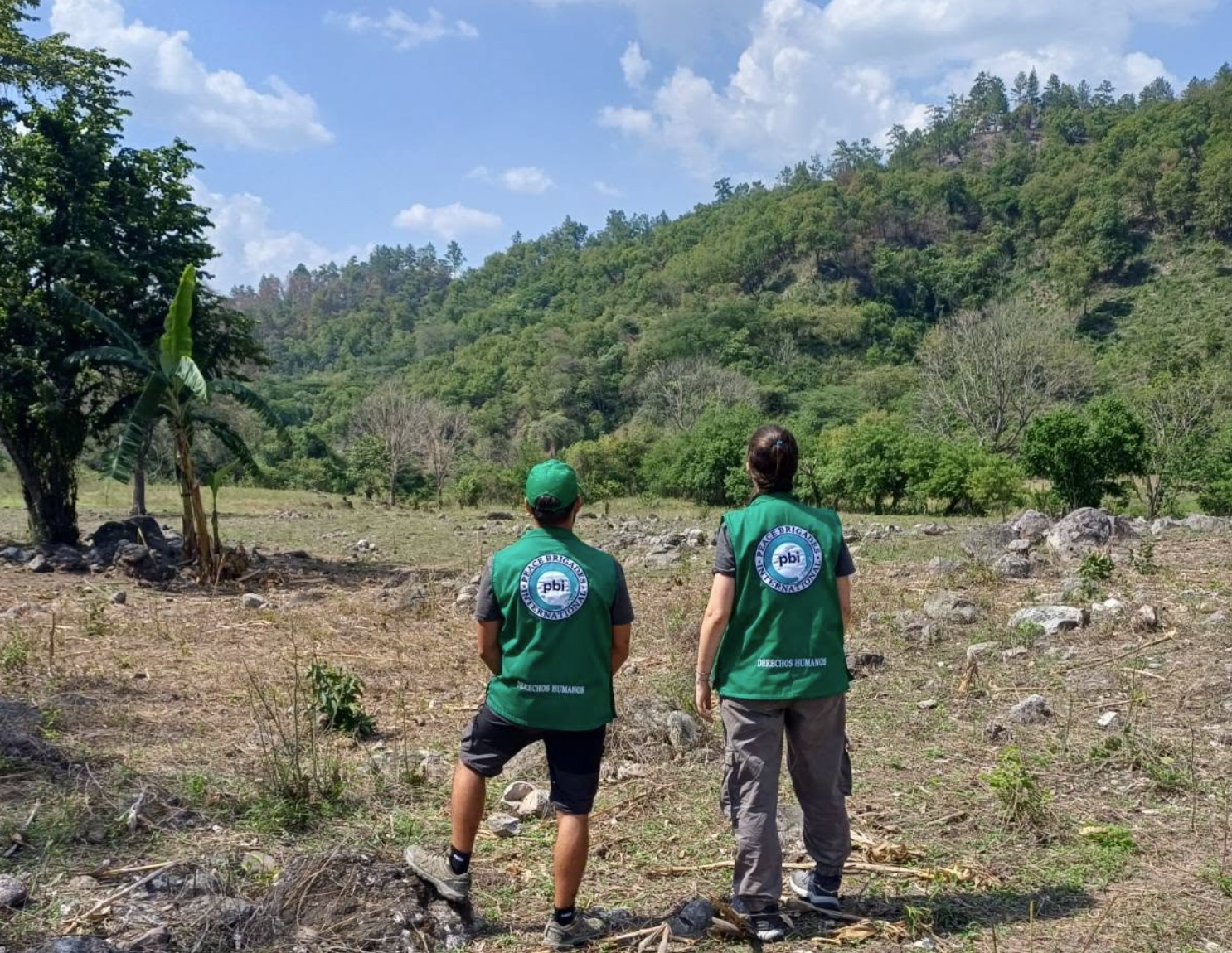
The Peace Brigades International-Honduras Project has posted on social media:
“For two decades, the Río Blanco community has played a key role in defending the #Gualcarque River, which is threatened by energy megaprojects.
Today, a land dispute is ongoing, and this Lenca indigenous community, located in the department of Intibucá, continues to defend the lands where they live and have farmed for years.
During our visit as PBI, we were able to observe firsthand the destruction of their crops and speak with the community about the harassment and threats they have suffered in recent weeks. For this reason, we emphasize the importance of the #righttoland for indigenous and peasant communities.”

COPINH opposition to the Canjel dam
At this time we recall a PBI-Canada article published in August 2021:
On January 30, 2015, the Civic Council of Popular and Indigenous Organizations of Honduras (COPINH) issued this condemnation of the Canjel dam and named “HYDROSYS (Canada)” along with Blue Energy.
On March 4, 2016, Telesur reported: “Two years after the [Rio Blanco] community set up a road blockade [in April 2013] to resist the foreign-backed Agua Zarca dam project on the Gualcarque River, Caceres and her fellow activists found out that Blue Energy planned to build a dam on another local waterway, the Canjel River.”
That article adds: “The community was never consulted about the project and COPINH publicly opposed the dam.”
Blue Energy said dam was in Santa Barbara
On March 9, 2015, Upside Down World reported: “When Blue Energy filed paperwork with Honduras’ Environmental Ministry, they listed the project as being located in the Municipality of Intibucá.”
“However, when the Environmental Ministry requested the company provide documentation of authorization to construct the dam in Intibucá, Blue Energy responded by simply claiming the dam was now in Santa Barbara. In this way, they avoided consulting the Indigenous people of Intibucá.”
That article adds: “In December 2014, Rio Blanco community members walked the borders of the Rio Blanco territory and found the dam being constructed; the Indigenous elders of Rio Blanco report the dam is partly in Lenca territory, in Intibucá.”
The Canadian company that built the dam
On March 7, 2016, the Honduras Culture and Politics blog also noted: “Recently, a new dam project in the same region, on the Rio Canjel, was awarded to a US firm, Rio Energy LLC, owned by Peter L. Ochs of Capital III, along with Canadian firm Hydrosys Consultants.”
That article highlights: “Hydrosys has sole responsibility for the planning and construction according to their own project description.”
Then on August 9, 2016, Radio Canada International (RCI) reported: “So far, the Canadian government has not made any statement concerning the case of Berta Cáceres, which is surprising since a company from this country, Hydrosys, has directly participated in the feasibility studies, plans and specifications for the construction, supervision, construction management and commissioning of the Canjel River hydroelectric project in the Lenca indigenous territory to which Cáceres was openly opposed.”
Police search for Caceres on bus en route to protest Rio Canjel project
The Honduras Culture and Politics blog adds: “On January 27 of [2016], a bus load of Rio Blanco protestors was stopped on their way to protest the Rio Canjel project by Honduran police in the community of Agua Caliente and the bus was searched for the presence of Berta Cáceres, who fortunately was not aboard the bus but rather back in Rio Blanco.”
Death threats from Blue Energy
Telesur has also reported: “Caceres warned on multiple occasions that she had received death threats and other harassment from state and corporate agents, including Canadian hydroelectric giant Blue Energy, as a result of her activism resisting unwanted development projects on Indigenous territory.”
That article adds: “Caceres made statements [in April 2015] claiming that ‘men close to Blue Energy’, a transnational Canadian company looking to build a dam in the Rio Blanco area in western Honduras, or people ‘close to politicians’ and ‘death squads promoted from government policies’ were behind the death threats leveled against her.”
On April 28, 2016, less than two months after Caceres was murdered, this media release stated: “CIMA+, one the largest Canadian consulting engineering firms, has recently merged with Hydrosys Consultants Inc., a firm specializing in engineering services for hydropower and hydraulic structures.”
Furthermore, CIMA+ notes on its Hydropower Construction, Honduras webpage that its client was “Blue Energy SA” and that “CIMA+ provided a complete range of engineering for the construction of the 3 MW hydropower project.”
That webpage adds: “CIMA+ also ensured work supervision. The final stages of the project were achieved with the support of a local partnership and technology transfer by CIMA+ experts to our client’s local employee. The project included a large concrete weir with a desander and a 4 km penstock leading to the powerhouse located 290 m below.”
PBI-Canada visits Lenca territory
PBI-Canada was present on Lenca territory in March 2026 to commemorate the 10th anniversary of the killing of Berta Caceres.
For more on that: Photo-journal of PBI-Canada with PBI-Honduras accompanying COPINH on the 10th anniversary of the sowing of Berta Caceres (March 3, 2026).
Peace Brigades International has accompanied the Civic Council of Popular and Indigenous Organizations of Honduras (COPINH) since May 2016.

